
Inquiry Basket
 Loading ......
The definition of a pesticide given by the Food and Agriculture Organization (FAO) of the United Nations is any substance or mixture of substances intended for preventing, destroying, or controlling any pest. According to the World Health Organization (WHO), more than 1,000 pesticides are used all over the world. Although the use of pesticides helps fight diseases and increase agricultural productivity, their residues may remain on food and be transported to the air, soil, and water.
Pesticides are widely applied in modern agriculture to control weeds and pests and regulate the growth of plants. The application of pesticides can prevent devastating losses in agriculture industries, enabling them to meet the demands of a rising global population. However, the development of agricultural industrialization makes the production of agricultural products increasingly dependent on foreign substances such as pesticides, antibiotics and hormones. The excessive use of pesticides can lead to drug residues in food and the environment, which can threaten human health through food chains. Therefore, effective detection methods for residues need to be used for monitoring food safety and ensuring public health.
The traditional methods for pesticide residue determination are usually based on instrumental techniques such as gas chromatography (GC), high performance liquid chromatography (HPLC), or chromatographic methods coupled with mass spectrometry (MS) detectors. However, these systems are limited by complicated sample pre-treatments and require highly trained technicians and expensive equipment. Rapid methods such as immunoassays, provide relatively convenient and highly sensitive strategies for the determination of pesticides.
Various immunochemical methods can be applied for the detection of pesticides. ELISA involving antibodies combined with enzymatic markers has taken a leading position in immunoassay methods. Due to the low molecular weight of the target analytes, competitive ELISA is commonly used for residue determination.
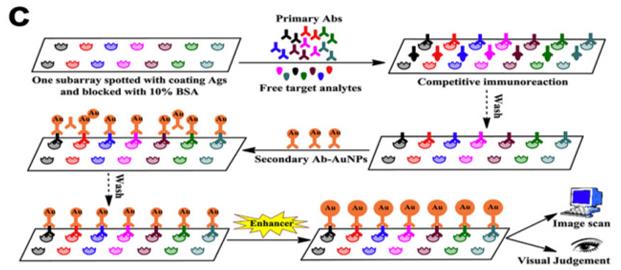 Figure 1. Illustration of a competitive immunochip assay based on Nanogold-labeled antibodies for simultaneous detection of seven pesticides
In addition to ELISA methods, lateral flow immunoassay (LFIA) is another conventional immunochemical method, which has been widely used for the on-site detection of residues. The most commonly used LFIA method employs gold nanoparticles (AuNPs) as reporters for colorimetric detection.
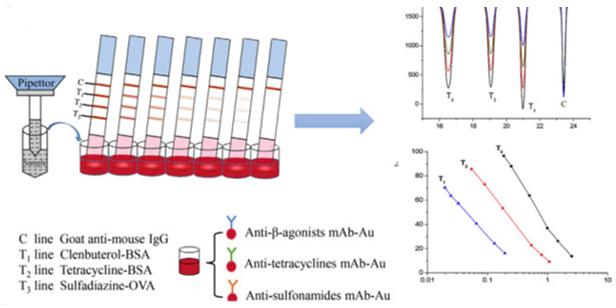 Figure 2. Illustration of colorimetric assays for multi-residues detection using a AuNPs-based multiplex lateral flow immunoassay (LFIA)
Antibodies have long been the most common recognition element used in rapid detection methods. Creative Diagnostics provides highly sensitive and cost-effective pesticide detection antibodies for multiple applications. We also offer customized services, which can asset customers to achieve their immunoassay development.
References
Loading ......
