
Inquiry Basket
 Loading ......
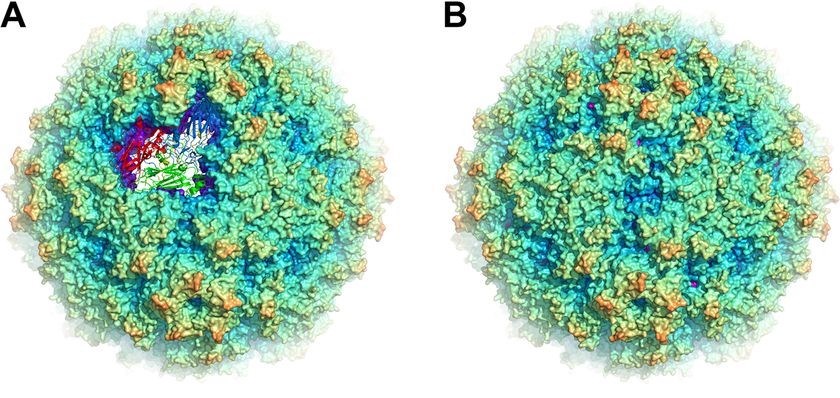 Fig. 1 The structures of mature coxsackie virus A16 and empty coxsackie virus A16 (Ren J, et al. 2015)
 Fig. 2 The coxsackie virus B3 life cycle (Garmaroudi FS, et al. 2015)
Coxsackie virus belongs to a family of non-enveloped, linear, positive-sense and single-stranded RNA viruses. The viral particule contains no enzyme and no envelope. Its size is 22–30 nm. Coxsackieviruses belong to the Picornaviridae family, genus Enterovirus, group of human enteroviruses. They have two subgroups, named coxsackievirus A (CA) with 23 serotypes 1–24 (23 is missing) and coxsackievirus B (CB) with six serotypes 1–6. Coxsackie viruses commonly cause diseases in humans. Young children are the reservoir of the virus. CA viruses cause herpangina; hand, foot, and mouth disease; and acute hemorrhagic conjunctivitis. CB viruses cause myopericarditis, epidemic pleurodynia, and systemic neonatal disease. Many reports regarding isolation of CB from surface or waste waters, soils, raw vegetables and shellfish have shown that these viruses are a major public health problem.
The RNA genome of Coxsackie virus contains two conservative non-coding regions at the ends and one coding region. The 5' terminal covalently binds a small molecule protein, named as Vpg (~ 7kDa), which regulates the viral RNA synthesis and genome assembly; The 5 'untranslated region of Coxsackie virus doesn't have poly pyrimidine and poly-C region while the 3' end possesses a poly A tail. Each capsid of viral particle has four capsid proteins, VP1-VP4, all of which have antigenic activity. VP1, VP2 and VP3 imbed at the surface of the virus capsid; once the virus VP1 binds to the receptor, VP4 of Coxsackie virus will change its conformation which changes the location from inside to outside of the viral capsid.
Creative Diagnostics is one of the best manufactures of viral antigens, customers from all over the world find their satisfactory with our product and service. Welcome to contact our sales representative if you are in need of coxsackie virus antigens.
References
Loading ......
