Cell Therapy
Cell therapy is a cutting-edge medical treatment that uses live cells as the final drug products to repair or replace damaged tissues or enhance immune function. It can be divided into autologous therapy (cells from a patient) or allogeneic therapy (cells from a donor), and utilize a range of cell types, including stem cells for tissue regeneration, and engineered T cells expressing specialized T cell receptors (TCRs) or chimeric antigen receptors (CARs), as well as many other cell types like natural killer (NK) cells and macrophages. Hematopoietic stem cell transplantation (also called bone marrow transplant) is the most frequently used cell therapy and is used to treat a variety of blood cancers and hematologic conditions. Potential applications of cell therapies include treating cancers, autoimmune disease, urinary problems, and infectious disease, rebuilding damaged cartilage in joints, repairing spinal cord injuries, improving a weakened immune system, and helping patients with neurological disorders. With several approved therapies, such as Kymriah (CAR T-cell therapy for cancer), Cell Terapy demonstrated immense potential.
 Fig. 1 The different types of cell therapy
Mechanisms of action
Cell therapy is targeted at many clinical indications in multiple organs and by several modes of cell delivery. However, there are two main principles by which cells facilitate therapeutic action:
- Stem, progenitor, or mature cell engraftment, differentiation, and long-term replacement of damaged tissue. Multipotent or unipotent cells differentiate into a specific cell type in the lab or after reaching the site of injury, then integrate into the site of injury, replacing damaged tissue, and thus facilitate improved function of the organ or tissue. An example of this is the use of cells to replace cardiomyocytes after myocardial infarction, to facilitate angiogenesis in ischemic limb disease, or the production of cartilage matrix in intervertebral disc degeneration.
- Cells that have the capacity to release soluble factors such as cytokines, chemokines, and growth factors which act in a paracrine or endocrine manner. These factors facilitate self-healing of the organ or region by inducing local (stem) cells or attracting cells to migrate towards the transplantation site.
Stem cell therapy
Stem cell therapy, also known as regenerative medicine. Stem cells can be manipulated to become specific types of cells, and to repair damaged or diseased tissue. Stem cells used or targeted by cell therapy can be grouped into three categories: pluripotent stem cells (PSCs), adult stem cells (ASCs), and cancer stem cells (CSCs).
 Fig.2 Diseases and conditions where stem cell treatment is promising or emerging
- PSCs give rise to all cell types except extraembryonic placental cells. Currently, the clinical use of PSCs is limited to investigational regenerative medicine, with the rationale of cell differentiation/tissue repair in different diseases, including macular degeneration and heart failure.
- The use of ASCs is mainly observed with hematopoietic stem cells (HSCs), skeletal muscle stem cells, or mesenchymal stem cells (MSCs). In cancer, HSCs have long been the standard treatment for hematological malignancies. In addition, HSCs have further been investigated in solid cancers as progenitors of immune cells. skeletal muscle stem cells can be used for rebuilding damaged cartilage in joints. MSCs have also been investigated in cancer settings due to their anti-tumorigenic properties yet have had only limited successes.
- Cancer stem cells (CSCs) possess self-renewal, differentiation, metastasis, and immunosuppressive properties and play an important role in cancer metastasis, relapse, and resistance to chemotherapy and radiotherapy. Identification criteria of CSCs generally include surface protein markers (e.g., CD133, CD44, tumor-associated antigens) and metabolic/functional properties (e.g., high metabolism, slow cell division). The clinical use of CSCs is seen in cancer settings and involves targeting CSCs by different signaling pathway-interfering agents that subsequently prevent cancer growth and relapse.
Adoptive cell therapy
Adoptive cell therapy (ACT), also known as cellular immunotherapy. ACT involves the intravenous transfer of modified peripheral or tumor-resident immune cells into patients to mount an immunologic reaction against tumors. Modified immune cells used in ACT include tumor-infiltrating lymphocytes (TILs), tumor-specific T-cell receptor (TCR)–modified T cells, and chimeric antigen receptor (CAR)-T cells.
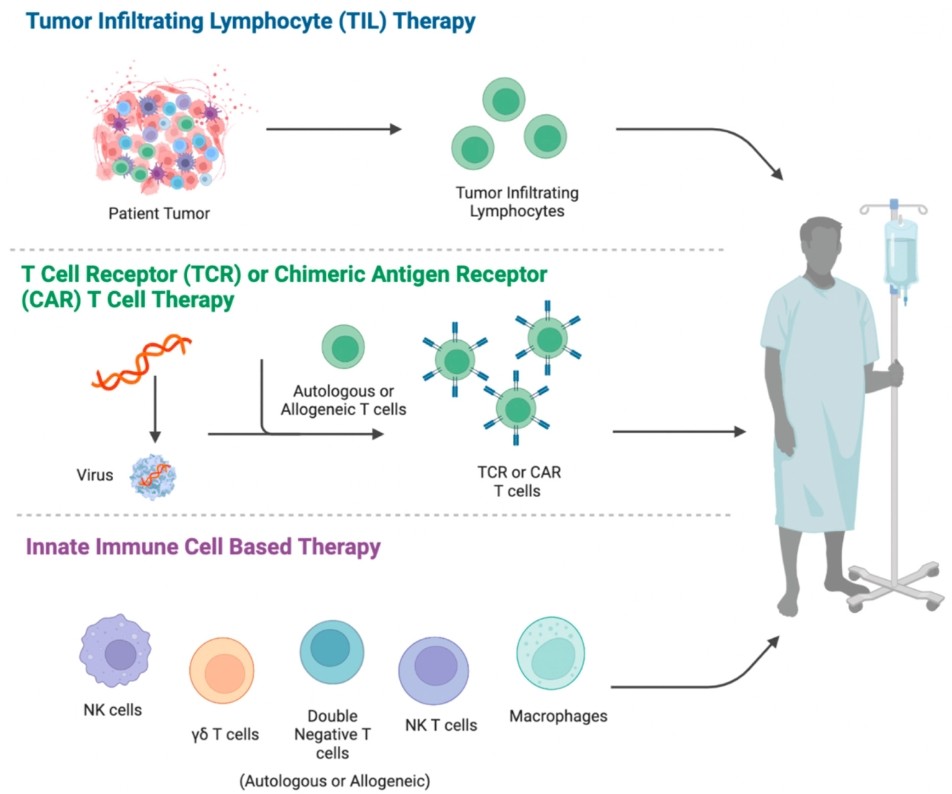 Fig. 3 Types of adoptive cell therapy.
- Tumor-Infiltrating Lymphocyte (TIL) Therapy
This approach harvests naturally occurring T cells that have already infiltrated patients' tumors, and then activates and expands them. Then, large numbers of these activated T cells are re-infused into patients, where they can then seek out and destroy tumors. - Engineered T Cell Receptor (TCR) Therapy
T cells isolated from peripheral blood by leukapheresis can be genetically engineered in vitro to express modified TCRs that can be directed against specific tumor antigens, such as melanoma differentiation antigens and cancer/testis antigens; however, the downside of this TCR gene therapy remains its evasion by tumor cells, which can downregulate their major histocompatibility complex (MHC) expression. - Chimeric Antigen Receptor (CAR) T Cell Therapy
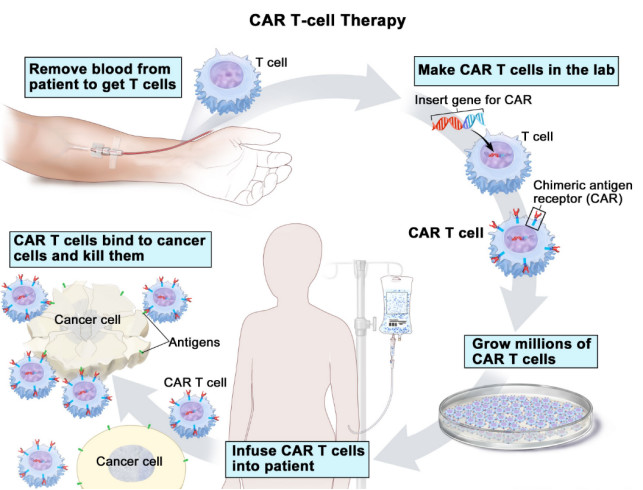
CAR-T cells employ synthetic antibody-based CARs, which can be of a proteinaceous, carbohydrate, or glycolipid nature. The transfer of CARs to T cells can be performed by various techniques, including retroviral infection. The genetic construct of CARs encodes the single-chain variable fragment (scFv) of a monoclonal antibody (serves as the extracellular antigen recognitions domain), a CD3ζ chain (serves as the intracellular signaling domain of TCR), and a co-receptor, such as CD28, for co-stimulation. Upon tumor antigen binding by the scFv domain, CD3ζ is phosphorylated, resulting in downstream signaling that is further amplified by co-receptor signals and that culminates in induction of cytotoxic activity. CAR-T cells are functionally similar to TCR gene therapy yet function in a non–MHC-restricted manner.
Other ACT strategies include lymphokine-activated killer (LAK) cells, cytokine-induced killer (CIK) cells, γδ T cells, and NK cells. LAK cells are PBMCs derived from patients by multiple leukaphereses and incubated with IL-2. CIK cells are also a heterogenous mixture of lymphocytes (mostly CD3+CD8+CD56+ T cells) with natural killer T (NKT) cell phenotype generated by incubation with various types of molecules, such as IL-2, IFN-γ, and CD3 monoclonal antibodies; their antitumor capacity can be further elevated by incubation with other cytokines, including IFN-γ and IL-1β. following their ex vivo expansion, γδ T cells become tumor-reactive with strong, non–MHC-restricted cytotoxicity. Like γδ T cells, NK cells possess the ability to kill tumor cells in a non–MHC-restricted manner. Immunophenotypically, NK cells are CD3−CD56+. To enhance their antitumor activity, NK cells are expanded by IL-2 incubation and/or co-administration.



 Loading ......
