Custom Cellular Biosensors for Ligand-receptor Interaction Studies
Custom Cellular Biosensors for Ligand-receptor Interaction Studies
Interactions of membrane-resident proteins are important targets for therapeutic interventions but most methods to study them are either costly, laborious or fail to reflect the physiologic interaction of membrane resident proteins in trans. Creative Diagnostics' scientific team with extensive experience in protein interaction research has developed a cellular biosensor technique to study receptor-ligand pairs. These cellular biosensors consist of fluorescent reporter cells that express chimeric receptors harboring ectodomains of cell surface molecules and intracellular signaling domains.
Cellular Biosensors for Ligand-receptor Interaction
Chimeric receptors are generated by fusing the extracellular domain of a receptor and the transmembrane (TM) domain of a co-stimulatory receptor, or a complete receptor, with potent intracellular signaling domains
Chimeric receptors harboring potent signaling domains are combined with compatible reporter cells by lentiviral transduction to generate highly sensitive cellular biosensors
Stimulator cells express the respective biosensor molecule ligands through transient transfection, lentiviral or retroviral transduction
Stimulator cells and biosensor cells are co-cultured and the activation of the reporter gene is assessed by flow cytometry. Blocking agents such as sera, intravenous immunoglobulin preparations, antibodies, fusion proteins and small molecule inhibitors are preincubated with stimulator cells before initiation of the co-culture.
Fig.1 Schematic illustration of interaction of SARS-CoV-2 Spike on stimulator cell with ACE2-ζ chimeric receptor on biosensor cell.
Applications
To evaluate the interactions of viral proteins with cell surface receptors
Cellular biosensors expressing chimeric virus receptors can be deployed in a type of diagnostic surrogate neutralization assay that avoids the use of pseudo-typed viruses or costly recombinant proteins.
To characterize the effectiveness of drugs blocking cell surface receptor-ligand interactions such as checkpoint inhibitors or anti-viral antibodies
Chimeric molecules harboring the ectodomains of the immune checkpoints PD-1 or PD-L1 are capable of mediating strong reporter activation upon engagement and can be used to evaluate immune checkpoint inhibitors targeting the PD-1/PD-L1 axis.
Our Featured Services
Creative Diagnostics provides cellular biosensors for studying the interaction of the following receptor-ligand pairs. If you require customized solutions, don't hesitate to reach out. Our team is dedicated to empowering your research and driving innovation in the field of protein interaction interactions.

 Loading ......
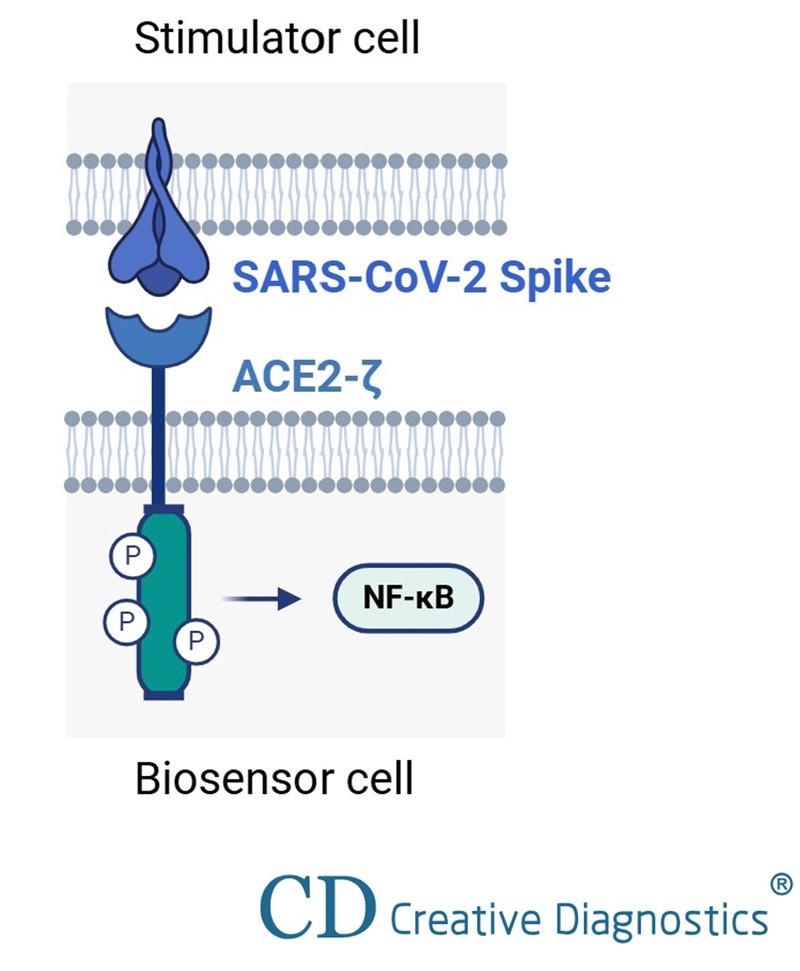 Fig.1 Schematic illustration of interaction of SARS-CoV-2 Spike on stimulator cell with ACE2-ζ chimeric receptor on biosensor cell.