

Inquiry Basket
 Loading ......
Creative Diagnostics offers the off shelf VLP productions and services to customize VLP generation and package the VLPs to mature ELISA kit, test standard reagent, superantigens and relevant products. Our experienced scientists and technicians have created a comprehensive platform to generate VLPs supporting both academic and industrial goals and open to discuss the strategy for the cooperation on the cutting edge study.
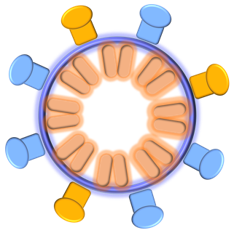
VLPs were first identified in the sera of patients with Down's syndrome, leukemia and hepatitis in 1968. VLP is defined as nanoscale structures made up of assembled viral proteins that lack viral genetic material and non-infectious. People developed variety of systems to produce VLP, including plants, insects, bacteria, and mammals. So far, the structural proteins from human immunodeficiency virus (HIV), adeno-associated virus, Hepatitis B virus (HBV), Hepatitis C virus (HCV) and bacteriophages are popular used for producing VLPs. As an efficient vehicle, VLPs can deliver drugs to the targeted tissue for treatment or diagnostics.
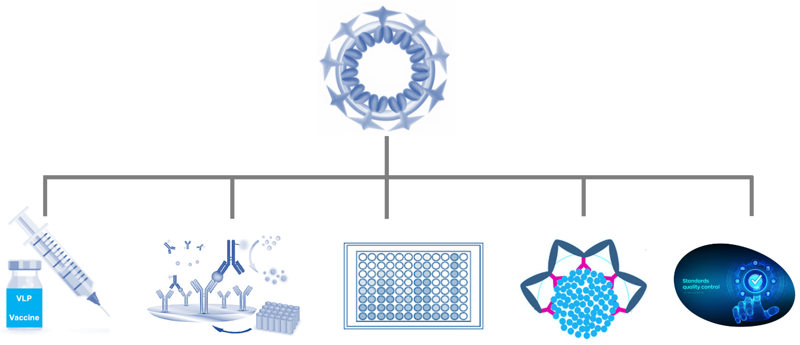 Figure 1. VLP applications
Compared to the conventional vaccine, VLP is a superior vaccine approach. The particle size and shape of VLP are similar with the native viruses and able to stimulate both humoral and cellular immune responses without the potential for replication within the target cells. The VLP-based vaccine improves the safety especially for immunocompromised or elderly vaccinees. Several VLP-based vaccines have been approved for use in the clinic and are now commercially available, such as Human Papilloma Virus (HPV) vaccine, Hepatitis B Virus vaccine, Influenza virus vaccine, SARS-CoV2 vaccine, Respiratory Syncytial Virus (RSV) vaccine, HIV vaccine and Ebola vaccine.
There are three main sections of a VLP-based vaccine manufacturing process: production, purification, and formulation. The production section includes the design and clone the gene of interest to the vector, transfect the plasmids and the viral structural protein plasmids to the express system in prokaryotic (bacteria, yeast) or eukaryotic (baculovirus/insect cell, mammalian cell and plant) and the particle harvest. Then, ion-exchange chromatography and ultracentrifugation are used for the VLP purification as needed. The last step of purification is removing the residual host cell proteins and nucleic acids. The final step of formulation and sterile filtration are essential for the VLPs vaccine production efficiency and safety.
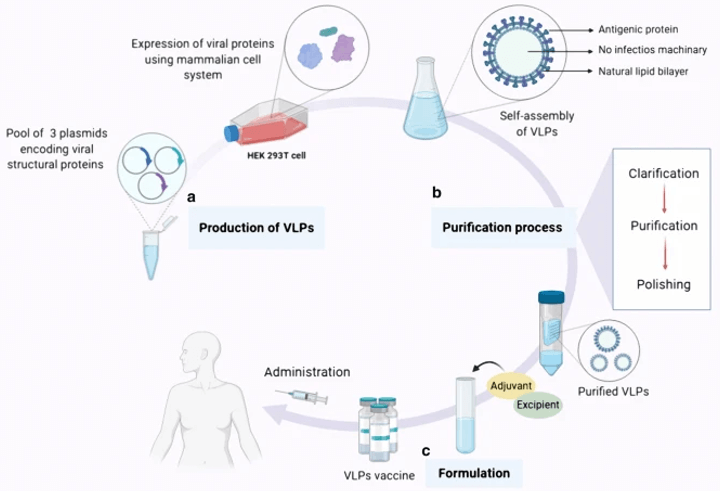 Figure 2. VLP vaccine production workflow (Nooraei, Saghi, et al. "Virus-like particles: Preparation, immunogenicity and their roles as nanovaccines and drug nanocarriers." Journal of nanobiotechnology 19.1 (2021): 1-27.)
As the self-assembled VLPs are antigenically and morphologically without the infectious risk, VLP has been used as a highly effective type of alternative antigen in several viral diseases. In the property packaging system, the protein folding pattern mimic the protein status in the wild-type pathogen, which can present the protein binding dynamics exclude the bio-security concern. The glycosylation and lipidation can be modulated by the genetic technology. Due to the safety and adjustability, VLP based ELISA methods were developed for the serology evaluation and comparable to the gold standard methodology based on live virus. The VLPs based on the vital antigens of Hepatitis B, HPV16, foot-and-mouth disease virus serotype A and human norovirus were used for the serum test by ELISA (2-5).
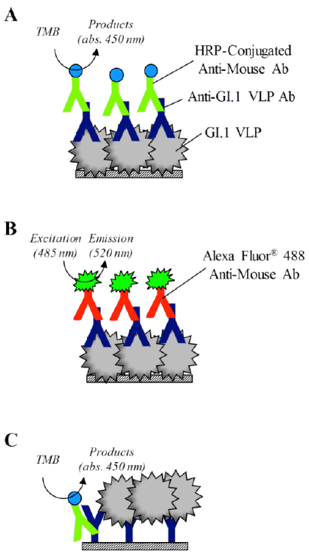 Figure 3. Human Norovirus VLPs based ELISA (Broglie, Jessica Jenkins, et al. "Design and evaluation of three immuno-based assays for rapid detection of human norovirus virus-like particles." Journal of Analytical & Bioanalytical Techniques 5.6 (2014): 1.)
Creative Diagnostics offers the VLP productions that qualify to be utilized to ELISA and micro-neutralization assays for preliminary test and scaling-up projects. The bulk order of the packaged ELISA kits based on VLP antigen is available as well.
Superantigen is the immunogen that stimulates powerful immune response of binding to major histocompatibility complex class II molecules (MHC-II) via T cells presenting. The natural superantigens are discovered in bacteria and viruses. With increasing requirements of differentiated antibodies on the biopharmaceutical field, artificial superantigen benefit to the development superior antibody. To utilize VLP as a super vehicle, the general antigen can be delivered to the T cells and stimulate the advantageous immune response, like superantigens. Thus, the artificial superantigens based on VLP is promising to develop competitive antibody and diagnostic productions.
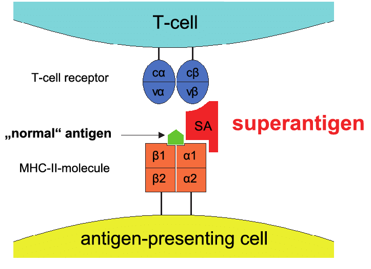 Figure 4. Superantigen (Emmer, A., et al. "Superantigen-mediated encephalitis." Pathogenesis of encephalitis. InTech, Rijeka (2011): 213-234.)
As the highly structured protein particle, certain VLP's morphology is evaluable and stable. Compared to the single expressed protein, the displayed protein on the VLP mimic the nature status on the wild-type pathogen. As the concerns of the experimental repeatability and biosecurity, VLP productions with/without the interest proteins are the idea standard reagents for the batch-to-batch quality control and large-scale screening studies.
Creative Diagnostics offers a comprehensive resolution of VLP productions and customized service. For more detailed information, please feel free to contact us or directly send us an inquiry.

Loading ......
