

Inquiry Basket
 Loading ......
The Enzyme-Linked Immunosorbent Assay (ELISA) stands as a fundamental diagnostic technology which effectively detects and measures various analytes including protein biomarkers for infectious diseases and oncological and inflammatory conditions. The immunoassay stands as a "gold standard" because it demonstrates established high sensitivity and specificity.
Talk to our experts Available Services
The ELISA platform functions as an immunological assay which depends on the strong antigen-antibody binding reaction. The basic operation requires fixing one of these components (usually the antigen or capture antibody) to a solid surface which is typically a multi-well plate. A detection antibody with an enzyme attached through covalent bonding is introduced to the system. The enzyme performs a detectable reaction on a specific substrate which produces a measurable signal (e.g., color change) whose strength directly correlates with the amount of analyte in the sample.
The versatility of ELISA is demonstrated through its various formats, each suited for different analytical needs:
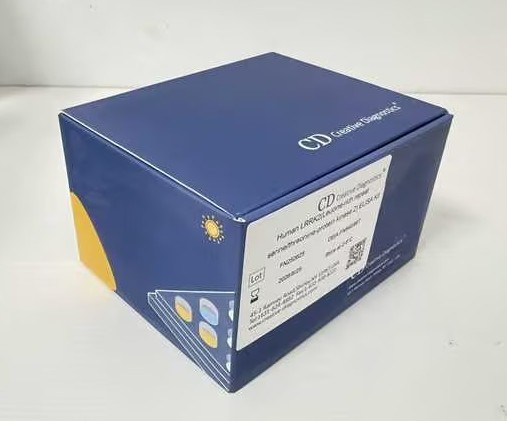
 Figure 1. Standard ELISA kit formats
Depending on the fluorescent materials used in ELISA, it can be divided into ELISA based on fluorescent organic small molecules, silicon/carbon nanoparticles, metal nanoclusters and quantum dots, etc. In addition, depending on the different marker enzymes used, it can be divided into ELISA using ALP, HRP and other enzymes as marker enzymes, etc.
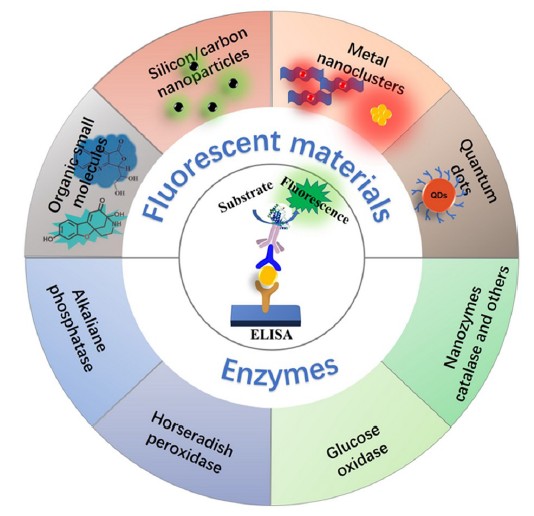 Figure 2. Illustration of fluorescence enzyme linked immunosorbent assay (ELISA) based on different fluorescent materials and labeled enzymes.
At Creative Diagnostics, our ELISA Kit Development Service follows a rigorous, stepwise process to ensure assay performance, reproducibility, and scalability. This systematic approach ensures that each ELISA kit we develop meets the highest standards of reliability and performance.
The development begins with Proof of Concept, where optimal antibodies are selected and paired, and an initial standard curve is generated to assess assay feasibility.
In the Assay Development phase, we refine assay conditions and validate the standard curve for consistency and accuracy.
During Assay Validation, the kit is tested using real samples, and its sensitivity, specificity, precision, and stability are thoroughly evaluated.
Finally, in the Assay Manufacturing stage, we conduct comprehensive quality control, deliver pilot kits for field use, and provide full documentation transfer to support regulatory and production needs.
Our ELISA platform enables sensitive and reproducible detection in a variety of contexts:
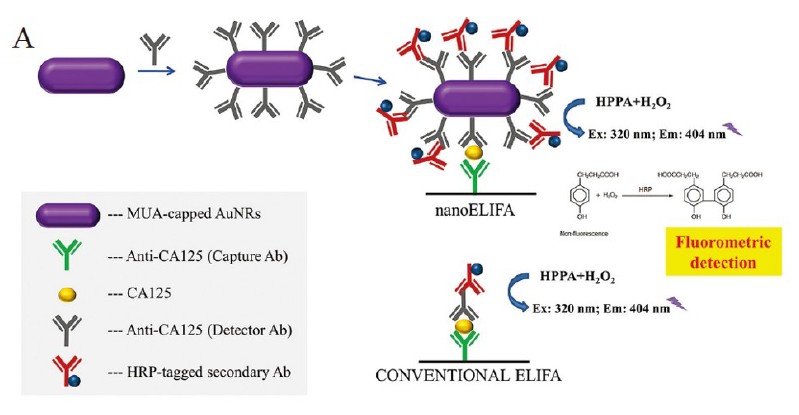
Schematic diagram of fluorescent ELISA based on horseradish peroxidase (HRP) loaded on gold nanorods.
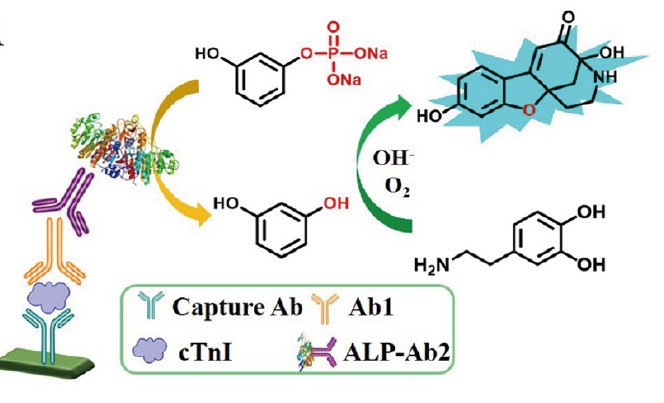
Schematic representation of ELISA based on the fluorogenic reaction between resorcinol and dopamine (DA).
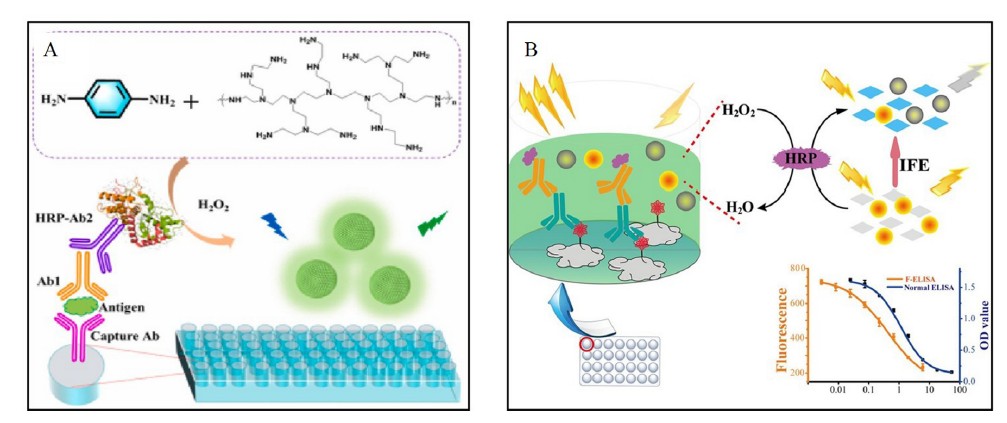
Schematic diagram of ELISA based on (A) HRP-triggered in situ generated fluorescent carbon nanoparticles and (B) carbon dots (CDs) fluorescent IFE caused by TMB oxidation.
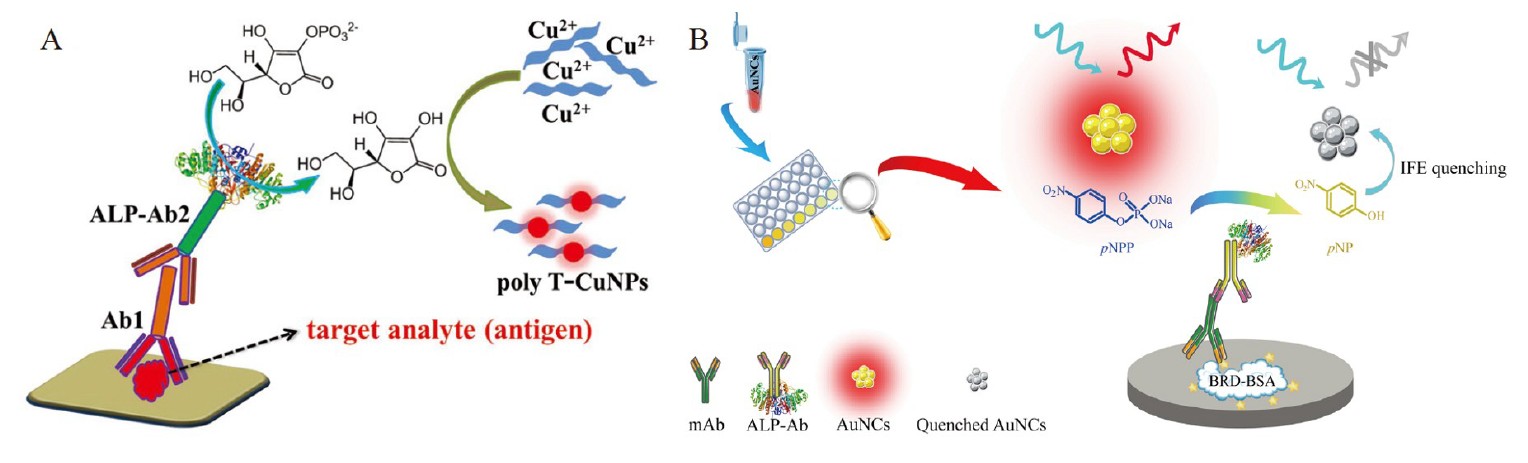
Schematic representation of ELISA based on (A) alkaline phosphatase (ALP)-triggered synthesis of fluorescent copper nanoclusters (CuNCs) and (B) AuNCs fluorescent inner filter effect (IFE) caused by 4-nitrophenyl phosphate (pNPP) hydrolysate.
Yes. Our ELISA Kit Development Service is fully customizable. We deliver complete support for developing RUO or IVD-grade kits that match your project requirements through antibody pairing and standard curve generation and assay validation and manufacturing.
The ELISA platform operates at high sensitivity levels to detect molecules at picogram per milliliter (pg/mL) concentrations based on assay design and target molecule characteristics.
Yes. Our ELISA platform includes traditional colorimetric detection alongside fluorescence-based ELISA platforms that use organic dyes and quantum dots and metal nanoclusters with HRP or ALP marker enzymes for improved signal output.
Our ELISA platform accepts multiple sample types including serum, plasma, cell culture supernatants, tissue lysates, urine, saliva and cerebrospinal fluid (CSF). Our team will adapt the protocol according to your particular sample origin.
Loading ......
