Hepatitis C Virus (HCV) Antigens
Hepatitis C Virus Antigen Products by Targets
 Fig. 1 HCV genome organization and polyprotein processing
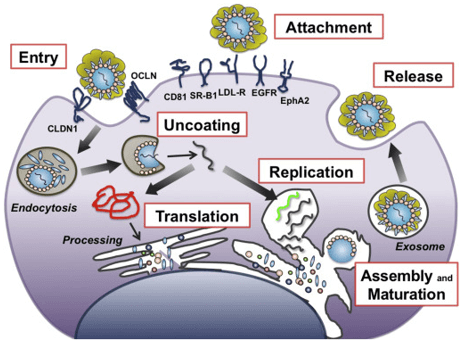 Fig. 2 The HCV replication cycle
Hepatitis C virus (HCV) is a member of the Flaviviridae family, genus hepacivirus. HCV has been thought to be the only member of this genus until some other members was found recently. HCV causes hepatitis C, a liver disease, and can ultimately result in liver cirrhosis, hepatic failure or hepatocellular carcinoma. More than 170 million people were injected by HCV all over the world and hundreds of thousands of them were dead for this each year. The growth of HCV in cultured cells is difficult and it is hard to find small-animal models for HCV research. These difficulties limited our knowledge of HCV.
HCV is an enveloped small virus with the particle size of 55-65nm. HCV genome consists of a positive-sense single-stranded RNA. The viral genome was covered by an icosahedral capsid. The HCV genome ORF (open reading frames) encodes at least 11 proteins, including 3 structural proteins (Core or C, E1 and E2) and eight nonstructural proteins (p7, NS2, NS3, NS4A, NS4B, NS5A, NS5B, and F).
- Core protein The HCV core protein is released as a precursor with 191 AA residues (23kDa, P23), and then will be cut into multiple variants (17-23kDa). It contains three domains as predicted by different theories: the N-terminal hydrophilic domain (Domain D1, 120 AA), the C-terminal hydrophobic domain (Domain D2, 50 AA) and the last peptide (about 20 AA) serves as a signal for the downstream protein E1.
- Enveloped protein E1 and E2 are two type 1 transmembrane glycoproteins that are essential components of the envelope. They can assemble as non-covalent heterodimers and are necessary for viral entry and fusion.
- Non-structural protein 2 NS2 is a 217 amino acids (aa) long cysteine-protease composed of a highly hydrophobic N-terminal membrane binding domain (MBD) and a C-terminal globular and cytosolic protease subdomain. The latter is capable to form dimers creating a composite active site. NS2 is essential for HCV assembly.
- Non-structural protein 3 The N-terminal one-third of NS3 contains the protease activity responsible for processing of the non-structural region of the polyprotein and some cellular proteins. The C-terminal two-thirds of NS3 is an RNA helicase of the DExH family. The biological function of the RNA helicase activity is not known but may include 1) RNA folding/remodeling, 2) enhancement of polymerase processivity, and/or 3) genome encapsidation.
- Non-structural protein 4 NS4B is an integral membrane protein that is required for assembly of the “membranous web,” the organelle used for RNA replication. NS4A is a cofactor for NS3 that directs the localization of NS3 and modulates its enzymatic activities.
- Nonstructural protein 5 NS5B is the viral RNA-dependent RNA polymerase. NS5A is a phosphoprotein capable of specifically interacting with the 3'-NTR of the HCV genome, other non-structural proteins, and numerous cellular proteins. NS5A also functions in virus assembly.
With years of experience in production of proteins and antigens, Creative Diagnostics now can provide our customers various Hepatitis C virus (HCV) proteins and antigens with high-quality and cheaper price. Welcome to contact us for more details.

 Loading ......
