
Inquiry Basket
 Loading ......
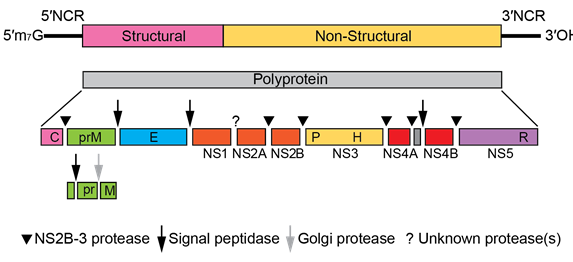 Fig. 1 The yellow fever virus genome (Andrew MQ King, et al. 2011)
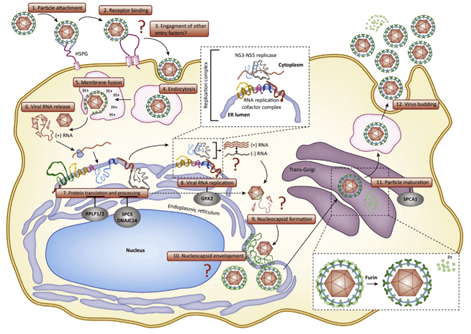 Fig. 2 Schematic representation of the yellow fever virus life cycle (Florian Douam and Alexander Ploss. 2018)
Similar to other flaviviruses, the common symptoms of yellow fever (YF) are fever, headache, muscle aches, nausea, and vomiting, however, the in-hospital case fatality rate (CFR) could dramatically reach 67%, giving this disease a particular interest for public health. Traced back to around 3000 years ago, YF was mainly encountered in Africa where it was isolated in 1927 in Ghana. Yellow fever virus (YFV) was transported via ships sailing from West Africa to the West Indies during the slave trade. Massive and recurrent transports of goods also brought competent vectors such as the mosquito Aedes aegypti contributing to initiate YFV transmission cycles in ships and later, on land at their destination. The in-depth understanding of YFV transmission cycle in the early 1900s permitted to implement successful vector control strategies since 1916 and to develop the YFV 17D vaccine in 1936. However, YFV still causes an estimated 51,000–380,000 annual severe cases. Insecticide-resistance of mosquito populations, as well as a supply shortage, distribution, and uptake of YFV vaccines, are among the main causes of this current burden.
YFV is an enveloped virus that contains a single-stranded, positive-sense RNA genome of about 11 000 nucleotides. A single open reading frame encodes a large polyprotein of 3400 amino acids that is processed into ten viral proteins: three structural proteins (Core, PrM, and E) and seven nonstructural (NS) proteins (NS1, NS2A–2B, NS3, NS4A–B, and NS5).
YFV binds in a nonspecific manner to glycosaminoglycan heparan sulfate on the surface of host cells such as hepatocytes or dendritic cells (DCs). However, the host cellular receptor to which E, the major YFV envelope glycoprotein, binds before virus fusion remains unknown. Following entry via clathrin-mediated endocytosis and release of the viral genome into the cytoplasm, the viral RNA genome is translated into a large polyprotein and processed by cellular signal peptidases and the NS2B/3 viral protease. Several host factors are involved in flavivirus protein processing or translation, such as the endoplasmic reticulum-associated signal peptidase complex (SPCS; involved in Pr-E junction processing), DNAJC14 (involved in regulation of polyprotein processing), and the ribosomal proteins RPLP1 and RPLP2 (important for polyprotein translation). Following effective polyprotein translation and processing, the formation of the RNA replication complex–likely via recruitment of NS1 and the NS3–NS5 replicase complex by NS2A, NS4A, and NS4B–along with NS4A-induced membrane rearrangements promotes active viral RNA replication. The G-protein-coupled receptor kinase 2 (GRK2) is also suggested to play a role in YFV viral RNA replication as well as during dengue and hepatitis C virus infections.
Loading ......
