
Inquiry Basket
 Loading ......
Creative Diagnostics is a professional supplier in the field of in vitro diagnostics (IVD), focusing on providing comprehensive solutions covering IVD antibody preparation and rapid test kit development. We currently provide kit development services based on lateral flow immunochromatography (LFIA) technology, which are widely used in disease screening and diagnosis, infectious pathogen detection and treatment effect monitoring. According to different application requirements, we can provide customers with highly customized development services to help them accelerate product transformation and clinical application.
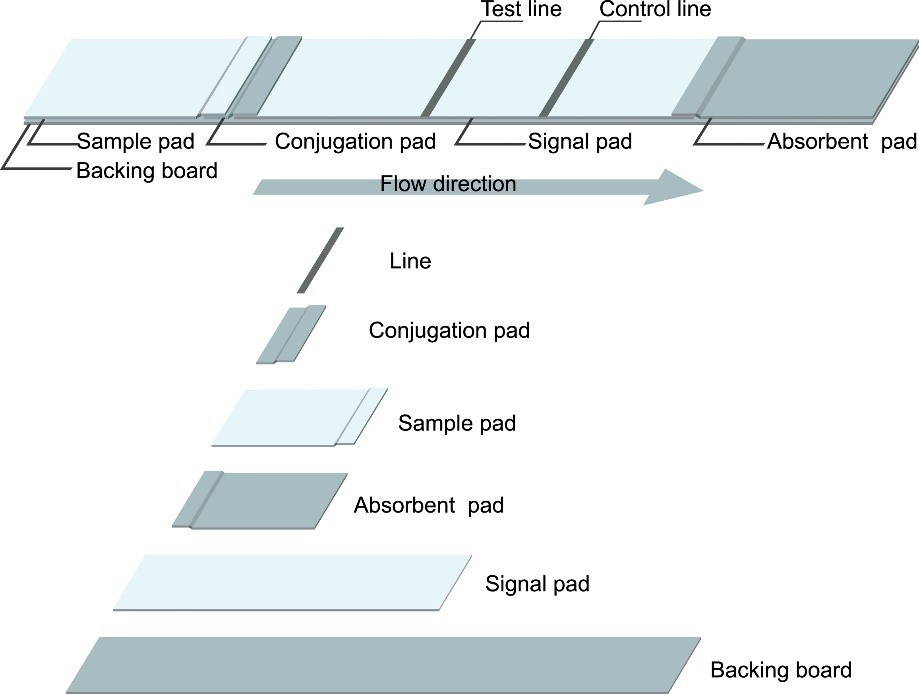 Figure 1. Component of rapid strip test for diagnosis. Lateral flow immunoassay.
Lateral flow immunoassay (LFIA) is a popular, easy to perform and low-cost analytical method which can be used for screening, diagnosis and monitoring of various diseases. For these reasons the applicability of this type of tests is very high, they can be used by any medical staff and even by the patient at home. The LFIA kit consists of sample, conjugate, and absorbent pads attached to a nitrocellulose membrane backbone. A liquid sample to be diagnosed is loaded onto the sample pad and developed toward the absorbent pad. When the developed sample reaches the conjugate pad, it is mixed with preloaded probes. Subsequently, samples and probes are developed together. Targets in the sample are bound and complexed with the probes by antibodies. Upon reaching the test line where target-capturing antibodies are immobilized, the target-probe complexes are captured and cannot be developed further. Other components in the samples and non-complex probes pass the test line, with noncomplex probes captured at the control line by antibodies immobilized on the control line. The captured probes exhibit their characteristic optical signal at the corresponding lines with the type of optical signal and signal intensities varying based on the probe type and optical properties. Thus, we reviewed papers on LFIA after classifying them based on the type of optical NPs used as probes in LFIA.
At Creative Diagnostics, our LFIA platform integrates advanced nanotechnology, tailored bio-conjugation strategies, and precision membrane engineering to deliver next-generation assay performance. Whether for qualitative screening or quantitative measurement, we offer complete LFIA development and customization services to accelerate your diagnostics pipeline.
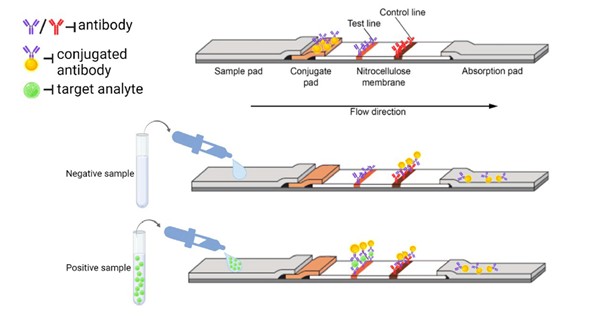 Figure 2. The operation principle of LFIA sandwich-based method. (Mirica, Frontiers in Bioengineering and Biotechnology, 2022.)
Probe selection is essential for the efficient detection or quantification of target biomarkers using LFIA. Our LFIA platform supports a broad portfolio of traditional and next-generation detection labels, such as gold NPs (GNPs), colored latex beads (LMPs), magnetic nanoparticles (MNPs), quantum dots (QDs), carbon nanoparticles (CNPs), silica nanoparticles (SiNPs), europium nanoparticles (EuNPs) and upconversion NPs (UCNPs), each tailored for specific performance attributes:
We offer particle functionalization services for gold, magnetic, silica, carbon, and europium nanoparticles, with validated conjugation protocols and batch-to-batch consistency.
Detection labels and conjugation are the core links that determine the sensitivity and specificity of LFIA. With the development of nanotechnology, label materials have continued to evolve, and conjugation strategies have become increasingly sophisticated, providing strong support for the performance improvement of LFIA.
The choice of LFIA detection labels directly affects the strength, stability, and visibility of the test signal. Commonly used label materials include:
Gold Nanoparticles (GNPs): The most common color indicator label, providing an intuitive red reading, with good biocompatibility and easy-to-modify surface properties.
Latex Microparticles (LMPs): Available in a variety of colors to achieve multiple detection, and easy to introduce carboxyl or amino groups on the surface for covalent conjugation.
Magnetic Nanoparticles (MNPs): Can enhance detection sensitivity through an external magnetic field to achieve magnetic focusing technology.
Quantum Dots (QDs): have excellent fluorescence properties, strong luminescence, and resistance to photobleaching, suitable for high-sensitivity quantitative detection.
Carbon Nanoparticles (CNPs): low cost, strong stability, suitable for physical adsorption coupling.
Silica Nanoparticles (SiNPs): have highly modifiable surfaces and good biocompatibility, suitable for building fluorescent signal systems.
Europium Nanoparticles (EuNPs): suitable for high-sensitivity fluorescent immunoassays, and can achieve detection as low as pg/ml level.
Up-Conversion Nanoparticles (UCNPs): emit visible light through near-infrared excitation, low background noise, suitable for high-sensitivity background complex sample analysis.
Before constructing an efficient coupling system, the label needs to be surface functionalized to introduce functional groups (such as carboxyl-COOH, amino-NH₂, thiol-SH) to facilitate the subsequent covalent connection of antibodies or antigens. For example: Gold nanoparticles: can be modified by thiol ligands (such as 1-mercaptododecane) or PEG derivatives to form a stable self-assembled monolayer. Latex particles: carboxyl/amino functional groups can be modified by grafting polymerization or RAFT polymerization. Magnetic nanoparticles: DHCA, PEI, HSA coatings are often used to improve surface hydrophilicity and biocompatibility. Quantum dots: PEG, amines, thiol and other ligands are used for water solubility and biofunctional modification. Silicon nanoparticles: APTES, acetylation and other methods are often used to modify surface amino or carboxyl groups.
The coupling methods of labels and biomolecules mainly include:
Non-covalent binding: such as electrostatic adsorption and hydrophobic interaction, the process is simple but the stability is poor and it is easily affected by environmental factors.
Covalent binding: through activators such as EDC/NHS, the carboxyl group and the amino group of the antibody form an amide bond, which has strong stability and good repeatability.
Multiplex LFIA refers to the simultaneous detection of multiple targets on a single strip using different colored labels or spatially separated test lines. Compared to other immunoanalytical techniques, such as those carried out in microplate format (i.e., ELISA, Enzyme Linked ImmunoSorbent assay), LFIA is particularly suited for enabling multiplex analysis. Indeed, the architecture of an LFD includes the possibility of aligning more than one detection site in a single analvtical device); Yes, our platform supports the design and development of multiplex assays using multi-color latex particles or dual-signal readouts.
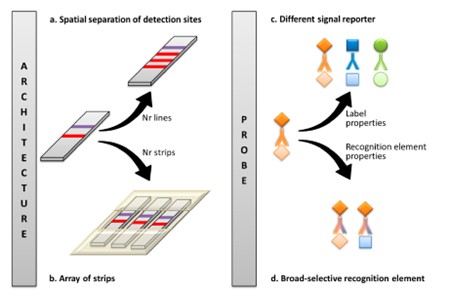 Figure 3. Strategies for multiplexing LFIA. (Anfossi, Laura, et al. Biosensors, 2018.)
References
Loading ......
