
Inquiry Basket
 Loading ......
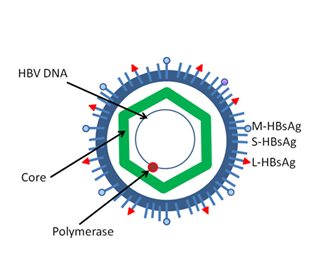 Fig. 1 Model of hepatitis B virus
 Fig. 2 Hepatitis B virus replication cycle
Hepatitis B virus, abbreviated HBV, is a species of the genus Orthohepadnavirus, which is likewise a part of the Hepadnaviridae family of viruses. HBV causes the disease hepatitis B. As far as known, HBV is only susceptible to infect human beings and primates, causing hepatitis B disease. Hepatitis B virus has been found by Dana in 1965. The diameter of this virus is 42 nm and viral particle contains two parts, named shell and core. HBVs have widely tolerance to various stress conditions, such as boiling in 65-degree water for 10 hours and still keeping alive. But in some extremely conditions, such as boiled in 100 degree for 10 minutes or high-pressure steam, peracetic acid and povidone-iodine can inactivate HBV.
There are eight known genotypes labeled A through H. Type A is prevalent in Europe, Africa and South-east Asia, including the Philippines. Type B and C are predominant in Asia; type D is common in the Mediterranean area, the Middle East and India. Type A has two subtypes: Aa (A1) in Africa/Asia and the Philippines and Ae (A2) in Europe/United States. Type B has two distinct geographical distributions: Bj/B1 ('j'—Japan) and Ba/B2 ('a'—Asia). Type C has two geographically subtypes: Cs (C1) in South-east Asia and Ce (C2) in East Asia. The C subtypes have been divided into five clades (C1–C5). A sixth clade (C6) has been described in the Philippines but only in one isolate to date. Type D has been divided into 7 subtypes (D1–D7). Type E is localized in sub-Saharan Africa; type F (or H) is restricted to Central and South America. The E and F strains appear to have originated in aboriginal populations of Africa and the New World, respectively. Type F has been subdivided into 4 subtypes (F1–F4).
Welcome to contact our customer service to get a quotation if you are in need of high-quality HBV Core Antigens, HBV Surface Antigens, HBV E Antigens and different subtypes of HBV antigens.
Loading ......
