
Inquiry Basket
 Loading ......
 Fig. 1 The human norovirus genome (Elizabeth Robilotti, et al. 2015)
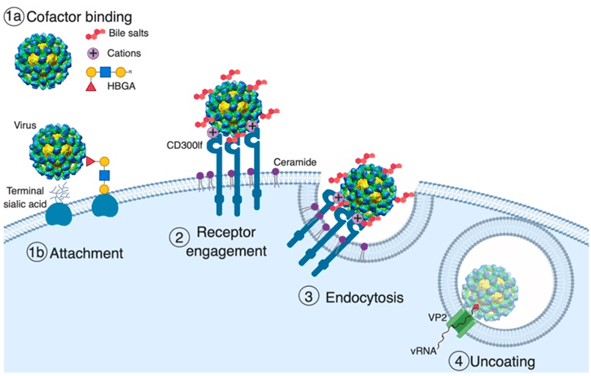 Fig. 2 Model of norovirus entry (Vincent R. Graziano, et al. 2019)
Norovirus gastroenteritis remains a leading cause of morbidity and is still a major public health problem worldwide. The virus usually causes mild and self-limiting gastroenteritis symptoms in all age groups, mainly through the fecal-oral transmission route. Norovirus causes inflammation of the stomach or intestines. This is called acute gastroenteritis. The most common symptoms of norovirus are diarrhea, vomiting, nausea and stomach pain. A person usually develops symptoms 12 to 48 hours after being exposed to norovirus. Most people with norovirus illness get better within 1 to 3 days. Norovirus is sometimes called the stomach flu or stomach bug. However, norovirus illness is not related to the flu which is caused by influenza virus.
Noroviruses belong to the family Caliciviridae. They are a group of non-enveloped, single-stranded RNA viruses. Noroviruses were previously called Norwalk or Norwalk-like viruses. They were named after the original Norwalk strain, which caused an outbreak of gastroenteritis in a school in Norwalk, Ohio in 1968. Noroviruses are now classified into ten genogroups (GI-GX) and 48 genotypes. Some genotypes were reclassified, for example, GII.15 became a new genogroup GIX. Variants of the GII.4 genotype (such as GII.4 Sydney, GII.4 New Orleans, GII.4 Hong Kong, etc.) are the most common cause of norovirus illnesses worldwide.
Noroviruses have single-stranded positive-sense RNA genomes that encode three open reading frames (ORFs). ORF1 encodes the nonstructural proteins that are processed by a viral 3C-like protease. ORF2 encodes the major structural protein VP1, and ORF3 encodes a minor structural protein, VP2. The capsid is composed of 180 copies of VP1. VP1 folds into a shell (S) domain and a protruding (P) domain that is further divided into P1 and P2 domains. The P1 domain consists of amino acid residues 225 to 278 and 406 to 520. This region is relatively well conserved among norovirus strains across genogroups. The P2 domain consists of amino acids 279 to 405 as an insertion into the P1 domain, is hypervariable in sequence, and is suggested to be the primary domain that mediates cellular receptor binding. Expression of VP1 in insect cells by recombinant baculoviruses results in the assembly of virus-like particles (VLPs) that can be purified in high yields. The availability of VLPs has contributed substantially to an understanding of norovirus structure, immunogenicity and antigenicity, and cell binding properties and was critical in determining correlates of susceptibility to infection.
VP1 VP1 is the main structural protein of the capsid of HuNoVs. It has an approximate molecular weight of 58 kDa. The three-dimensional structure of the NV capsid is composed of 90 VP1 dimers. NV capsid has two distinct substructures, the shell (S) and the protruding (P) domains, which are linked by a flexible hinge.
Loading ......
