
Inquiry Basket
 Loading ......
Neisseria gonorrhoeae belongs to the genus Neisseria, and it is a Gram-negative diplococci that most commonly infects the lower genital tract, the cervix in women, and anterior urethra in men. N. gonorrhoeae mainly colonizes the genital mucosa, but it can also colonize the ocular, nasopharyngeal, and anal mucosa. N. gonorrhoeae colonization may result in either symptomatic or asymptomatic infection, the prevailing opinion in the field is that female genital infections are mostly asymptomatic and male infections are mostly symptomatic. However, untreated infections in females who are often asymptomatic can lead to severe health outcomes such as pelvic inflammatory disease, ectopic pregnancy, infertility and occasionally maternal death. To date, N. gonorrhoeae is a major public health threat worldwide. It is the second most common bacterial STI in the world after Chlamydia trachomatis.
 Fig. 1 Overview of Neisseria gonorrhoeae infection
(Quillin SJ, Seifert HS. Nat Rev Microbiol. 2018)
N. gonorrhoeae is polyploid, with three recognized plasmids (of which one is conjugative and one mobilizable), often in large copy numbers, which facilitate horizontal gene transfer, also indicating a potential reservoir for antimicrobial resistant genes. The rate of genetic variation and genome reorganization is increased further by natural transformation. Thus, N. gonorrhoeae has an extraordinary ability to develop resistance mechanisms to antibiotics. With the introduction of each new antibiotic, resistance soon followed: sulfonamides (90% resistance by 1940s), penicillins (no longer recommended 1989), spectinomycin (reported resistance rapidly emerge in 1987), tetracyclines (high-level resistance reported in 1985), fluoroquinolones (no longer recommended in 2007), azithromycin (no longer recommended in 2007), ceftriaxone (first high-level resistance strain reported in 2009), cefixime (clinical failures in Japan in 2010). Ceftriaxone is currently the final remaining empiric treatment option, highlighting the urgent need for research and development of new antibiotics. Ceftriaxone is currently the final remaining empiric treatment option, highlighting the urgent need for development of vaccine.
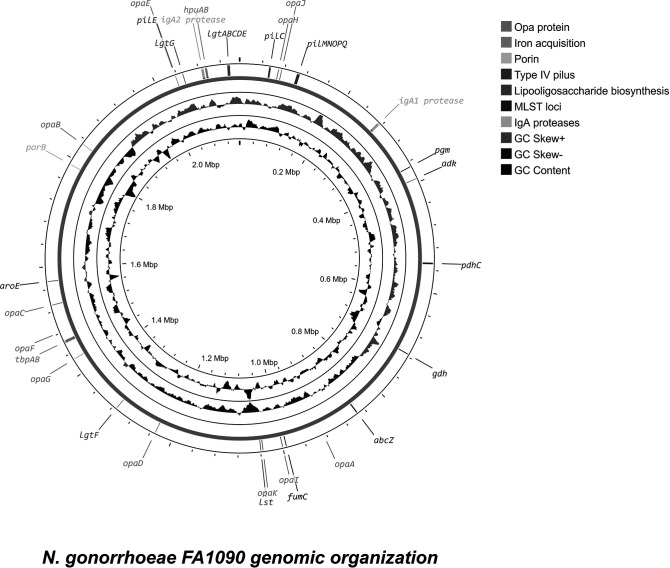 Fig. 2 Visualization of the bacterial chromosome of N. gonorrhoeae FA1090 strain with a selection of confirmed and putative virulence factors marked.
(Kurzyp K, Harrison OB. Microb Genom. 2023)
The product pipeline for N. gonorrhoeae vaccines is currently in the "discovery phase," and progress in antigen discovery is ongoing. Candidate antigens involved in gonococcal physiology or metabolism include the transferrin receptor TbpA/B, the methionine receptor MetQ (NG02139), nitrite reductase (AniA), and phospholipase D. Other promising new candidates identified using a non-biased proteomics screen are involved in membrane biogenesis (BamA), LOS assembly (LptD), or translocation assembly (TamA). Vaccine targets that mediate evasion of host innate defenses include MtrE, the outer membrane channel of the MtrCDE active efflux pump, the lysozyme inhibitor SliC (NGO1063), and the Neisseria adhesion complex protein (ACP). Two antigens that were identified by immunoproteomics as targets of antibodies induced by intravaginal immunization of mice with gonococcal OMV plus microencapsulated IL-12 are elongation factor (EF)-Tu and PotF3, a polyamine-binding protein.
With years of protein and antigen production experience and advanced platforms, Creative Diagnostics now can provide high quality native N. gonorrhoeae antigens match your research needs. Welcome to contact us for quotation and more details.
References
Loading ......
