
Inquiry Basket
 Loading ......
Rotavirus is a genus of double-stranded RNA viruses in the family Reoviridae. There are nine species of the genus, referred to as A, B, C, D, F, G, H, I and J. Rotavirus A, the most common species, causes more than 90% of rotavirus infections in humans. Human group A rotaviruses are the most frequently identified etiologic agents in children hospitalized due to acute, severe, dehydrating diarrhea worldwide. Rotavirus infections range in presentation from asymptomatic mild infections to severe and sometimes fatal disease. An estimated 450,000 children who are less than 5 years old die of rotavirus infections each year, most in developing countries.
The genome of rotaviruses consists of 11 unique double helix molecules of RNA (dsRNA) which are 18,555 nucleotides in total. Each helix is a gene. Each gene codes for one protein, except genes 9, which codes for two. The RNA is surrounded by a three-layered icosahedral protein capsid. Viral particles are up to 76.5 nm in diameter and are not enveloped. There are six viral proteins (VPs) that form the virus particle (virion). These structural proteins are called VP1, VP2, VP3, VP4, VP6 and VP7. Figure 1 shows the schematic model of the rotavirus.
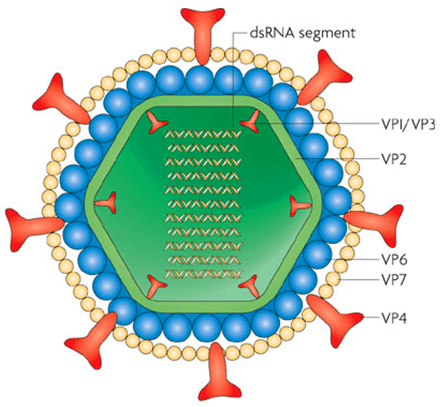 Fig. 1 The Schematic Model of the Rotavirus (Angel J, et al. 2007)
Within rotavirus A there are different strains, called serotypes. A dual classification system is used based on two proteins on the surface of the virus. The glycoprotein VP7 defines the G serotypes and the protease-sensitive protein VP4 defines P serotypes– that act as neutralizing antigens to elicit protective humoral immune responses. Since VP7 and VP4 are encoded by separate genome segments, both (sero) type specificity and type-specific immunity segregate in an independent manner. There are at least 36 G types and 51 P types but in infections of humans only a few combinations of G and P types predominate. They are G1P, G2P, G3P, G4P, G9P and G12P.
The virus is transmitted by the faecal-oral route. It infects and damages the cells that line the small intestine and causes gastroenteritis. The fully infectious RV particle (virion) consists of 3 protein layers and is also termed triple-layered particle (TLP). TLPs first attach to sialo-glycans (or histo-blood group antigens) on the surface of host cells through VP4 TLPs first attach to sialo-glycans (or histo-blood group antigens) on the host cell surface, followed by interactions with other cellular receptors, including integrins and Hsc70. Virus is then internalized by receptor-mediated endocytosis. Removal of the outer layer, triggered by the low calcium of the endosome, results in the release of transcriptionally active double-layered particles (DLPs) into the cytoplasm. The eleven dsRNA strands remain within the protection of the two protein shells and the viral RNA-dependent RNA polymerase creates mRNA transcripts of the double-stranded viral genome, which are for both protein biosynthesis and gene replication. Most of the rotavirus proteins accumulate in viroplasm, where the RNA is replicated and the DLPs are assembled. The DLPs migrate to the endoplasmic reticulum where they obtain their third, outer layer (formed by VP7 and VP4). The progeny viruses are released from the cell by lysis. Figure 2 indicates the rotavirus replication cycle.
 Fig. 2 Replication cycle of Rotavirus (Desselberger U, 2014)
Loading ......
