
Inquiry Basket
 Loading ......
The complement system is part of the innate immune system and plays an important role in the host defense, inflammation, tissue regeneration, and other physiological processes. It helps defend against foreign pathogens through complement fragments that participate in opsonization, chemotaxis, and activation of leukocytes and through cytolysis by the terminal attack complex (MAC). It is also involved in B and T cell response regulation.
The complement system comprises more than 60 plasma and surface proteins. These are covered by nine central components of the cascade (C1 to C9), multiple activation products (such as C3a and C3b), regulators and inhibitors (e.g. Factor H and C4BP), proteases and newly assembled enzymes (e.g. C4b2a and Factor B), and effector molecule receptors (such as C3aR and C5aR).
Complement can be activated through three pathways: classical, lectin, and alternative.
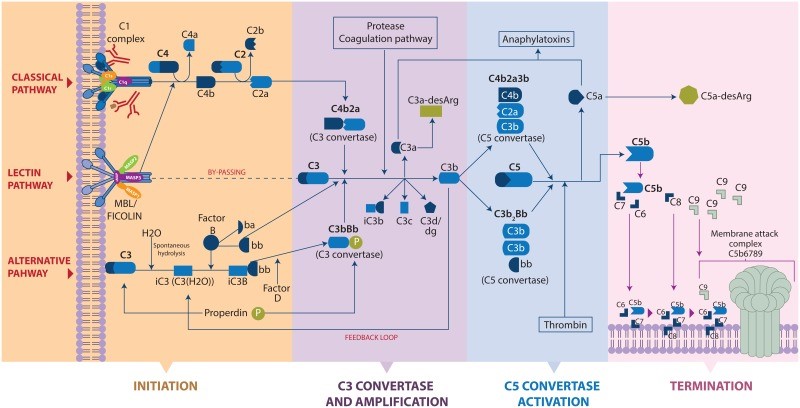 Fig. 1 The complement cascade
C4 and C2 cleavage products form the classical and lectin pathway C3 convertase, C4bC2a, which cleaves C3 into C3b and C3a. A second molecule of C3b can associate with C4bC2a to form the C5 convertase of the classical and lectin pathways, C4bC2aC3b.
All three pathways culminate in the formation of the convertases, which in turn generate the major effectors of the complement system: anaphylatoxins (ATs) (C4a/C3a/C5a), the membrane attack complex (MAC), and opsonins (e.g., C3b). Anaphylatoxins are potent proinflammatory molecules derived from the cleavage of C4, C3, and C5. The MAC is a terminal assembly of complement components C5b through C9, which can directly lyse targeted surfaces (Figure 2, bottom left). C3b induces phagocytosis of opsonized targets (Figure 2, bottom right) and also serves to amplify complement activation through the AP.
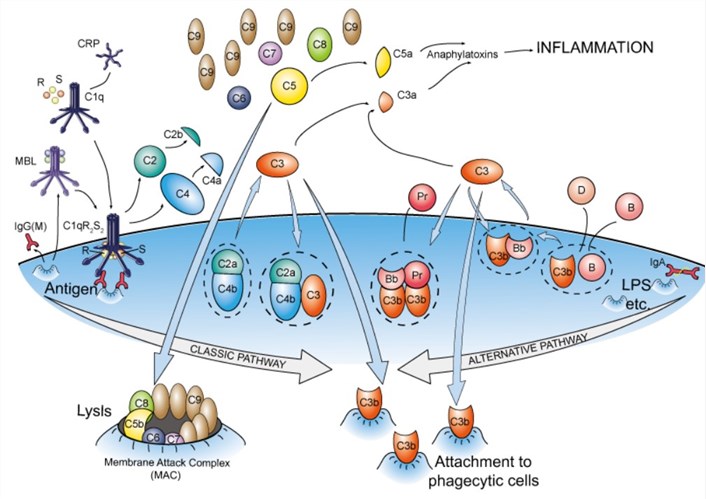 Fig. 2 The main effectors involved in the complement system
The complement system (CS) protein involved in this mechanism is C5L2. This protein is essential in glucose uptake and lipid and triglyceride clearance by induction of C3desArg. C1q, C3, C4, and MAC are present in atherosclerotic lesions while a murine model shows that a deficiency of regulatory proteins (protectin) accelerates atherosclerosis. Other studies have shown that CS facilitates macrophage extravasations and foam cell formations, which release proinflammatory factors and enhance atherosclerosis. Complement proteins have been proposed as biomarkers of atherosclerosis.
Recently it has been suggested that the CS, mainly the CP pathway, may play an important role in neurodegenerative disease. This is based on the enrollment of CS in the synapse elimination by recognition of C1q and induction of phagocytosis mediated by C3b or iC3. Therefore, alterations in this process result in neuron loss and neurodegenerative progression such as Alzheimer's disease, glaucoma, Parkinson's diseases, multiple sclerosis and schizophrenia. In the case of Alzheimer's disease, amyloid-beta peptides are known to accumulate in the extracellular milieu to form amyloid plaques. As result, these plaques are recognized by C1q and they induce CP triggered neuronal damage.
CS is involved in several mechanisms within tumor cells. First of all, the resistance of tumor cells to CS actions is due to the production of regulatory proteins such as CR1, CD46 and DAF which are important in controlling C3 activation. Secondly, anaphylatoxins bind to receptors on the tumor cells and they induce the production of IL-6, thus resulting in cell cycle progression and apoptosis mechanism inhibition. MAC can induce similar mechanisms. The last mechanism is tumor cell production of C5a which binds to C5aR on myeloid-derived suppressor cells. This results in increased reactive oxygen and nitrogen species that prevent the activation of CD4+, CD8+, NK and stimulate tumorigenesis and angiogenesis. Studies have shown that treatment directed toward C5aR slowed tumor progression.
Innate immune alterations are crucial for the development of autoimmune diseases (ADs), but complement pathway alteration has also been associated. Systemic lupus erythematosus (SLE) is the most studied. However, others have been associated such as Sjogren's Syndrome (SS), antiphospholipid syndrome (APS), rheumatoid arthritis (RA), vasculitis, multiple sclerosis and dermatomiositis.
The complement system is involved in several homeostasis mechanisms and pathological conditions. Hence, CS could be an important therapeutic target for autoimmune diseases, cancer, Alzheimer's disease, atherosclerosis, etc. At present, only drugs that inhibit the complement on two key points: C1 and C5 have been approved for clinical use.
Moreover, complement-regulatory activity can be achieved by immunoglobulins (IVg). They inhibit complement (e.g. C3b, C4b, and ATs) deposition on target cells when activation is triggered by antibodies through the CP. This treatment is used in ADs such as Kawasaki disease, idiopathic thrombocytopenic purpura, and SLE.
Creative Diagnostics offers comprehensive antibody products for complement system, which include complement cascade, related diseases, therapeutic targets, and so on. Our product portfolio covers different targets of different species, as well as humanized chimeric antibodies. All of antibody products are well-validated in comprehensive applications, including WB, IHC, IF, and ELISA. They can be used for assay development, or quality control materials in addition to scientific research.
Loading ......
