Bordetella Pertussis Antigens
Bordetella Pertussis Antigen Products by Targets
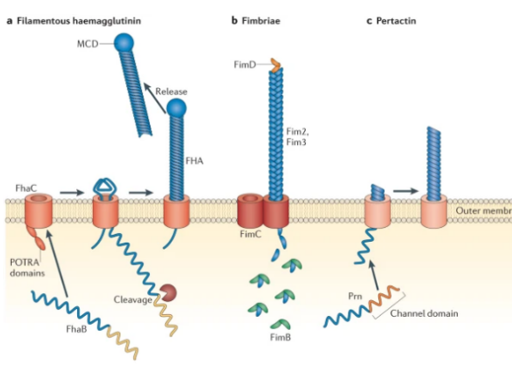 Fig. 1 Presentation of filamentous haemagglutinin, fimbriae and pertactin on the Bordetella cell surface (Jeffrey A. Melvin, et al. 2014)
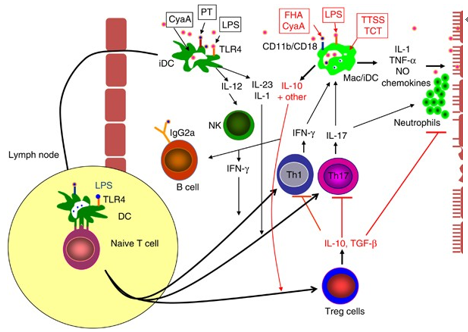 Fig. 2 Immunity to Bordetella pertussis in a naive host (R Higgs, et al. 2012)
Pertussis is a highly contagious respiratory disease that is transmitted directly from human to human, probably via aerosolized respiratory droplets. The primary causative agent, Bordetella pertussis, is a Gram-negative bacterium that was first described by Bordet and Gengou in 1906. The closely related bacterium Bordetella parapertussis Hu is responsible for a minority of cases and is less capable of causing severe disease. Both B. pertussis and B. parapertussis are human-specific, and phylogenetic analyses indicate that they evolved from Bordetella bronchiseptica or a B. bronchiseptica-like ancestor.
Bordetella pertussis produces a complex array of adhesins, aggressins and toxins that are presumed to be important in the colonisation of its human host and in ensuring its survival and propagation. The organism also has highly sophisticated mechanisms for regulating virulence factor expression, in response to environmental signals or by reversible mutations. Toxins of Bordetella pertussis mainly include Pertussis toxin (PT), Adenylate cyclase toxin (ACT), Type III secretion, Tracheal cytotoxin (TCT) and Dermonecrotic toxin (DNT). The main surface structures include Filamentous haemagglutinin (FHA), Fimbriae (Fim), Pertactin (PRN), Lipopolysaccharide (LPS) and additional surface proteins.
- Pertussis toxin (PT) Pertussis toxin, which is sometimes referred to as lymphocytosis-promoting factor owing to its ability to induce lymphocytosis in mammals, was one of the first identified, and is one of the most extensively characterized, B. pertussis virulence factors. The presumed requirement of PT for the development of infection and the observed positive correlation between PT-specific immunity and bacterial clearance led to the hypothesis that pertussis, like cholera and diphtheria, is a toxin-mediated disease.
- Adenylate cyclase toxin (ACT) Adenylate cyclase toxin, which is a member of the RTX (repeats in toxin) toxin family, is encoded by cyaA and is produced by all Bordetella subspecies that infect mammals. ACT is secreted by the cyaBDE-encoded type I secretion system and is palmitoylated by the product of cyaC. The toxin contains two distinct functional modules: the C-terminal domain, which contains the RTX repeats, mediates binding to target cells and forms cation-selective pores in plasma membranes; and the N-terminal domain, which is a calmodulin-dependent adenylate cyclase that converts ATP to cyclic AMP (cAMP).
- Filamentous haemagglutinin (FHA) Filamentous haemagglutinin is a large rod-shaped protein and, together with FhaC (filamentous haemagglutinin transporter protein), it functions as a prototypical member of the two-partner secretion pathway (TPS pathway). It is initially synthesized as a ∼370 kDa pre-pro-protein (FhaB) that undergoes processing to produce the mature ∼250 kDa FHA as it is translocated across the cytoplasmic membrane by the Sec translocation system and across the outer membrane by FhaC.
- Fimbriae (Fim) Bordetella spp. produce type I pili, which are also known as fimbriae. The putative chaperone (FimB), usher (FimC) and tip adhesin (FimD) are encoded by the fimBCD operon. The fim2 and fim3 genes, which encode the two major fimbrial subunits, are located elsewhere on the chromosome. Fimbriae can mediate adherence to ciliated respiratory epithelium, also seem to be involved in adherence and/or suppression of the initial inflammatory response to infection.
- Pertactin (PRN) Pertactin is a member of the classical autotransporter family of outer membrane proteins. The surface-localized 'passenger' domain forms a β-helix in which β-strands are connected by short turns or, in a few cases, large extrahelical loops. PRN contributes to the adherence of B. pertussis to ciliated respiratory epithelium.
- Lipopolysaccharide (LPS) B. pertussis produces a penta-acylated lipid A that is linked to a complex core trisaccharide, because it lacks O-antigen, B. pertussis LPS is often referred to as lipooligosaccharide.

 Loading ......
