
Inquiry Basket
 Loading ......

All antibodies display a feature on their variable portion that is a unique set of antigenic determinants (epitopes), known as the idiotope. An anti-idiotypic antibody (Anti-ID) will bind to the idiotope of another antibody, usually an antibody drug, which makes it an incredibly powerful tool in the development of antibody drugs.
Since anti-ID Abs are capable of binding to antibody drugs within biological fluids, they are commonly used in the preclinical setting to analyze the pharmacokinetics (PK) and pharmacodynamics (PD) of antibody drugs. Due to the similarity between anti-ID Abs and anti-drug antibodies, anti-ID Abs are also commonly used as a reference standard for antibody-drug immunogenicity, anti-drug antibody (ADA) studies, and neutralization antibody measurements.
In drug development, Pharmacokinetic assays provide essential information on a drug's interaction with the body, as well as the intensity and duration of its efficacy. For the development of biosimilar drugs, comparative PK assays are required to evaluate potential differences in biological activity to the reference drug.
Anti-IDs can be used to detect and quantify antibody drug levels in animal or human serum and are critical detection reagents for PK studies. Based on different binding modes and properties, anti-idiotype antibodies can be classified into three types: antigen-blocking, non-blocking and complex specific. Based on these features, different formats of PK assays can be set up to measure free, total, or bound antibody drug concentrations in serum.
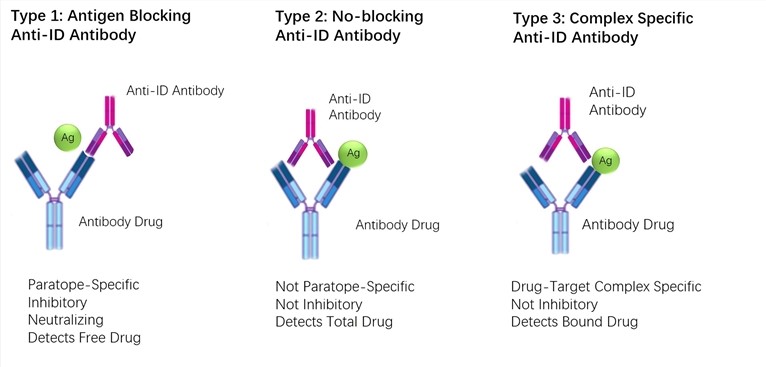 Fig. 2 Types of anti-ID antibodies.
There are a variety of analytical methods for quantitative analysis of antibody drugs, with ELISA as the most commonly used format, including indirect, competitive, sandwich or bridging ELISA. Among them, bridging ELISA is considered to be the best option, because of its low non-specific background and high sensitivity. Four common ways of performing an ELISA based PK assays are shown in Figure 3. Normally the second type in the schematic diagram is used for measuring total drug, and the non-blocking anti-ID antibodies are used to enable the measurement of total drug – free, partially and fully bound.
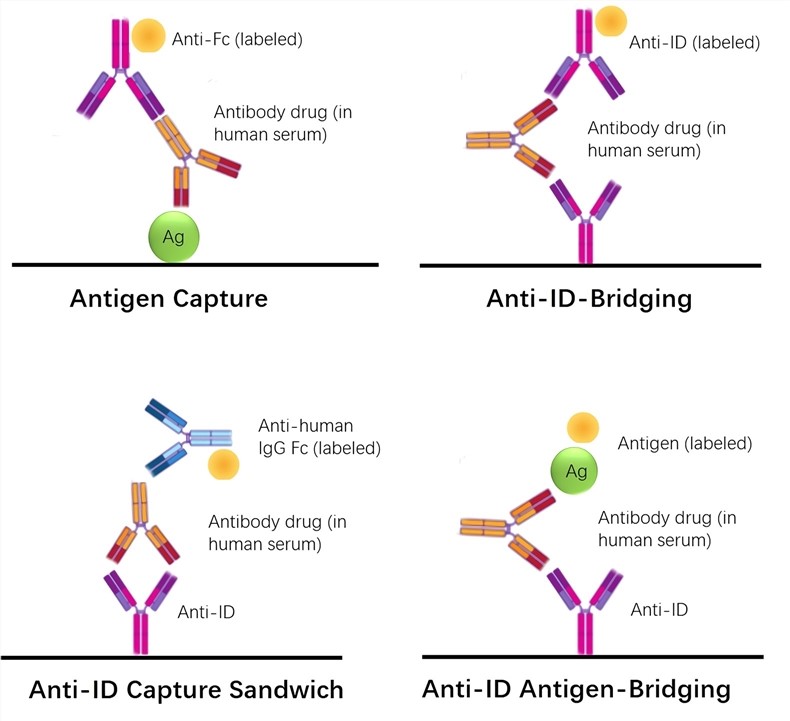 Fig.3 Types of ELISA-based PK assays.
Arising of ADAs against biotherapeutic drugs has been widely observed in preclinical and clinical research resulting in significant changes in toxicology, efficacy and pharmacokinetic (PK), resulting from the generation of drug-induced (neutralizing) autoantibodies against e.g. insulin, erythropoietin and can be responsible for allergic reactions, and even anaphylactic shock. Assays for the detection of ADAs facilitate understanding of potential immune responses to biologic drug candidates. Determining the presence of ADAs and evaluating their clinical implications are important for any antibody drug development program. A complete ADA determination entails the following steps:
1. Screening Assays – bridging ELISA, direct ELISA or competitive ELISA
2. Confirmation Assay - determination of specificity
3.Characterization Assay - isotypes identification, neutralizing ability
As shown in Figure 2, type 1 anti-idiotypic antibodies are inhibitory for measuring free drug and are ideal for neutralizing assays. Type 1 anti-idiotypic antibodies can also be used as a control or calibrator as a surrogate for human ADAs.
To support preclinical/clinical immunogenicity and PK analysis, Creative Diagnostics has developed a series of high-affinity anti-idiotypic antibodies. Our pipeline covers a variety of hot targets and provides assay protocols that can be applied to different application scenarios to assist the drug development process.

ELISA, PK study
CABT-ZB203 binds with Eculizumab. While the antibody does not recognize the human lgG Fc fragment (data not shown).
Coating antigen: Eculizumab, 1 μg/ml.
CABT-ZB203 dilution start from 1,000 ng/ml, EC50=73.14 ng/ml.

ELISA, PK study
Standard curve of Daratumumab Sandwich ELISA. The Daratumumab Sandwich ELISA assay is developed by using CABT-ZB192 and CABT-ZB193 as capture and detection antibodies, respectively. In this ELISA assay, CABT-ZB193 was labeled with Biotin.
The sensitivity of detecting Daratumumab is up to 0.039 ng/ml

ELISA, PK study
CABT-ZB180 blocks Avelumab binding with Human PD-L1.
Coating antigen: Avelumab, 1 μg/ml.
PD-L1 concentration: 6 ng/ml.
Anti-Avelumab antibody dilution starts from 30 μg/ml. IC50=0.748 μg/ml.
Loading ......
