Zika Virus Antigens
Zika Virus Antigen Products by Targets
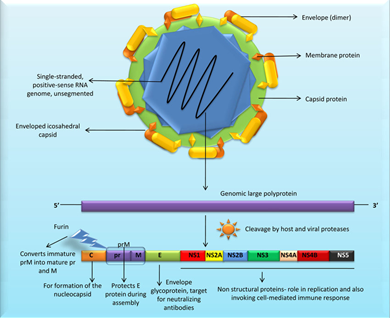 Fig. 1 Structure of Zika virus and its genome
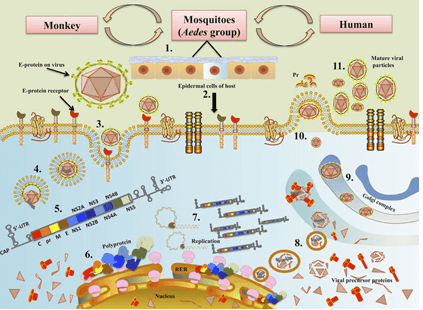 Fig. 2 Zika virus life cycle
Zika virus (ZIKV) is a member of the Spondweni serocomplex within the genus Flavivirus, family Flaviviridae. Zika virus was first isolated from a sentinel rhesus monkey placed in the Zika Forest near Lake Victoria, Uganda in April 1947; a second isolation from the mosquito Aedes africanus followed at the same site in January 1948. In the sylvatic transmission cycle, humans likely serve as incidental hosts. However, in areas without non-human primates, humans probably serve as primary amplification hosts and potentially as reservoir hosts if their viremia is sufficient in duration and magnitude.
Human case reports of clinically diagnosed ZIKV infections include self-limiting acute febrile illnesses with fever, headache, myalgia and rash. This clinical picture could easily be mistaken for dengue (DEN) or chikungunya (CHIK) fevers, two common arboviral infections which both produce similar clinical presentations. A recent epidemic on Yap Island, Federated States of Micronesia, and a pediatric case of ZIKV infection in Cambodia demonstrate that ZIKV is also capable of causing human disease and may be expanding its geographic distribution.
Zika virus has a positive-sense, single-stranded RNA genome approximately 11 kilobases in length. The genome contains 59 and 39 untranslated regions flanking a single open reading frame (ORF) that encodes a polyprotein that is cleaved into three structural proteins: the capsid (C), premembrane/membrane (prM), and envelope (E), and seven non-structural proteins (NS1, NS2A, NS2B, NS3, NS4A, 2K, NS4B, and NS5). A previous genetic study using nucleotide sequences derived from the NS5 gene indicated three ZIKV lineages: East African (one strain examined), West African (three strains examined), and Asian (one strain examined).
- Capsid protein (C) Plays a role in virus budding by binding to the host cell membrane and packages the viral RNA into a nucleocapsid that forms the core of the mature virus particle. During virus entry, may induce genome penetration into the host cytoplasm after hemifusion induced by the surface proteins. Can migrate to the cell nucleus where it modulates host functions.
- Envelope protein (E) ZIKV E protein consists of 4 domains: the stem-transmembrane domain pair, and 3 domains found outside of the membrane referred to as ectodomains I, II, and III. The basic organizational unit of E protein in mature flaviviruses is a dimer with each E monomer within the dimer related to its neighbor by 2-fold symmetry. E proteins could influence receptor interactions, antibody response, and perhaps downstream biology of the virus.
- Nonstructural protein (NS) NS1: Plays a role in the inhibition of host RLR-induced interferon-beta activation by targeting TANK-binding kinase 1/TBK1; NS2A: Component of the viral RNA replication complex that recruits genomic RNA, the structural protein prM/E complex, and the NS2B/NS3 protease complex to the virion assembly site and orchestrates virus morphogenesis; NS2B: Required cofactor for the serine protease function of NS3; NS3: Displays three enzymatic activities: serine protease, NTPase and RNA helicase; NS4A: Regulates the ATPase activity of the NS3 helicase activity; NS4B: Induces the formation of ER-derived membrane vesicles where the viral replication takes place; NS5: Replicates the viral (+) and (-) RNA genome, and performs the capping of genomes in the cytoplasm.
- Precursor Membrane protein (PrM) Plays a role in host immune defense modulation and protection of envelope protein E during virion synthesis. PrM-E cleavage is inefficient, many virions are only partially matured and immature prM-E proteins could play a role in immune evasion. Contributes to fetal microcephaly in humans. Acts as a chaperone for envelope protein E during intracellular virion assembly by masking and inactivating envelope protein E fusion peptide. prM is the only viral peptide matured by host furin in the trans-Golgi network probably to avoid catastrophic activation of the viral fusion activity in acidic Golgi compartment prior to virion release.

 Loading ......
