
Inquiry Basket
 Loading ......
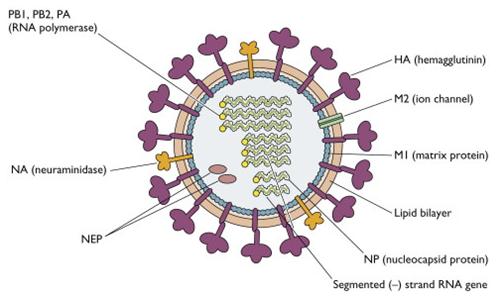 Fig. 1 The schematic model of IAV
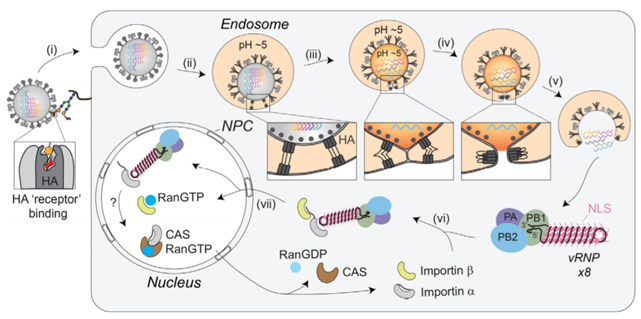 Fig. 2. Illustration of IAV cell entry
Influenza A virus (IAV) causes influenza symptom in birds and mammals, and belongs to the family of Orthomyxoviridae. There are several subtypes of influenza A virus. All subtypes are labeled according to an H number (for the type of hemagglutinin) and an N number (for the type of neuraminidase). There are 18 different known H antigens (H1 to H18) and 11 different known N antigens (N1 to N11). All strains of influenza A virus have been isolated from wild birds, and some isolates of them cause severe disease both in domestic poultry and, rarely, in humans. Occasionally, viruses are transmitted from wild aquatic birds to domestic poultry, and this may cause an outbreak or give rise to human influenza pandemics.
Influenza A virus possesses negative-sense, single-stranded, non-circle RNAs. The genome of it consists of eight independent fragments of which combines with ribonucleoprotein and form an RNA-protein complex. Each fragment contains a relatively conserved non-coding sequence and one open reading frame (ORF). The 13 nucleotides of the 5 'end of the gene were highly conserved and had the following sequence: 3'-GGAACAAAGAUGAppp-5', and also12 highly conserved nucleotides at the 3 'end: 3'-HO · UCGUCUuuCGUCC-5. The genome of influenza virus A contains 10 gene segments which separately encodes 10 proteins: PB1, PB2, PA, HA, 5-NP, NA, M and NS protein.
Hemagglutinin (HA)--Influenza hemagglutinin (HA) is a homotrimeric glycoprotein found on the surface of influenza viruses and is integral to its infectivity. HA is responsible for binding Influenza virus to sialic acid on the surface of target cells and the fusion of the viral envelope with the late endosomal membrane once exposed to low pH.
As one of the excellent bio-manufacturers, Creative Diagnostics is capable of satisfying our clients with our high-quality product and services. Welcome to contact our sales representative if you are in need of influenza A virus antigens.
Loading ......
