
Inquiry Basket
 Loading ......
Rabies virus (RABV) is a neurotropic, enveloped, single-stranded RNA virus. It belongs to the Rhabdoviridae family, genus Lyssavirus. RABV infection causes rabies in humans and other animals. They are characterized by an extremely broad host spectrum ranging from plants to insects and mammals. Rabies causes inflammation of the brain in humans and other mammals. Early symptoms of rabies include fever and tingling at the site of exposure, followed by one or more symptoms such as fear of water, violent movements, confusion, uncontrolled excitement, inability to move parts of the body, and loss of consciousness. The mortal rate is nearly 100% once the symptoms appear. Each year, rabies causes approximately 59,000 deaths worldwide. However, the disease is 100% vaccine-preventable through the prompt administration of human postexposure prophylaxis (PEP) and vaccination of animal reservoirs.
RABV has a bullet-like shape with a length of about 180 nm and a cross-sectional diameter of about 75 nm. One end is rounded or conical and the other end is planar or concave. The RABV genome is a single-stranded, negative-sense RNA with a length of nearly 12k nt. It encodes five viral proteins including: nucleoprotein (N), phosphoprotein (P), matrix protein (M), glycoprotein (G) and polymerase (L). RABV virion has two main structural components including an envelope and a helical ribonucleoprotein core (RNP), which is the same as all other rhabdoviruses. In the RNP, genomic RNA is tightly encased by the nucleoprotein. Phosphoprotein and polymerase are associated with the RNP too. The matrix protein is believed to be the central molecule for the assembly of RABV particles, and also associated with the envelope of RABV. The glycoprotein forms approximately 400 trimeric spikes which are tightly arranged on the surface of the virus.
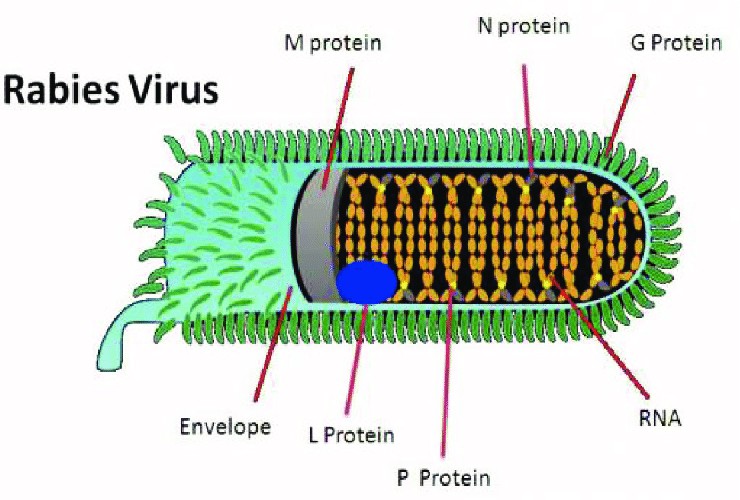 Fig 1. Structure of Rabies virus1
Transmission of RABV infections is mostly through the contamination of bite wounds with the saliva of an infected animal. It then spreads into the end terminals of motor neurons innervating the muscle and travels along the neurons' long axon fibers to the neuronal cell bodies. From there, the virus can spread throughout the central nervous system and into the salivary glands, where it can be readily transmitted to other hosts. RABV is highly neurotropic and causes fatal encephalitis, when the virus gains access to the central nervous system (CNS). The virus binds to the cell surface receptors via its glycoprotein and enters by endocytosis. Subsequently, the viral membrane fuses with the endosomal membrane to release the viral genome. The negative-stranded RNA genome is transcribed by the polymerase complex, and their translation into the five viral proteins above. Later in infection, the activity of the polymerase switches to replication in order to produce full-length positive-strand RNA copies, which function as templates for the synthesis of new negative-strand RNA genomes. They are packaged together with protein N to form ribonucleoprotein which then can form new viruses. At last, the viral components are assembled and the RABV virions bud and are released, starting a new round of infection.
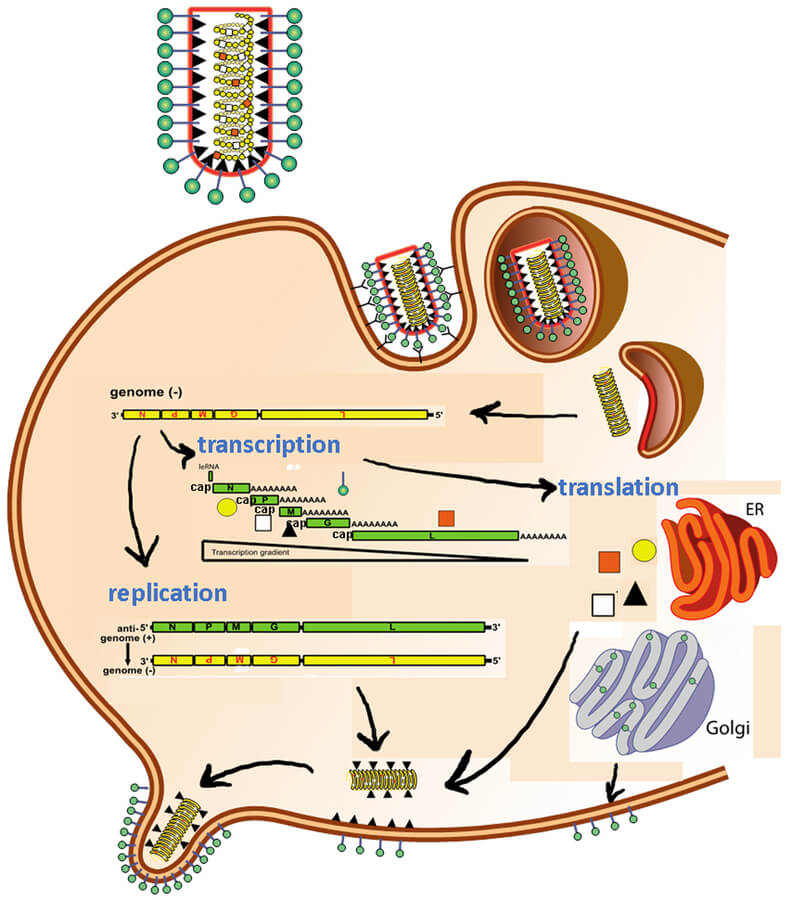 Fig.2 Life cycle of Rabies virus2
Creative Diagnostics now can provide multiple Rabies virus (RABV) antigens and proteins for different applications. Welcome to contact us for more details.
Loading ......
