
Inquiry Basket
 Loading ......
Mycotoxins are toxic substances produced by fungi (mycotoxigenic fungi) on the different substrates where they grow. Mycotoxins can be toxic when inhaled, absorbed through the skin, or consumed at very low concentration levels, which means that even a few milligrams in food or feed may pose a risk for human and animal health.
To date, more than 400 mycotoxins have been described. However, most research and worldwide regulations have focused on the group of the most toxic and prevalent mycotoxins, including aflatoxins, ochratoxin A, patulin, fumonisins, zearalenone, and the group called trichothecenes: deoxynivalenol (AKA DON or vomitoxin), nivalenol, T-2, and HT-2.
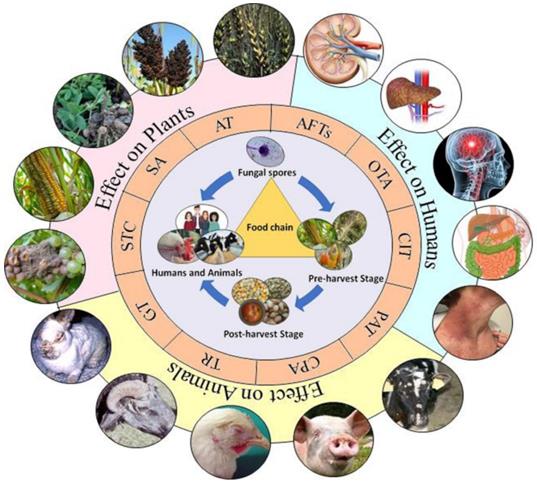 Figure 1. Aspergillus-derived mycotoxin contamination in food and the environment and its effects on humans, animals, and plants [1]
Many international agencies are trying to achieve universal standardization of regulatory limits for mycotoxins. Currently, over 100 countries have regulations regarding mycotoxins in the feed industry, in which 13 mycotoxins or groups of mycotoxins are of concern. Food-based mycotoxins were studied extensively worldwide throughout the 20th century. In Europe, statutory levels of a range of mycotoxins permitted in food and animal feed are set by a range of European directives and EC regulations. The U.S. Food and Drug Administration has regulated and enforced limits on concentrations of mycotoxins in foods and feed industries since 1985. It is through various compliance programs that the FDA monitors these industries to guarantee that mycotoxins are kept at a practical level. These compliance programs sample food products including peanuts and peanut products, tree nuts, corn and corn products, cottonseed, and milk. There is still a lack of sufficient surveillance data on some mycotoxins that occur in the U.S.
To address the legislation and ensure food safety, the development of analytical methods with high sensitivity and accuracy is in great demand. The instrumental methods (such as GC and HPLC) are usually used as the gold standard. Nevertheless, despite their accurate and precise determination, sophisticated instrumental methods have some limitations related to high cost, long detection time, and the requirement of skilled operators. Rapid methods are preferred by analysts who need to know the results immediately (e.g., on-site screening of high numbers of samples) or in routine analysis in laboratories where the classical method is not available. Immunoassays have already found widespread use as screening methods, providing beneficial attributes, such as rapidness, simplicity, cost-efficiency, required sensitivity, and specificity. So far, antibodies have been regarded with no doubt as the gold-standard recognition element in immunoassays and biosensors.
 Figure 2. Schematic representation of several methods of mycotoxin detection [2]
Antibodies serve as a necessary tool for the detection of toxins, with a need for the efficient detection and quantification of the toxins in complex matrices, such as environmental, food, and clinical matrices. Creative Diagnostics provides highly sensitive and cost-effective toxins detection antibodies for multiple applications. We also offer customized services, which can asset customers to achieve their immunoassay development.
References
Loading ......
