
 S1+S2 ECD
 S2
S2Inquiry Basket
 Loading ......
Creative Diagnostics now can provide a variety of antigens and antibodies of SARS-CoV-2, including SARS-CoV-2 mutant proteins, biotinylated proteins, SARS-CoV-2 antibody pairs, neutralizing antibodies and so on. These antigens and antibodies can be used for scientific research, detection of SARS-CoV-2 and specific antibodies. All of our products are produced using a standardized production process to ensure the highest quality.
SARS coronavirus, also known as SARS-CoV, emerged in the human population in Guangdong province of southeastern, China in 2002, Within months, the outbreak had spread to 29 countries and regions causing over 8000 human cases and almost 800 deaths in the 2002-2003 outbreak. Phylogenetic analysis of coronavirus from scientist indicated a high probability that SARS coronavirus originated in bats and spread to humans either directly or through animals held in Chinese markets. The bats did not show any visible signs of disease but are the likely natural reservoirs of SARS-like coronaviruses.
Coronaviruses are a family of large, enveloped, positive-stranded RNA viruses that cause upper respiratory, gastrointestinal and central nervous system diseases in humans and other animals. The coronavirinae family consists of four genera based on their genetic properties, including genus alphacoronavirus, genus betacoronavirus, genus gammacoronavirus, and genus deltacoronavirus. Host range and tissue tropism show a lot of variation among different CoVs. Human coronaviruses HCoV-OC43, HCoV-229E, HCoV-NL63 and HCoV-HKU1 circulate in humans and cause mild respiratory diseases. However, the outbreak of SARS-CoV in 2002, MERS-CoV in 2012 and SARS-CoV-2 in 2019 showed that coronaviruses can cross the species barrier and emerge as highly pathogenic viruses. SARS-CoV, SARS-CoV-2 and MERS-CoV all belong to the betacoronavirus genus and are zoonotic pathogens that can cause severe respiratory diseases in humans. An outbreak of SARS-CoV-2 disease in 2019 showed many similarities with the SARS-CoV outbreak, and the viral agent was identified as another strain of the SARS-related coronavirus, SARS-CoV-2. Although the two are strains of the same virus, SARS-CoV-2 is not a direct descendant of SARS-CoV, and made the jump into humans separately.
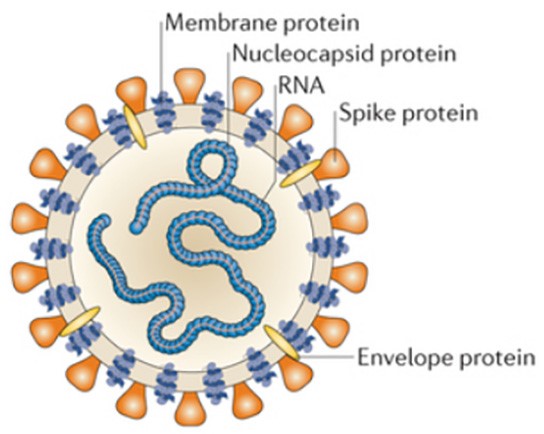 Fig. The Viral Structure of SARS-CoV
Source: Nature Reviews \ Microbiology
SARS-CoV is an enveloped virus with round and sometimes pleiomorphic virions of approximately 80 to 120 nm in diameter. It contains positive-strand RNA, with the largest RNA genome (approximately 30 kb). The genome RNA is complexed with the basic nucleocapsid (N) protein to form a helical capsid found within the viral membrane. The structural proteins of SARS-CoV include the surface spike (S) glycoprotein, the membrane (M) protein, the small envelope (E) glycoprotein, and the nucleocapsid (N) protein. The spike (S) glycoprotein of the coronavirus is a class I viral fusion protein located on the outer envelope of the virion that plays a critical role in viral infection by recognizing host cell receptors and mediating fusion of the viral and cellular membranes. The coronavirus S glycoprotein is synthesized as a precursor protein consisting of ~1,300 amino acids that is then cleaved into an amino (N)-terminal S1 subunit (~700 amino acids) and a carboxyl (C)-terminal S2 subunit (~600 amino acids). Three S1/S2 heterodimers assemble to form a trimer spike protruding from the viral envelope.
<| Target | Cat. | Product Name | Source | Tag | |
 S1 S1 | DAGC215 | Biotinylated Recombinant SARS-CoV-2 S1 protein [His,Avi] | HEK293 Cells | His, Avi | Inquiry |
| DAGC233 | Biotinylated Recombinant SARS-CoV-2 S1 Protein [His] | HEK293 Cells | His | Inquiry | |
 RBD RBD | DAGC221 | Biotinylated Recombinant SARS-CoV-2 S protein RBD [His,Avi] | HEK293 Cells | His, Avi | Inquiry |
| DAGC236 | Biotinylated Recombinant SARS-CoV-2 Spike RBD Protein [His,Avi] | Insect Cells | His, Avi | Inquiry | |
| DAGC234 | Biotinylated Recombinant SARS-CoV-2 Spike RBD Protein (HEK293 Cells) [His] | HEK293 Cells | His | Inquiry | |
| DAGC235 | Biotinylated Recombinant SARS-CoV-2 Spike RBD Protein (Insect Cells) [His] | Insect Cells | His | Inquiry | |
 NP NP | DAGC237 | Biotinylated Recombinant SARS-CoV-2 Nucleocapsid Protein [His] | Insect Cells | His | Inquiry |
| DAGC223 | Biotinylated Recombinant SARS-CoV-2 Nucleocapsid protein [His,Avi] | E.coli | His, Avi | Inquiry |
*DAGC149 pair with DAGC091; DAGC173 pair with DAGC174
| Cat. | Product Name | Source | Tag | |
| DAGC094 | Recombinant SARS-CoV-2 Nucleocapsid Protein (E.coli) [His] | E.coli | His | Inquiry |
| DAGC140 | Recombinant SARS-CoV-2 Nucleocapsid protein N3 fragment (C-ter domain) [His] | E.coli | His | Inquiry |
| DAGC141 | Recombinant SARS-CoV-2 Nucleocapsid protein N5 fragment (N-ter partiallytruncated) [His] | E.coli | His | Inquiry |
| *DAGC155 | Recombinant SARS-CoV-2 Nucleocapsid Protein (truncated, N3) [His] | E.coli | His | Inquiry |
| *DAGC156 | Recombinant SARS-CoV-2 Nucleocapsid Protein (truncated) [His] | E.coli | His | Inquiry |
| DAGC161 | Recombinant SARS-CoV-2 Nucleocapsid Protein (a.a.1-419) [His] | Insect Cells | His | Inquiry |
| DAGC192 | Recombinant SARS-CoV-2 Nucleocapsid Protein [FLAG] | HEK293 cells | FLAG | Inquiry |
| DAGC196 | Recombinant SARS-CoV-2 Nucleocapsid Protein (HEK293 cells) [His] | HEK293 cells | His | Inquiry |
| DAGC311 | Recombinant SARS-CoV-2 Nucleocapsid Protein | Mammalian cells | non-tag | Inquiry |
* Highly recommended for the SARS-CoV-2 antibody lateral flow immunoassay development.
| Cat. | Product Name | Source | Tag | |
| DAGC165 | Recombinant SARS-CoV-2 Envelope Protein [His] | E.coli | His | Inquiry |
| DAGC197 | Recombinant SARS-CoV-2 S + M + E Protein [His] | E.coli | His | Inquiry |
*Recommended antibody pair for further development of an LFA for SARS-CoV-2 Antigen.
| Cat. | Product Name | Host | Isotype | |
| CABT-CS064 | SARS-CoV-2 Spike Neutralizing Monoclonal antibody, clone NN54 | Mouse | IgG | Inquiry |
| CABT-CS065 | SARS-CoV-2 Spike Neutralizing Monoclonal antibody, clone NN68 | Mouse | IgG | Inquiry |
| CABT-CS079 | SARS-CoV-2 Spike RBD Neutralizing Monoclonal antibody, clone 112 | Rabbit | IgG | Inquiry |
| CABT-CS033 | SARS-CoV-2 S1 Monoclonal antibody, clone BIB114 | Humanized | IgG | Inquiry |
| CABT-CS056 | SARS-CoV-2 S1 Polyclonal antibody | Rabbit | IgG | Inquiry |
| CABT-CS057 | SARS-CoV-2 S1 Polyclonal antibody | Monkey | IgG | Inquiry |
| Target | Cat. | Product Name | Host | Isotype | |
 S S | CABT-CS033 | SARS-CoV-2 S1 Monoclonal antibody, clone BIB114 | Humanized | IgG | Inquiry |
| CABT-CS044 | SARS-CoV-2 Spike RBD Monoclonal antibody (purified), clone BIB116 | Humanized | IgM | Inquiry | |
| CABT-CS062 | SARS-CoV-2 S-RBD Monoclonal antibody (unpurified), clone CTN12 | Humanized | IgM | Inquiry | |
| CABT-CS088 | Human Anti-SARS-CoV-2 RBD Monoclonal antibody, clone 31Z51 | Humanized | IgA | Inquiry | |
 N N | CABT-CS037 | SARS-CoV-2 Nucleoprotein Monoclonal antibody, clone CO10 | Humanized | IgG | Inquiry |
| CABT-CS061 | SARS-CoV-2 Nucleoprotein Monoclonal antibody (purified), clone CON12 | Humanized | IgM | Inquiry | |
| CABT-CS055 | SARS-CoV-2 Nucleoprotein Monoclonal antibody (unpurified), clone CON12 | Humanized | IgM | Inquiry | |
 S+N S+N | CABT-CS067 | SARS-CoV-2 N+S-RBD Monoclonal antibody (cocktail), clone COTHN12 | Humanized | IgG, IgM | Inquiry |
Loading ......
