
Inquiry Basket
 Loading ......
Human papillomavirus (HPV) is a diverse virus with multiple strains, each identified by a specific number. HPV types 16 and 18 belong to the high-risk category, posing significant health risks. While there are over 150 types of HPV, only a subset is known to cause cancer. The Centers for Disease Control and Prevention (CDC) identifies 13 HPV types associated with cervical cancer. Among them, types 16 and 18 have been extensively studied due to their strong correlation with various malignancies.
HPV is responsible for nearly all cases of cervical cancer. Among the various high-risk HPV types (HPV-16, HPV-18, HPV-31, HPV-33, HPV-35, HPV-39, HPV-45, HPV-51, HPV-52, HPV-56, HPV-58, HPV-59, HPV-66, and HPV 68), HPV16 and HPV18 are particularly relevant due to their prevalence in cancer cases. Studies have shown that HPV type 16 is responsible for approximately 50-60% of all cervical cancer cases, while HPV18 is responsible for about 10-15% of cases. Multiple screening assays often differentiate between HPV16, HPV18, and other high-risk types, enabling targeted management strategies.
The distinction between HPV16 and HPV18 is crucial because they are associated with different disease spectra. HPV16 is commonly found in precursor lesions, such as cervical intraepithelial neoplasia (CIN) grade 2 (CIN2) and CIN3, which can be identified during colposcopy. It is the most prevalent type not only in cervical cancer but also in these precursor lesions. On the other hand, HPV18 is more frequently linked to endocervical lesions that may not be visible during a colposcopy, leading to potential challenges in early detection and treatment.
Learn more about Recombinant HPV 16 and 18 Antigens
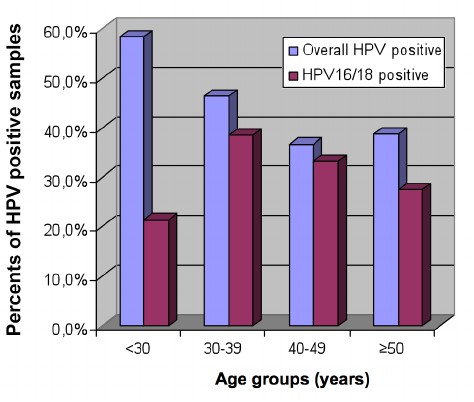 Figure 1. Overall HPV and HPV16/18 prevalence by age group in women with normal cervical cytology.
(Source: Malisic, E. et al., 2014)
These high-risk strains can infect the cells of the cervix, leading to the development of precancerous changes known as dysplasia. If left undetected or untreated, dysplasia can progress to invasive cancer. Regular screening through Pap tests or HPV tests plays a crucial role in identifying these changes early on, enabling timely intervention and reducing the risk of cancer progression.
In addition to cervical cancer, HPV types 16 and 18 are also associated with other anogenital and oropharyngeal cancers.
To prevent HPV-related cancers, including those associated with types 16 and 18, vaccination is crucial. Vaccines targeting these high-risk types have been developed and are highly effective in preventing HPV infection and subsequent disease development.
Learn more about HPV L1 Antibodies for Neutralization and Vaccine Development
HPV vaccines, such as Gardasil and Cervarix, provide protection against multiple HPV types, including types 16 and 18. These vaccines stimulate the immune system to generate antibodies that neutralize the virus. By vaccinating individuals before they become sexually active, the risk of acquiring HPV infections, including types 16 and 18, can be significantly reduced.
It is important to note that HPV vaccines are most effective when administered prior to exposure to the virus. Therefore, widespread vaccination programs targeting adolescents and young adults are essential for achieving maximum impact in preventing HPV-related cancers.
References
| Target | Cat. No. | Product Name | Size | Species Reactivity | Application | Detection Sample | |
| HPV | DEIASL404 | Human HPV18 IgM ELISA kit | 96T | Qualitative | Serum, plasma | Inquiry | |
| DEIASL405 | Human HPV 16 L1-capsids IgG ELISA Kit | 96T | Qualitative | Serum, plasma | Inquiry | ||
| DEIASL406 | Human HPV 16 IgM ELISA Kit | 96T | Qualitative | Serum, plasma | Inquiry | ||
| DEIASL408 | Human HPV 18 L1-capsids IgG ELISA Kit | 96T | Qualitative | Serum, plasma | Inquiry | ||
| DEIASL409 | Rabbit HPV 16 L1-capsids IgG ELISA Kit | 96T | Qualitative | Serum, plasma | Inquiry | ||
| DEIASL119 | HPV(18) Antigen ELISA Quantitation Kit | 96T | Quantitative | Serum, plasma | Inquiry | ||
| DEIASL171 | Human HPV 16 E7 Oncoprotein ELISA Kit | 96T | Human | Quantitative | Cell lysates, tissue lysates, cervical smears, plasma, serum | Inquiry | |
| DEIASL172 | Human HPV 18 E7 Oncoprotein ELISA Kit | 96T | Quantitative | Cell lysates, tissue lysates, or cervical smears | Inquiry | ||
| HPV16 | DEIASL118 | HPV (16) Antigen ELISA Quantitation Kit | 96T | Human | Quantitative | Serum and plasma | Inquiry |
Loading ......
