
Inquiry Basket
 Loading ......
ADP-ribosylation is a vital process in cellular biology that involves the transfer of ADP-ribose groups from nicotinamide adenine dinucleotide (NAD+) to target proteins. This post-translational modification (PTM) plays a crucial role in various cellular processes, including DNA repair, transcriptional regulation, apoptosis, and signal transduction. However, dysregulation of ADP-ribosylation can lead to abnormal protein activity and disrupt normal cellular functions. In cancer, this dysregulation can contribute to tumor growth, metastasis, and resistance to therapy.
Explore all ADP-related products
 Figure 1. Principles of ADP-ribosylation.
(Source: Lüscher, B. et al., 2018)
ADP-ribosylation occurs through the addition of one or more ADP-ribose moieties to a protein. The catalytic mechanism involves the transfer of ADP-ribose from the redox cofactor NAD+. This transfer reaction occurs through the cleavage of the N-glycosidic bond of NAD+, followed by a nucleophilic attack by the target amino acid side chain. The enzymes involved in ADP-ribosylation can perform two types of modification: mono(ADP-ribosyl)ation and poly(ADP-ribosyl)ation.
Mono(ADP-ribosyl)ation is the addition of a single ADP-ribose moiety to the target protein. It is catalyzed by enzymes known as mono(ADP-ribosyl)transferases. These enzymes recognize specific target proteins and transfer the ADP-ribose group from NAD+ to a specific amino acid residue on the target protein.
The amino acids most commonly targeted for mono(ADP-ribosyl)ation are arginine, glutamate, and aspartate. The transfer of ADP-ribose to these amino acids occurs via a nucleophilic attack mechanism. The reaction proceeds through the cleavage of the N-glycosidic bond of NAD+, resulting in the formation of an oxonium ion. The nucleophilic amino acid residue then attacks the electrophilic carbon adjacent to the oxonium ion, leading to the formation of a glycosidic bond between the target amino acid and ADP-ribose.
Glutamate residues often play a critical role in the catalytic mechanism of mono(ADP-ribosyl)transferases. They act as general bases, deprotonating the nucleophilic amino acid to enhance its reactivity. Glutamate residues also participate in the stabilization of the transition state during the nucleophilic attack.
Poly(ADP-ribosyl)ation involves the addition of multiple ADP-ribose units to the target protein. This process is catalyzed by enzymes called poly(ADP-ribose)polymerases (PARPs). PARPs use the same substrate, NAD+, as mono(ADP-ribosyl)transferases, but they elongate the ADP-ribose chain, forming a polymer.
The mechanism of poly(ADP-ribosyl)ation starts with the binding of NAD+ to the PARP enzyme. The acceptor protein, which is already modified with an initial ADP-ribose unit, is also bound to PARP. PARP transfers ADP-ribose from NAD+ to the acceptor protein, extending the polymer chain. The attachment of each ADP-ribose unit occurs through an O-glycosidic linkage between the ribose of ADP-ribose and the target amino acid residue.
PARPs contain a conserved catalytic triad of amino acid residues, typically His-Tyr-Glu, which is essential for their enzymatic activity. The histidine residue acts as a general base, deprotonating a water molecule that attacks the ribose-O-glycosidic bond of NAD+, resulting in the cleavage of the N-glycosidic bond. The tyrosine residue acts as a nucleophile, attacking the ribose carbon, and forming a covalent intermediate. Finally, the glutamate residue stabilizes the transition state and facilitates the transfer of ADP-ribose to the target protein.
Poly(ADP-ribosyl)ation can result in the formation of long and branched chains of ADP-ribose, which can have various effects on the target protein's structure and function.
The function of ADP-ribosylation is vast and encompasses various cellular processes. Some key functions of ADP-ribosylation include:
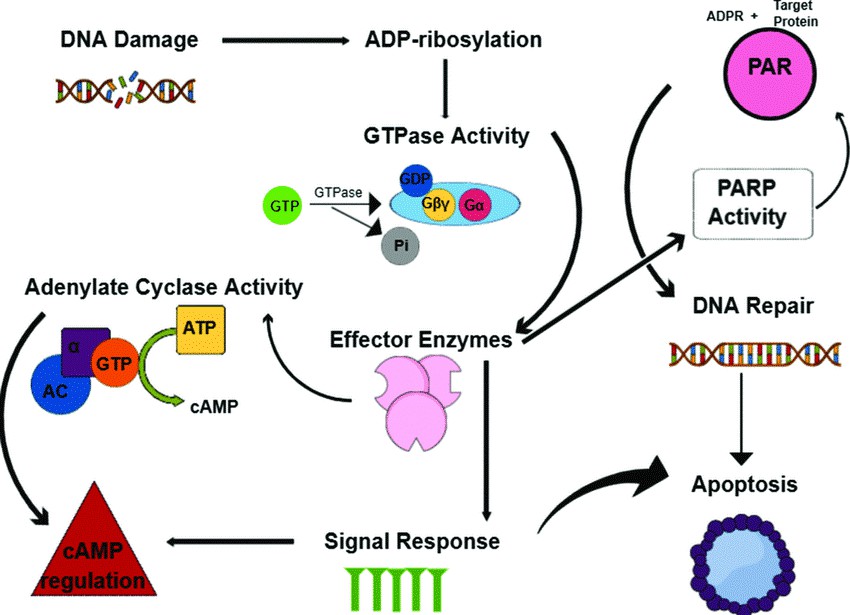 Figure 2. Role of ADP-ribosylation in signal transduction and metabolism.
(Source: Chutshela, A. et al., 2021)
ADP-ribosylation has significant clinical implications and is involved in various physiological and pathological processes. Dysregulation of ADP-ribosylation has been observed in various types of cancer. Alterations in the activity or expression of enzymes involved in ADP-ribosylation, such as PARPs, can impact DNA repair processes, genomic stability, and cell survival. Mutations in PARP genes, for example, can lead to defects in DNA repair mechanisms, rendering cancer cells more susceptible to DNA damage and potential therapeutic interventions.
Given its involvement in various disease processes, ADP-ribosylation has emerged as a promising therapeutic target. Inhibition of specific ADP-ribosyltransferases or modulation of poly(ADP-ribose) levels using PARP inhibitors has shown therapeutic potential in cancer treatment, particularly in combination with DNA-damaging agents. Additionally, targeting ADP-ribosylation pathways may hold promise for the treatment of neurodegenerative diseases, inflammation-related disorders, and infectious diseases.
References
For research use only, not for use in diagnostic procedures.
| Target | Cat. No. | Product Name | Expression System | Tag/Conjugate | Application | |
| CHD2 | DAG-P0350 | Human CHD2 peptide | N/A | Unconjugated | ELISA | Inquiry |
| D-aspartate | DAG3273 | D-Aspartate [BSA] | N/A | BSA | N/A | Inquiry |
| D-Glutamate | DAG3297 | D-Glutamate [BSA] | N/A | BSA | IHC, ICC | Inquiry |
| D-Tyrosine | DAG3305 | D-Tyrosine [BSA] | N/A | BSA | IHC, ICC | Inquiry |
| L-Arginine | DAGS074 | L-Arginine standard | N/A | N/A | ELISA | Inquiry |
| DAG3361 | L-Arginine [G-BSA] | N/A | BSA | IHC, ICC | Inquiry | |
| L-Aspartate | DAGA-963 | Human aspartate aminotransferase (>95%) | Human heart tissue | Unconjugated | Controls, Calibrators | Inquiry |
| DAG3274 | L-Aspartate [G-BSA] | N/A | G-BSA | N/A | Inquiry | |
| L-Glutamate | DAG3311 | L-Glutamate [G-BSA] | N/A | BSA | IHC, ICC | Inquiry |
| DAG3648 | L-glutamate [G-Pc] | N/A | G-Pc | N/A | Inquiry | |
| Low molecular weight protein-tyrosine-phosphatase Ptp | DAGA-3391 | Recombinant Low molecular weight protein-tyrosine-phosphatase ptp [His], E. coli | E. coli | His | N/A | Inquiry |
| DAGA-3392 | Recombinant Low molecular weight protein-tyrosine-phosphatase ptp [His], Baculovirus | Baculovirus | His | N/A | Inquiry | |
| DAGA-3393 | Recombinant Low molecular weight protein-tyrosine-phosphatase ptp [His] | Mammalian cell | His | N/A | Inquiry | |
| mono methyl Arginine | DAG3642 | L-Arginine [BSA] | N/A | BSA | N/A | Inquiry |
| NO2-Tyrosine | DAG3372 | NO2-Tyrosine [G-BSA] | N/A | G-BSA | IHC, ICC | Inquiry |
| PARP1 | DAG-P1766 | Human PARP1 peptide | N/A | Unconjugated | ELISA | Inquiry |
| PARP12 | CDBP2199 | Human PARP12 blocking peptide | N/A | Unconjugated | Apuri, BL, ELISA | Inquiry |
| PARP2 | CDBP2200 | Human PARP2 blocking peptide | N/A | Unconjugated | Apuri, BL, ELISA | Inquiry |
| PARP3 | CDBP2201 | Human PARP3 blocking peptide | N/A | Unconjugated | Apuri, BL, ELISA | Inquiry |
| PARP4 | CDBP2202 | Human PARP4 blocking peptide | N/A | Unconjugated | Apuri, BL, ELISA | Inquiry |
| S. faecalis Tyrosine Decarboxylase | DAG1873 | Recombinant S. faecalis Tyrosine Decarboxylase | S. faecalis | Unconjugated | N/A | Inquiry |
| DAG1874 | Recombinant S. faecalis Tyrosine Decarboxylase | S. faecalis | Unconjugated | N/A | Inquiry | |
| Tyrosine | DAG3418 | L-Tyrosine [G-BSA] | N/A | G-BSA | N/A | Inquiry |
| tyrosine hydroxylase | DAG-P2033 | Human TH peptide | N/A | Unconjugated | ELISA | Inquiry |
| CDBP3110 | Human TH blocking peptide | N/A | Unconjugated | Apuri, BL, ELISA | Inquiry | |
| Tyrosine-protein kinase ptk | DAGA-3390 | Recombinant Tyrosine-protein kinase ptk [His] | Yeast | His | N/A | Inquiry |
| Target | Cat. No. | Product Name | Size | Species Reactivity | Application | Detection Sample | |
| mono methyl Arginine | DEIA10208 | L-Arginine ELISA Kit | 96T | Human | Quantitative | EDTA-plasma | Inquiry |
| Homoarginine | DEIABL437 | Homoarginine ELISA Kit | 96T | Quantitative | Plasma, Serum, Cell Culture Samples | Inquiry | |
| PARP | DEIA-BJ2224 | Rat Poly-ADP-ribose polymerase ELISA Kit | 96T | Quantitative | Serum, plasma, cell culture supernatants, body fluid and tissue homogenate | Inquiry | |
| PARP1 | DEIA-FN1081 | Human PARP1 (Poly [ADP-ribose] polymerase 1) ELISA Kit | 96T | Quantitative | serum, plasma, cell culture supernatants, tissue homogenate | Inquiry | |
| PARP1 | DEIA-FN1082 | Rat Parp1 (Poly [ADP-ribose] polymerase 1) ELISA Kit | 96T | Quantitative | serum, plasma, cell culture supernatants, tissue homogenate | Inquiry | |
| PARP2 | DEIA-FN1083 | Human PARP2 (Poly [ADP-ribose] polymerase 2) ELISA Kit | 96T | Quantitative | serum, plasma, cell culture supernatants, tissue homogenate | Inquiry | |
| PARP4 | DEIA-FN1084 | Human PARP4 (Poly ADP Ribose Polymerase 4) ELISA Kit | 96T | Quantitative | serum, plasma, cell culture supernatants, tissue homogenate | Inquiry | |
| Tyrosine | DEIANS071 | Nitrotyrosine ELISA Kit | 96T | N/A | Quantitative | cell lysates, serum, plasma and purified proteins | Inquiry |
| DEIA3981 | Nitrotyrosine ELISA Kit | 96T | Human | Quantitative | Cell Lysate, Other biological fluids, Plasma, Serum, Urine | Inquiry | |
| DEIA087J | Nitrotyrosine ELISA Kit | 96T | Human | Quantitative | EDTA plasma, serum | Inquiry | |
| DEIA088J | Nitrotyrosine ELISA Kit | 96T | Human | Quantitative | stool, serum, EDTA plasma | Inquiry | |
| DEIA100J | Tyrosine ELISA Kit | 96T | Human | Quantitative | EDTA plasma, serum | Inquiry | |
| DEIA-PYR064 | Tyrosine Colorimetric Assay Kit | 100T | Quantitative | serum, plasma, urine, other body fluids | Inquiry |
Loading ......
