
Inquiry Basket
 Loading ......
Hybridoma technology is the classical technique used to produce monoclonal antibodies. The process includes the fusion of myeloma cells with B cells from immunized mice, the screening of antigen specific antibody-secreting hybridoma cells and obtaining monoclonal antibodies by production and purification.
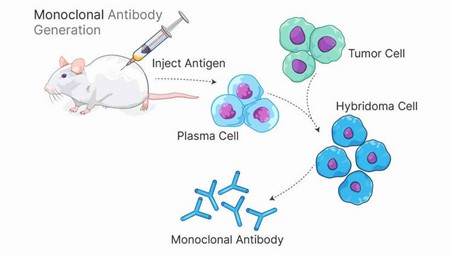
Creative Diagnostics provides mouse and rat hybridoma development services including customized antigen design, animal immunization, clone screening and antibody identification to produce high-quality monoclonal antibodies that align with the client's final application requirements and meet the clients' different needs.
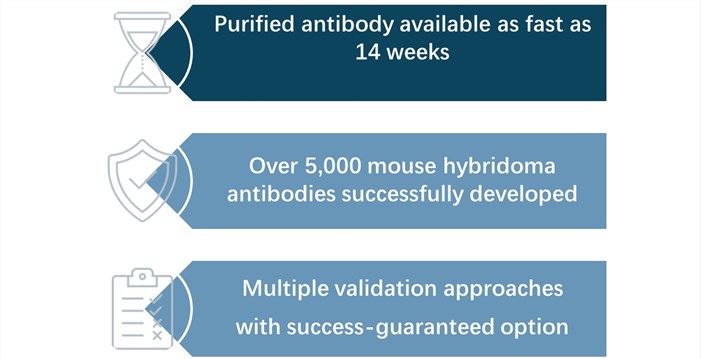

We purify native antigens and produce both recombinant proteins, VLP-Displayed antigens, synthetic peptides and small molecule conjugates in-house. That means we have complete control over their design and QC.
Our services include DNA synthesis plasmid construction, protein expression, peptide design, peptide synthesis and cross-linking peptides onto carrier proteins, hapten design and synthesis .
Creative Diagnostics offers a quick and professional hybridoma antibody sequencing service. We can not only quickly obtain cDNA encoding the variable heavy (VH) and variable light (VL) domains of your hybridoma cell line but can also use mature codon optimization and gene synthesis strategies to express and purify antibodies for customers.
There are many human cytokeratin genes and corresponding proteins, and they have very similar sequences of amino acids, which greatly increases the difficulty of developing and screening high specific cytokeratin antibodies. We designed an effective antigen preparation and antibody screening program. After a series of cross-screening and verification, a full range of cytokeratin antibodies with high sensitivity and specificity were obtained.
Application: IHC

Target: KRT8
Sample: Small intestine tissue
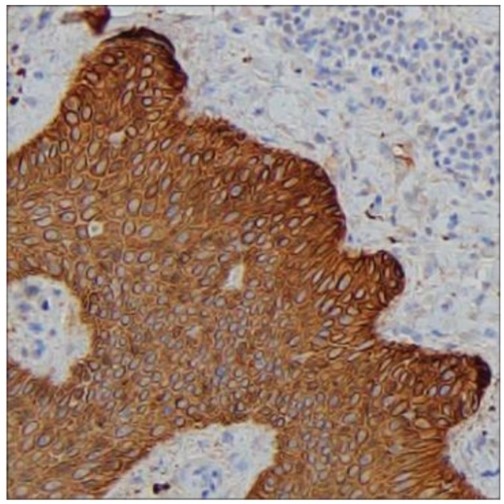
Target: KRT10
Sample: Skin tissue

Target: KRT20
Sample: Colon tissue
Application: ELISA
Data for expanded cultured (24 wells plate) hybridoma supernatants sensitivity test
| Cell/Ab No. | 101 | 201 | 301 | 401 | 501 | |||||
| Clone No. | 1H1-F10 | 1H4-H3 | 1E8-F5 | 1F11-H8 | 2E9-G12 | |||||
| Supernatants Dilution 1:x x= | Standard Concentration (ppb, ng/ml) | |||||||||
| 0 | 8ppb | 0 | 8ppb | 0 | 8ppb | 0 | 8ppb | 0 | 8ppb | |
| 1 | NoCalc | NoCalc | NoCalc | NoCalc | NoCalc | 3.8474 | NoCalc | NoCalc | 3.7359 | 2.6483 |
| 3 | NoCalc | NoCalc | NoCalc | NoCalc | 3.4408 | 1.8196 | NoCalc | NoCalc | 2.2892 | 1.0601 |
| 9 | NoCalc | NoCalc | NoCalc | 2.9592 | 1.9583 | 0.82 | NoCalc | 3.9104 | 0.9706 | 0.437 |
| 27 | NoCalc | NoCalc | 3 | 1.4829 | 0.8721 | 0.3482 | 3.9119 | 2.5334 | 0.4104 | 0.1662 |
| 81 | 3.9171 | 2.4139 | 1.6303 | 0.721 | 0.368 | 0.1924 | 2.4698 | 1.3494 | 0.1879 | 0.0947 |
| 243 | 2.1189 | 1.1031 | 0.6526 | 0.3074 | 0.1741 | 0.1021 | 1.2055 | 0.5943 | 0.0915 | 0.0577 |
| 729 | 1.0125 | 0.4634 | 0.292 | 0.4511 | 0.0888 | 0.0664 | 0.4936 | 0.2387 | 0.0642 | 0.0586 |
| NC | 0.0339 | 0.0296 | 0.0315 | 0.0247 | 0.0311 | 0.0503 | 0.0413 | 0.026 | 0.0414 | 0.0341 |
Loading ......
