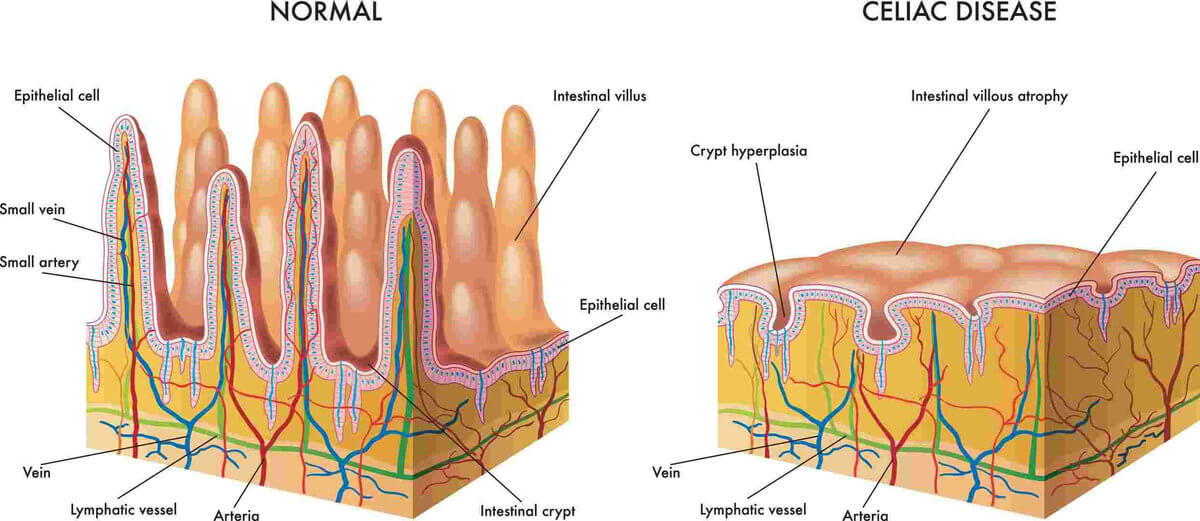
Celiac disease manifests as a severe autoimmune disorder in those who have genetic susceptibility because gluten from wheat, rye, and barley damages their small intestine. Out of all people worldwide 1% have celiac disease yet only 30% receive an accurate diagnosis. Celiac disease patients experience an immune reaction to gluten which attacks and eliminates the nutrient-absorbing villi in their small intestine. Harm to the villi creates problems with nutrient absorption which leads to additional health complications.
People with celiac disease exhibit a broad range of symptoms that commonly include diarrhea along with abdominal pain and weight loss as well as fatigue. Patients may not show clear gastrointestinal symptoms yet develop nutrient absorption problems that result in anemia and osteoporosis along with skin conditions. Celiac disease is genetically influenced and frequently occurs in people who have relatives with the condition.
Celiac Disease Testing and Analysis Services
We offer comprehensive testing and analysis services for celiac disease-related antigens, covering the following key testing items:
Anti-Gliadin Antibodies Gliadin functions as a gluten component while also serving as a prevalent antigen detectable in the bloodstream of individuals who have celiac disease. Anti-gliadin antibody testing can detect immune responses that occur when gluten is ingested. Research shows that IgA and IgG anti-gliadin antibodies demonstrate high diagnostic accuracy for celiac disease through excellent sensitivity and specificity.
Tissue Transglutaminase Antibodies (tTG) The primary autoantigen associated with celiac disease is tTG which exists mainly in the small intestine. The anti-tTG IgA antibody test reaches a high sensitivity level of about 88% and specificity rate of 97%, establishing it as the primary method for celiac disease screening. This test serves as an effective tool for monitoring patient compliance with a gluten-free diet.
Anti-F-Actin Antibodies F-actin is an essential component of the cytoskeleton, and abnormalities may be associated with celiac disease. Anti-F-actin antibody testing supports evaluations of cellular functions and inflammatory processes that enhance understanding of disease mechanisms.
Recombinant Human Tissue Transglutaminase Antibodies (Rh-tTG) Rh-tTG targets recombinant human tissue transglutaminase and offers higher sensitivity and specificity. This test can effectively evaluate disease status even after patients adhere to a gluten-free diet.
Diagnostic Technology Platform
Core Technology: ELISA
Our testing platform relies on ELISA which focuses on quantitative analysis of recombinant human tissue transglutaminase antibodies (Rh-tTG) and deamidated gliadin peptide antibodies (DGP). Key advantages include:
Target-Specific Accuracy: Genetically engineered Rh-tTG antigens enable the reliable differentiation between celiac disease and other gluten-related disorders while removing cross-reactivity.
Dynamic Monitoring Capability: The system monitors changes in antibody titers over time to quantitatively evaluate gluten-free diet compliance (e.g., significant therapeutic success is indicated by more than a 50% reduction in DGP-IgA after treatment).
End-to-End Standardization: Integrates automated liquid handling systems with AI-driven interpretation, ensuring full-process quality control and an intra-assay coefficient of variation<5%.
Complementary Diagnostic Technologies
To enhance diagnostic precision for complex cases, we offer synergistic testing approaches:
Indirect Immunofluorescence
S Screening for anti-F-actin antibodies exposes "reticular" fluorescence patterns which show intestinal epithelial damage and achieves 85% sensitivity.
Protein Microarray
The Protein Microarray test evaluates over 15 biomarkers such as Gliadin, Rh-tTG, and HLA-DQ2/DQ8 to identify patients with unusual symptoms or negative antibody tests.
Enzyme-Linked Immunospot
The test identifies gluten-specific T-cell reactions which helps diagnose seronegative patients who exhibit active immune activation at early stages.
Western Blot
Confirms gliadin antibody specificity, ruling out interference from food allergies or overlapping autoimmune conditions.
Service Process
Sample Collection: Clients are required to provide blood or other biological samples. We recommend using fresh or properly frozen samples to ensure accurate test results.
Sample Processing: Our laboratory will standardize sample processing to prepare for various tests.
Testing Execution: Select appropriate testing methods based on client needs for systematic analysis.
Result Interpretation: Professional team members will analyze test outcomes and compile comprehensive reports.
Follow-Up Consultation: We provide follow-up consultation services to help clients understand their results and determine next steps when necessary.
The report generation process normally requires 5 to 10 business days after sample reception although this timeline can change depending on the number of samples and the testing techniques applied.
Sample Requirements
Following the specified sample requirements will help achieve optimal testing results.
Medical professionals must obtain blood samples in sterile environments and ensure immediate transport to the lab.
Patient details and collection dates must be clearly marked on each sample.
Customized Services
We recognize that each client's needs may differ; therefore, we offer personalized services. Whether it involves specific test combinations or special sample processing requirements, we can adjust according to client requests.
Through our professional testing analysis services, you will receive high-quality and reliable test results related to celiac disease, helping you manage your health more effectively.

 Loading ......