
 AAV Titration ELISA
Inquiry Basket
 Loading ......
Adeno-associated virus (AAV) is a single-stranded DNA virus. AAV gene vectors are regarded as safe because of their good safety, wide range of host cells (dividing and non-dividing cells), low immunogenicity, and long expression of foreign genes in the body. It is one of the most promising gene transfer vectors and has been widely used in gene therapy and vaccine research around the world.
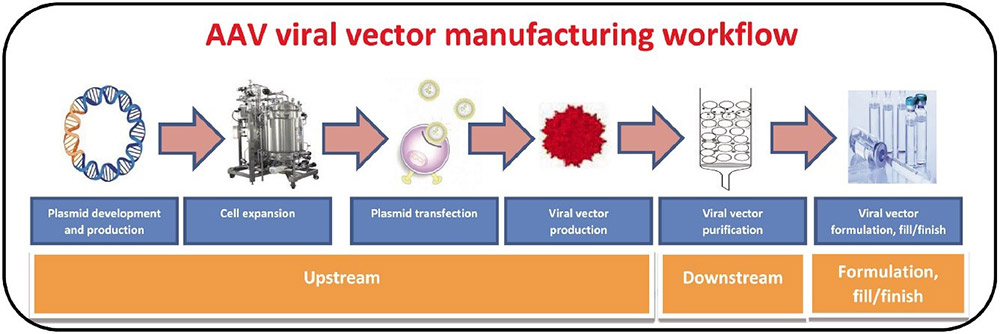 Figure 1. AAV viral vector manufacturing process workflow. (Srivastava A, et al.; 2021)
Adenovirus was first discovered in a laboratory in 1960 and has since been detected in human tissue. Adenovirus does not damage human tissue. Its life cycle is related to that of cooperating viruses. It replicates and assembles with the cooperation of adenovirus (Ad), herpes simplex virus (HSV) or human papilloma virus (HPV) to produce virus particles. Because the recombinant exosome DNA does not integrate into the host genome, it eventually becomes diluted over time as the cell undergoes repeated replication. These properties make rAAV ideal for certain gene therapy applications.
The production process of AVV is similar to the production of antibodies and vaccine drugs, mainly including upstream culture, downstream purification and formulation.
Producing high-titer viruses is the primary focus during the research and development process, while commercial production requires: product quality first, replicability, and amplification.
Generally, upstream includes the following processes:
Large amounts of cell culture are required to produce genes, and transient transfection is a popular method but is often more difficult to scale up. To make this process commercially viable to maximize productivity and reduce further scale-up and relative plasmid consumption are the main objectives. Scientists can turn to other systems such as helper virus-mediated transfection or insect cell platforms.
The second half of the virus production process requires purification of viral particles from process- and product-related impurities. These downstream processing steps can account for a large portion of the total cost of virus production, so it is important to efficiently produce high-purity virus. General downstream operations mainly include:
Cell Lysis
The basic mechanical technique for releasing AAV vectors from cells is repeated freezing/thawing followed by low-speed centrifugation steps. However, this technique is difficult to scale up for production. Mechanical homogenization, such as French press, is another lysis method in which cell membranes are ruptured under high-pressure shear forces. Although this method is scalable, it often results in product loss due to aggregation and precipitation caused by shear stress. Chemical cleavage methods, such as Triton X-100, have higher overall yields in the viral vector purification process and are easy to scale up. But it also has its limitations. Studies have shown that Triton X-100 causes some acute oral toxicity, eye damage, skin irritation and chronic aquatic toxicity. Therefore, this detergent was listed as a substance of very high concern by the European Chemicals Agency in 2016.
Filter
Filtration is the most expensive unit operation in AAV downstream processing. During the filtration process, AAV particles can aggregate or lose function due to shear stress. Optimizing filtration to achieve high-throughput recovery of adenovirus remains a challenge as it also depends on the AAV serotype being processed. Currently, continuous filtration as a separation technology may reduce filter clogging, but the industry has not yet implemented this technology. In addition, large hold-up volumes and product losses during the filtration process are also a problem.
Purification
Typical purification methods include affinity chromatography and ion exchange chromatography (IEC). Although affinity chromatography is capable of producing highly pure AAV, it cannot differentiate between empty and intact viral capsids. One of the biggest challenges in downstream purification is meeting the purification methods specific to each AAV serotype to achieve optimal yields while maintaining product potency and integrity.
Goals for formulation of AAV vectors include maintaining vector stability and activity during storage shelf life and achieving optimal target tissue transduction in vivo. The preparation process mainly includes:
Formulation development work includes identifying buffers and pH values for maximum stability and then screening excipients for optimal stability and effectiveness. These studies include forced degradation experiments. Typical forced degradation experiments: accelerated temperature, freeze-thaw, light, low and high pH, shear stress, forced oxidation and deamidation.
Comprehensive introduction to the three process stages of AVV preparation, it can be seen that downstream processing can account for a large part of the total cost of virus production, and it is also very difficult, especially the purification process.
One reason is that there are differences in the AAV proteins of different serotypes, as there are more than 100 different variant AAV capsids. Therefore, the surface characteristics of various serotypes make AAV purification difficult.
The second reason is the lack of an efficient and reproducible platform method for process- and product-related impurities (including host cell material, DNA, and empty capsids), especially to isolate intact capsids from empty capsids.
Therefore, in order to solve the above problems, pharmaceutical companies are committed to the development of new purification products in order to achieve:
Anti-AAV Antibody ELISA Kit
AAV Antibodies and Titration ELISA
Reference
| Target | Cat. No. | Product Name | Size | Species Reactivity | Application | Detection Sample | |
| AAV1 | DEIASL342 | AAV9 Titration ELISA Kit | 96T | Qualitative | serum, plasma | Inquiry | |
| AAV2 | DEIASL347 | AAV6 Titration ELISA Kit | 96T | Human | Qualitative | Serum | Inquiry |
| DEIASL347M | Mouse Anti-AAV8 ELISA Kit(Quantitative) | 96T | Mouse | Qualitative | Serum | Inquiry | |
| AAV5 | DEIASL343 | AAV8 Titration ELISA Kit | 96T | Qualitative | serum, plasma | Inquiry | |
| AAV6 | DEIAAV6 | Anti-AAV2 antibody ELISA Kit | 96T | N/A | Quantitative | cell culture supernatants, purified virus preparations | Inquiry |
| DEIASL344 | Anti-AAV9 antibody ELISA Kit | 96T | Human | Qualitative | Serum | Inquiry | |
| DEIASL344M | Anti-AAV1 Antibody ELISA Kit | 96T | Mouse | Qualitative | Serum | Inquiry | |
| AAV8 | DEIASL345MQ | Anti-AAV5 Antibody ELISA Kit | 96T | Mouse | Quantitative | Serum | Inquiry |
| DEIAAV8 | Anti-AAV6 ELISA Kit | 96T | N/A | Quantitative | cell culture supernatants, purified virus preparations | Inquiry | |
| DEIASL345 | Anti-AAV8 antibody ELISA Kit | 96T | Human | Qualitative | Serum | Inquiry | |
| DEIASL345M | Mouse Anti-AAV9 antibody ELISA Kit | 96T | Mouse | Qualitative | Serum | Inquiry | |
| AAV9 | DEIAAV9 | Mouse Anti-AAV2 antibody ELISA Kit | 96T | N/A | Quantitative | cell culture supernatants, purified virus preparations | Inquiry |
| DEIASL348 | Mouse Anti-AAV6 antibody ELISA Kit | 96T | Human | Qualitative | Serum | Inquiry | |
| DEIASL348M | Mouse Anti-AAV8 antibody ELISA Kit | 96T | Mouse | Qualitative | Serum | Inquiry |
Loading ......
