
 AAV Titration ELISA
Inquiry Basket
 Loading ......
Adeno-associated virus (AAV) has emerged as a pivotal delivery tool in clinical gene therapy owing to its minimal pathogenicity and ability to establish long-term gene expression in different tissues. Researchers have used AAV-based vectors in pre-clinical research and in clinical trials in which AAV-based vectors have demonstrated a good safety profile. AAVs have also demonstrated lasting therapeutic gene expression following a single treatment in preclinical and clinical studies.
Gene therapy represents a groundbreaking approach for addressing genetic diseases, employing a range of strategies to modify gene expression within target cells using non-viral or viral vehicles. One common strategy is gene replacement therapy, where a functional copy of the faulty gene is introduced to living cells. Another strategy is genome editing, which can be facilitated by clustered regularly interspaced short palindromic repeats (CRISPR)-based technologies to allow direct modifications of the somatic genome. Irrespective of the chosen strategy, gene therapy can be implemented either ex vivo or in vivo.
Adeno-associated virus (AAV) vectors have emerged as the preferred choice in clinical trials and FDA-approved applications. This is because of their broad tissue tropism, relatively good safety profile, and versatile manufacturing processes. Importantly, AAV is non-pathogenic, rarely integrates into the host genome, and can sustain long-term transgene expression. Moreover, vectors based on some AAV serotypes are inherently capable of efficient cellular entry and transgene expression, which enhances transduction efficacy.
AAV is used in a growing number of FDA applications and clinical trials worldwide. Due to the viral origin of AAV, the capsids can induce cellular and humoral immune responses that trigger neutralization of the vector with anti-AAV antibodies, which prevents transduction in patients. Over 90 percent of humans have preexisting binding antibodies to some AAV serotypes. Some of these antibodies are neutralizing and may cause loss of efficacy even on the first dose. Therefore, there is a critical need to improve our understanding of risks of AAV immunogenicity and to develop technologies for evaluating and mitigating this response.
Methods to detect pre-existing AAV immunity include cell-based in vitro TI assays, in vivo (for example, mice) TI assays, and enzyme-linked immunosorbent assay (ELISA)-based detection of total anti-capsid antibody (TAb) assays. The TAb assay may be able to detect low potency NAb that are below the threshold of TI assays, but it may not detect non-antibody neutralizing factors.
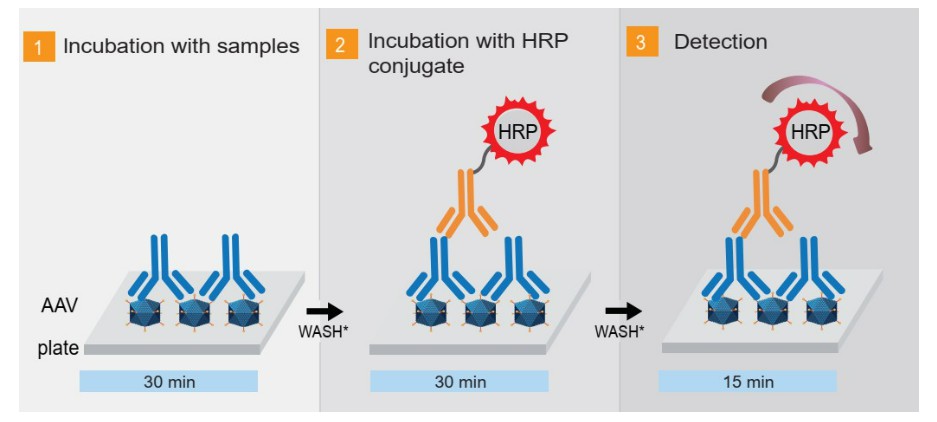
Creative Diagnostics developed a portfolio of anti-AAV antibody ELISA kits for the most commonly used AAV serotypes. The standardized assay developed to screen for AAV seropositivity was shown to be an essential tool in screening patients for pre-existing antibodies to minimize safety concerns and improve therapeutic efficacy with AAV-based gene therapies.
Non-scaled Venn diagram depicting the relationship between total (tAb) and specific confirmed total antibodies in samples. The results are highly consistent, indicating that ELISA has high accuracy in detecting AAV antibodies.
Anti-AAV8 antibody ELISA Kit (DEIASL345):

Anti-AAV9 antibody ELISA Kit (DEIASL348):

Anti-AAV8 antibody ELISA Kit (DEIASL345):

Anti-AAV9 antibody ELISA Kit (DEIASL348):

Anti-AAV8 antibody ELISA Kit (DEIASL345): The levels of the anti-aav8 antibodies (IgG) were analysed with this ELISA in a panel of 83 healthy blood donors. With a cut-off of 1 U, 30% of the blood donors were anti-aav8 positive (IgG) which reflects the known percentage of infections in the general population.

Anti-AAV9 antibody ELISA Kit (DEIASL348): The levels of the anti-aav9 antibodies (IgG) were analysed with this ELISA in a panel of 118 healthy blood donors. With a cut-off of 1 U, 35.6% of the blood donors were anti-aav9 positive (IgG) which reflects the known percentage of infections in the general population.

| Species | Cat. No. | Product Name | Application | Sample | |
| Universal | DEIA589 | AAV2 Titration ELISA Kit | Quantitative | Cell culture supernatants and purified virus preparations | Inquiry |
| DEIAAV5 | AAV5 Titration ELISA Kit | Quantitative | Cell culture supernatants and purified virus preparations | Inquiry | |
| DEIAAV6 | AAV6 Titration ELISA Kit | Quantitative | Cell culture supernatants and purified virus preparations | Inquiry | |
| DEIAAV8 | AAV8 Titration ELISA Kit | Quantitative | Cell culture supernatants and purified virus preparations | Inquiry | |
| DEIAAV9 | AAV9 Titration ELISA Kit | Quantitative | Cell culture supernatants and purified virus preparations | Inquiry |
Loading ......
