
Inquiry Basket
 Loading ......
Tetanus, caused by the bacterium Clostridium tetani, poses a significant threat to individuals worldwide. To combat this formidable foe, the tetanus vaccine, also known as the tetanus toxoid, has emerged as a key preventive measure. This vaccine plays a vital role in protecting individuals from the effects of the tetanus neurotoxin, tetanospasmin, produced by the bacteria.
Browse all Tetanus Toxoid products
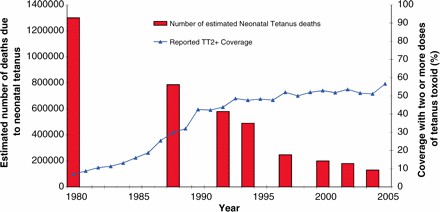 Figure 1. Global and national progress towards maternal and neonatal tetanus elimination.
(Source: Blencowe, H. et al., 2010)
Tetanus, also known as lockjaw, is a serious bacterial infection caused by the bacterium Clostridium tetani. The bacterium produces a powerful neurotoxin called tetanospasmin, which affects the nervous system, leading to muscle stiffness and spasms. Tetanus is characterized by painful muscle contractions, particularly in the jaw and neck muscles, which can make it difficult to open the mouth or swallow. The spasms can also affect other muscles in the body, including the chest and back muscles, leading to breathing difficulties.
Transmission of tetanus occurs through the introduction of Clostridium tetani spores into the body, typically through deep puncture wounds, cuts, or burns. The spores are commonly found in soil, dust, and animal feces, and they can enter the body when these contaminated substances come into contact with open wounds. Tetanus is not contagious and cannot be transmitted from person to person. The severity of tetanus depends on various factors, such as the amount of toxin produced, the site of the infection, and the individual's immune response.
The tetanus vaccine is a highly effective preventive measure against tetanus infections. It consists of inactivated tetanus toxin, also known as tetanus toxoid. The toxoid is produced by growing the C. tetani bacterium in a laboratory and then inactivating the toxin to render it non-toxic while still maintaining its immunogenic properties. The toxic strains are grown in liquid media, purified, and then treated with formaldehyde to remove their pathogenic properties. After purification and sterilization, the tetanus toxoid is combined with aluminum or calcium salts. This toxoid antigen is commonly used in combination with diphtheria and pertussis antigens to create a comprehensive vaccine formulation.
Vaccinations work by activating our immune system. When the tetanus toxoid is administered, it stimulates the immune response. This involves the activation of specific cells called TH2 and B cells. These cells produce immunoglobulins, which are antibodies that target the toxoid and provide protection against future tetanus infections. Multiple doses of the vaccine are needed to ensure a strong immune response.
There are four main types of vaccines used to protect against tetanus, diphtheria, or both diseases. These vaccines include:
The primary objective of tetanus vaccination is to confer immunity against the devastating effects of tetanus infection. The World Health Organization (WHO) recommends the administration of the primary series of tetanus vaccinations during adolescence. This series ensures comprehensive protection against the gram-positive bacillus, Clostridium tetani, and its neurotoxin, tetanospasmin. Additionally, children are advised to complete the 5-dose DTaP vaccination series before the age of 7, as per the CDC's guidelines. Further, adults should receive boosters with Tdap every ten years to maintain optimal immunity.
Reference
| Target | Cat. No. | Product Name | Expression System | Tag/Conjugate | Application | |
| C. tetani | DAG-WT234 | Native C. tetani Tetanus Toxin Antigen | N/A | Unconjugated | N/A | Inquiry |
| DAG-WT1006 | Recombinant Clostridium tetani Tetanus toxin [His, Avi] | E. coli | His, Avi | Immunoassays | Inquiry | |
| DAGC698 | Native C. tetani Antigen | N/A | Unconjugated | Immunogen, WB, ELISA | Inquiry | |
| DAGB112 | C. tetani Toxin Light Chain | E. coli | Unconjugated | ELISA | Inquiry | |
| DAGB113 | C. tetani Tetanus Toxin (C-Fragment) [FITC] | C. tetani | FITC | HA | Inquiry | |
| DAG4063 | Recombinant C. tetani Toxin C-Fragment | P. fluorescens | Unconjugated | N/A | Inquiry | |
| DAG2636 | Recombinant C. tetani TeNT Light Chain [His] | E. coli | His | N/A | Inquiry | |
| DAG2692 | Native C. tetani Tetanus Toxoid Antigen | C. tetani | N/A | Immunoassays | Inquiry | |
| C. tetani Tetanus Toxoid | DAGA-115 | Clostridium tetani Tetanus Toxoid | C. tetani | Unconjugated | N/A | Inquiry |
| C. diphtheriae | DAGC697 | Native C. diphtheriae Antigen | N/A | Unconjugated | Immunogen, WB, ELISA | Inquiry |
| C. diphtheriae Diphtheria Toxoid | DAG2689 | C. diphtheriae Diphtheria Toxoid | N/A | Unconjugated | ELISA | Inquiry |
| C. diphtheriae toxin | DAGH042 | C. diphtheriae toxin | N/A | Unconjugated | N/A | Inquiry |
| DAG4060 | Recombinant C. diphtheriae Toxin (mutation CRM197) | P. fluorescens | Unconjugated | N/A | Inquiry |
| Target | Cat. No. | Product Name | Size | Species Reactivity | Application | Detection Sample | |
| Tetanus Toxoid | DEIA378 | Human Tetanus Toxoid IgG ELISA Kit | 96T | Human | Quantitative | Serum, plasma | Inquiry |
| DEIASL075 | Rat Tetanus Toxoid IgG ELISA Kit | 96T | Quantitative | serum, plasma | Inquiry | ||
| DEIASL076 | Rat Tetanus Toxoid IgM ELISA Kit | 96T | Quantitative | serum, plasma | Inquiry | ||
| DEIASL077 | Monkey Tetanus Toxoid IgG1 ELISA Kit | 96T | Quantitative | serum, plasma | Inquiry | ||
| DEIASL078 | Monkey Tetanus Toxoid IgM ELISA Kit | 96T | Quantitative | serum, plasma | Inquiry | ||
| DEIA2568 | Human Anti-Tetanus Toxoid ELISA Kit | 96T | Human | Quantitative | Serum, plasma | Inquiry | |
| DEIA600 | Tetanospasmin ELISA Kit | 96T | Human | Quantitative | serum, plasma | Inquiry | |
| C. tetani | DEIA05565 | Clostridium tetani IgG - ELISA Kit | 96T | Human | Quantitative | serum, citrate plasma | Inquiry |
| DEIASL264 | Mouse Anti-Tetanus Toxoid IgG ELISA Kit | 96T | Quantitative | Srerum | Inquiry | ||
| DEIASL273 | Rabbit Anti-Tetanus Toxoid IgG ELISA Kit | 96T | Quantitative | Srerum | Inquiry | ||
| DEIA1794 | Tetanus toxin IgG ELISA Kit | 96T | Qualitative | serum | Inquiry | ||
| Diphtheriae | DEIA05524 | Corynebacterium diphtheriae IgG - ELISA Kit | 96T | Human | Quantitative | serum, citrate plasma | Inquiry |
| Diphtheria Toxoid | DEIASL262 | Mouse Anti-Diptheria Toxoid IgG ELISA Kit | 96T | Quantitative | Srerum | Inquiry | |
| DEIASL270 | Rabbit Anti-Diptheria Toxoid IgG ELISA Kit | 96T | Quantitative | Srerum | Inquiry | ||
| DEIAJX005 | Human Anti-Diphtheria Toxin/Toxoid (DTX) IgA ELISA kit | 96T | Quantitative | Serum and other biological fluids | Inquiry | ||
| DEIAJX002 | VacciGel Diphtheria Toxoid ELISA Kit | 96T | Quantitative | Vaccine formulated in Alum | Inquiry | ||
| DEIAJX003 | Monkey Anti-Diphtheria Toxin/Toxoid (CRM197) IgG ELISA kit | 96T | Quantitative | Serum or plasma samples | Inquiry | ||
| Diphtheria toxoid | DEIA328 | Diphtheria Toxoid IgG ELISA Kit | 96T | Human | Quantitative | Serum or plasma | Inquiry |
| Diphtheria toxin | DEIA1776 | Human Anti-Diphtheria Toxoid IgG ELISA Kit | 96T | Human | Quantitative | Serum or plasma | Inquiry |
Loading ......
