
Inquiry Basket
 Loading ......
Type 2 diabetes is a chronic metabolic disorder characterized by elevated blood sugar levels and impaired insulin function. Over the years, researchers and pharmaceutical companies have been striving to develop innovative therapies that effectively manage the condition and improve patients' quality of life. One such breakthrough in diabetes treatment is Exendin-4, a remarkable peptide with potent glucose-lowering effects. This remarkable peptide was originally isolated from the saliva of the Gila monster lizard (Heloderma suspectum). It has proven to be a potent agonist of the glucagon-like peptide-1 receptor (GLP-1R) and activates various signaling pathways involved in multiple biological activities, such as cell apoptosis, insulin secretion, and microglial cell inactivation.
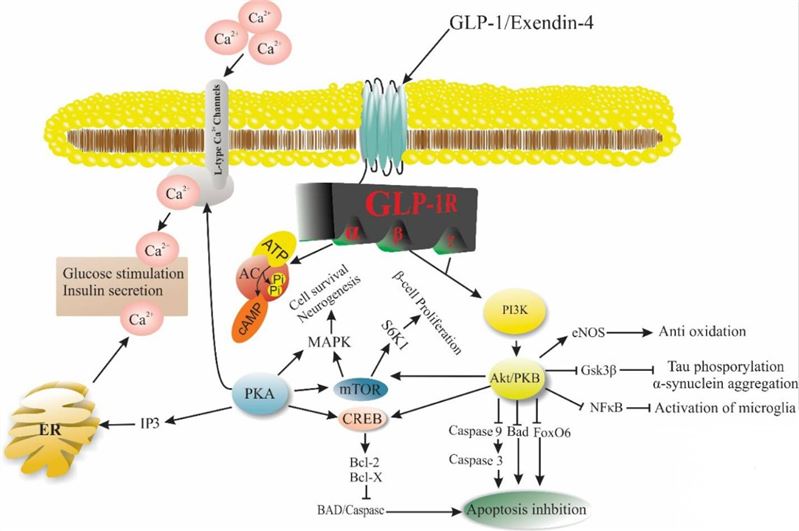 Figure 1. Exendin-4, a GLP-1R agonist plays a vibrant role in various biological activities such as apoptosis, Beta-cells proliferation, and glucose through different signaling pathways.
(Source: Rajabi, H. et al., 2022)
Exendin-4's mechanism of action revolves around its binding to the GLP-1R and subsequent activation of intracellular signaling pathways. Once administered, Exendin-4 exhibits high affinity and specificity for the GLP-1R, which is primarily located on pancreatic beta cells. Upon binding to the GLP-1R, Exendin-4 triggers a cascade of events that lead to improved glycemic control. One of the primary signaling pathways activated is the cyclic adenosine monophosphate (cAMP) pathway. Activation of this pathway ultimately results in increased intracellular cAMP levels, which play a crucial role in regulating glucose homeostasis.
By binding to GLP-1R, Exendin-4 stimulates insulin secretion from pancreatic beta cells. This effect occurs in a glucose-dependent manner, meaning that insulin release is enhanced when blood glucose levels are elevated. The amplification of the insulin response helps to maintain optimal glucose levels in the bloodstream. Furthermore, Exendin-4 inhibits the release of glucagon, a hormone that raises blood glucose levels. By suppressing glucagon secretion from pancreatic alpha cells, Exendin-4 reduces the production of glucose by the liver and prevents excessive glucose release into the bloodstream.
In addition, Exendin-4 influences gastric emptying and appetite regulation. It slows down the rate at which food moves through the stomach, leading to increased feelings of satiety and reduced food intake. This effect is especially beneficial for individuals with type 2 diabetes and obesity, as it can contribute to weight loss and improved metabolic parameters.
References
| Target | Cat. No. | Product Name | Expression System | Tag/Conjugate | Application | |
| GLP1R | DAG-P1598 | Human GLP1R blocking peptide | N/A | Unconjugated | BL | Inquiry |
| DAG-WT1513 | Recombinant Human GLP1R VLP | HEK293 cells | N/A | N/A | Inquiry | |
| MMP2 | DAG-P0301 | Human CASP9 peptide | N/A | Unconjugated | ELISA | Inquiry |
| CDBP0693 | Human CASP9 blocking peptide | N/A | Unconjugated | BL | Inquiry | |
| CDBP0694 | Human CASP9 blocking peptide | N/A | Unconjugated | BL | Inquiry | |
| CDBP5247 | CASP9 blocking peptide | N/A | Unconjugated | IB | Inquiry | |
| DAG-P1383 | CASP9 blocking peptide | N/A | Unconjugated | WB, BL | Inquiry | |
| DAG-P1794 | MMP2 peptide | N/A | Unconjugated | WB, ELISA | Inquiry | |
| BCL2 | CDBP5176 | BCL2 blocking peptide | N/A | Unconjugated | IB | Inquiry |
| CDBP5177 | BCL2 blocking peptide | N/A | Unconjugated | IB | Inquiry | |
| CDBP0579 | Human Bcl2 blocking peptide | N/A | Unconjugated | Apuri, BL, ELISA | Inquiry | |
| CDBP0580 | Human Bcl2 blocking peptide | N/A | Unconjugated | BL | Inquiry | |
| GSK3B | DAG-P0586 | Human GSK3B peptide | N/A | Unconjugated | ELISA | Inquiry |
| DAG-P1652 | GSK3B blocking peptide | N/A | Unconjugated | WB, BL | Inquiry | |
| DAG-KO110 | GSK3B Knockout Cell Lysate | WB | Inquiry |
| Target | Cat. No. | Product Name | Size | Species Reactivity | Application | Detection Sample | |
| GLP1R | DEIA-FN555 | Human GLP1R (Glucagon-like peptide 1 receptor) ELISA Kit | 96T | Quantitative | serum, plasma, cell culture supernatants, tissue homogenate | Inquiry | |
| DEIA-FN556 | Rat Glp1r (Glucagon-like peptide 1 receptor) ELISA Kit | 96T | Quantitative | serum, plasma, cell culture supernatants, tissue homogenate | Inquiry | ||
| DEIA-LL051 | Mouse Glp1r ELISA Kit | 96T | Mouse | Quantitative | Serum, plasma, tissue homogenates and other biological fluids | Inquiry | |
| Exendin-4 | DEIABL227 | Human Exendin-4 ELISA Kit | 96T | Human | Quantitative | Human serum or plasma | Inquiry |
| DEIA-XYZ77 | Rat Exendin-4 ELISA Kit | 96T | Rat | Quantitative | Serum, plasma | Inquiry | |
| DEIA10583 | Heloderma Suspectum Exendin-4 ELISA Kit | 96T | Quantitative | blood samples, plasma | Inquiry | ||
| DEIABL206 | Exendin-4 (Exenatide®) - ADA ELISA | 96T | Human | Quantitative | serum, plasma | Inquiry | |
| Insulin | DEIASL302 | Human Insulin ELISA Kit | 96T | Human | Quantitative | Plasma and serum | Inquiry |
| Glucagon | DEIA7396 | Glucagon ELISA Kit | 96T | Human, Mouse, Rat | Quantitative | serum, plasma | Inquiry |
| DEIA10609 | Human, Rat, Mouse GLP-1 (7-36)-Amide ELISA Kit | 96T | Human, Rat, Mouse | Quantitative | blood, plasma, tissues, CSF | Inquiry | |
| DEIA-XYZ84 | Glucagon (1-29) ELISA Kit | 96T | Quantitative | serum, plasma | Inquiry | ||
| DEIABL1 | Glucagon ELISA Kit | 96T | Human, rat, mouse | Quantitative | Serum, plasma, culture supernatants, cell lysates | Inquiry | |
| DEIA2827 | Human Glucagon ELISA Kit | 96T | Human | Quantitative | Serum, EDTA Plasma, and cell-culture medium | Inquiry | |
| DEIA2827R | Human Glucagon ELISA Kit | 96T | Human | Quantitative | Serum, plasma | Inquiry | |
| DEIABL230 | Glucagon ELISA Kit | 2 x 96T | Quantitative | biological matrices | Inquiry | ||
| DEIABL210 | Anti-Glucagon ELISA Kit | 2 x 96T | Qualitative | serum, plasma | Inquiry | ||
| IL-6 | DEIABL-G5 | Goat IL-6(Interleukin 6) ELISA Kit | 96T | Goat | Quantitative | Serum, plasma, tissue homogenates and other biological fluids. | Inquiry |
| DEIABL87 | Monkey IL-6(Interleukin 6) ELISA Kit | 5 Plates | Monkey | Quantitative | Serum, plasma, tissue homogenates and other biological fluids. | Inquiry | |
| CASP9 | DEIA2065 | Human Caspase-9 ELSIA Kit | 96T | Human | Quantitative | serum, plasma, tissue homogenates and other biological fluids | Inquiry |
| DEIA-XYA882 | Caspase 9 ELISA Kit | 96T | Qualitative | cultured cells | Inquiry | ||
| DEIA-BJ2380 | Mouse Caspase-9 ELISA Kit | 96T | Quantitative | Serum, plasma, cell culture supernatants, body fluid and tissue homogenate | Inquiry | ||
| DEIA-BJ2065 | Rat CASP9(Caspase 9) ELISA Kit | 96T | Rat | Quantitative | Serum, plasma, tissue homogenates and other biological fluids. | Inquiry | |
| DEIA-XYA883 | Caspase 9 (Phospho-Ser144) ELISA Kit | 2 x 96T | Qualitative | cultured cells | Inquiry | ||
| DEIA-XYA884 | Caspase 9 (Phospho-Ser196) ELISA Kit | 2 x 96T | Qualitative | cultured cells | Inquiry | ||
| DEIA-XYA885 | Caspase 9 (Phospho-Thr125) ELISA Kit | 96T | Human, Mouse, Rat | Qualitative | cultured cells | Inquiry | |
| DEIA-XYA886 | Caspase 9 (Phospho-Tyr153) ELISA Kit | 2 x 96T | Qualitative | cultured cells | Inquiry | ||
| MMP2 | DEIA7208 | Human MMP-2(Matrix Metalloproteinase 2) ELISA Kit | 96T | Human | Quantitative | Serum, plasma, tissue homogenates and other biological fluids | Inquiry |
| DEIA9541 | Human MMP-2(Matrix Metalloproteinase 2) ELISA Kit | 96T | Human | Quantitative | Serum, plasma, tissue homogenates and other biological fluids. | Inquiry | |
| DEIA749 | Mouse MMP2 ELISA Kit | 96T | Mouse | Quantitative | serum, plasma, other biological fluids | Inquiry | |
| DEIA750 | Rat MMP2 ELISA Kit | 96T | Rat | Quantitative | serum, plasma, other biological fluids | Inquiry | |
| DIA-XYA181 | MMP-2 ELISA Kit | 96T | Qualitative | cultured cells | Inquiry | ||
| BCL2 | DEIA-BJ326 | Human Inhibitor of apoptosis protein Like Protein2 ELISA kit | 96T | Quantitative | Serum, plasma, cell culture supernatants, body fluid and tissue homogenate | Inquiry | |
| ABPR-ZB006 | Human Bcl-2 Antibody Pair Set | 5 Plates, 15 Plates | Human | sELISA | Inquiry | ||
| DEIA7174 | Human Bcl-2(B-cell Leukemia/Lymphoma 2) ELISA Kit | 96T | Human | Quantitative | Serum, plasma, tissue homogenates and other biological fluids | Inquiry | |
| DEIA-XYA867 | BCL-2 ELISA Kit | 96T | Qualitative | cultured cells | Inquiry | ||
| DEIA-BJ2755 | Porcine Beta Cell Leukemia/Lymphoma 2 ELISA Kit | 96T | Quantitative | Serum, plasma, cell culture supernatants, body fluid and tissue homogenate | Inquiry | ||
| DEIA-XYA868 | BCL-2 (Phospho-Ser70) ELISA Kit | 2 x 96T | Qualitative | cultured cells | Inquiry | ||
| DEIA-XYA869 | BCL-2 (Phospho-Ser87) ELISA Kit | 2 x 96T | Qualitative | cultured cells | Inquiry | ||
| DEIA-XYA870 | BCL-2 (Phospho-Thr56) ELISA Kit | 2 x 96T | Qualitative | cultured cells | Inquiry | ||
| GSK3B | DIA-XYA127 | GSK3beta ELISA Kit | 96T | Qualitative | cultured cells | Inquiry | |
| DEIA3523 | Human GSK3β(Glycogen synthase kinase-3 beta) ELISA Kit | 96T | Human | Quantitative | Serum, plasma, tissue homogenates and other biological fluids | Inquiry | |
| DEIA3523V2 | GSK3beta (Phospho-Ser9) and total GSK3beta ELISA Kit | 96T | Human, Mouse and Rat | Qualitative | cell lysates | Inquiry | |
| DIA-XYA128 | GSK3beta (Phospho-Ser9) ELISA Kit | 2 x 96T | Qualitative | cultured cells | Inquiry |
Loading ......
