
Inquiry Basket
 Loading ......
Biofilms are a form of collective life with emergent properties that confer many advantages on their inhabitants, and they represent a much higher level of organization than single cells do. However, to date, no global analysis on biofilm abundance exists. Most bacteria and archaea on Earth (1.2×1030 cells) exist in the 'big five' habitats: deep oceanic subsurface (4×1029), upper oceanic sediment (5×1028), deep continental subsurface (3×1029), soil (3×1029) and oceans (1×1029). The remaining habitats, including groundwater, the atmosphere, the ocean surface microlayer, humans, animals and the phyllosphere, account for fewer cells by orders of magnitude. Biofilms dominate in all habitats on the surface of the Earth, except in the oceans, accounting for ~80% of bacterial and archaeal cells. In the deep subsurface, however, they cannot always be distinguished from single sessile cells; we estimate that 20–80% of cells in the subsurface exist as biofilms. Hence, overall, 40–80% of cells on Earth reside in biofilms.
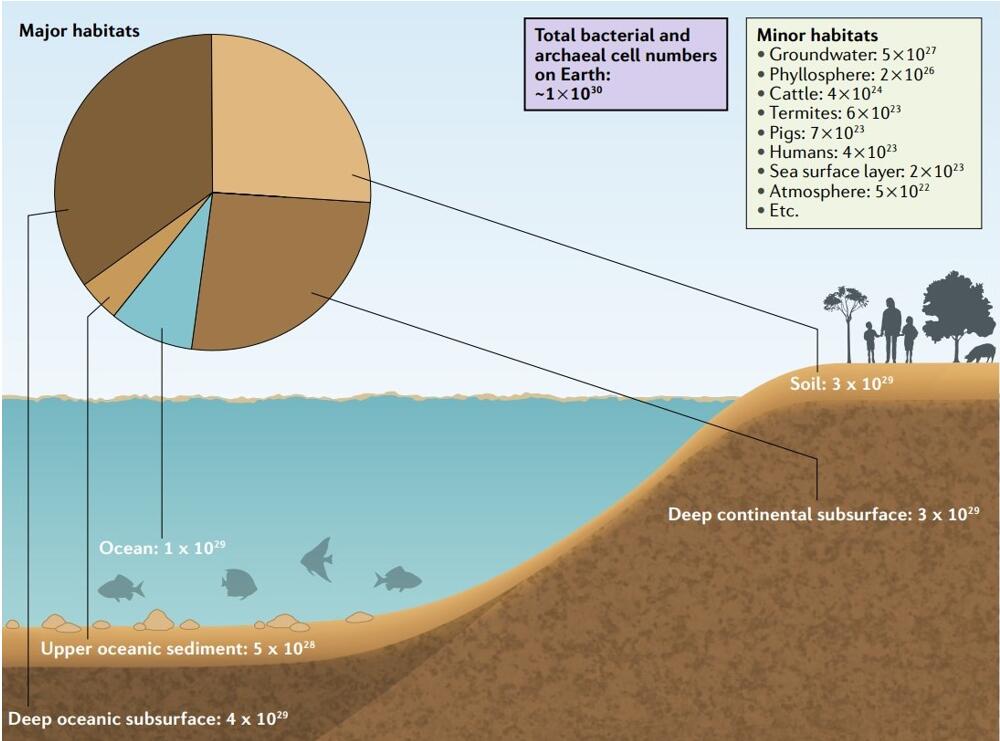 Fig. 1 | Abundance of bacteria and archaea in different habitats on Earth.
(Source: Nature Reviews Microbiology, 2019)
The deep suboceanic biosphere includes nearly 70% of the surface of the Earth, with an estimated volume of 1018 m3. The deep biosphere is highly dynamic and an integral part of biogeochemical fluxes and processes in the Earth's system over geological timescales. Although activities are generally low, with generation times up to thousands of years, the overall activity calculations demonstrated that subsurface sediments can be responsible for the majority of sediment activity and hence are biogeochemically relevant on a global level. Life in the Earth's crust consists of microorganisms that support complete ecosystems using both lithoautotrophy and heterotrophy. Cells retain the capacity for metabolic activities even when deeply buried for geologically relevant periods of time.
The deep continental subsurface has been defined as a depth from 8 m below the ground surface, excluding soil. Hard rock interfaces provide space for specialized microniches with conditions favourable to different microorganisms and enable the interchange of metabolic products. Subsurface microbial processes facilitated by biofilms are the basis for degradation and removal of contaminants along the underground passage of fluidsand provide natural water purification and bioremediation. In general, the existence of biofilms in the continental subsurface has been confirmed, and there is plenty of evidence that the cells are not simply buried and inactive but participate in global biogeochemical processes on geological timescales.
The uppermost centimetres represent the biologically most active sedimentary layer, even in the deepest trenches of the oceans and regardless of the height of the water column above it. Continental shelf sediments are mostly anoxic immediately below the sea floor, but 9–37% of global subseafloor sediments are oxygenated and harbour aerobic microorganisms. In fact, biofilms play an important role in stabilizing sediments and the subsequent diagenesis. In such an environment, cell clusters and colonies on mineral and detritus surfaces are prevalent biofilm manifestations. To summarize, the vast majority of cells in sediments down to 50cm depth exist as biofilms. Bacteria are now estimated at 4×1028 cells and archaea at 1×1028 cells in the upper ocean sediment, with archaeal numbers decreasing more slowly with depth than bacterial numbers.
Soil is the most heterogeneous component of the biosphere in terms of properties and processes and offers a huge internal surface area. Soil contains high numbers of bacteria and archaea, mainly in the form of microbial aggregates, with estimated total cell numbers ranging from 1×1027 for tropical rainforests to 6.3×1028 for desert scrub and a total of 3×1029 cells.
The surface microlayer (SML) is the interface between water and the atmosphere, comprising the first millimetre of the water phase. It is commonly thought that bacteria in the open ocean occur as single cells and that there are ~1×1029 microbial cells, 20% of which are archaea. The organisms living in the SML are referred to as neuston and include a range of diverse microorganisms adapted to this environment. To conclude, although the majority of microorganisms (~1029 cells) in the ocean seems to exist as single cells, the global fraction of cells bound to mineral and microplastic particles, to organic debris, to phytoplankton and zooplankton, to macrophytes such as kelp and to corals and sponges is unknown. Thus, the case for biofilms in oceans is still open.
The atmosphere contains substantial numbers of microorganisms. Their distribution varies greatly, depending on altitude, location and wind forces, with extremely high particle concentrations in hurricanes, tornadoes and cyclones. Aerosols can originate from any surface, including soil, water and plants, and carry microorganisms to the atmosphere. If bacteria are metabolically active in clouds, it is conceivable that they grow and form aggregates.
Plant leaves, humans, cattle and termites are colonized by microorganisms. These host-associated communities, ranging from the phyllosphere and rhizosphere to the gut microbiota, exhibit many of the key biofilm characteristics.
In summary, our estimate puts the total number of bacterial and archaeal cells on Earth at around 1.2×1030 cells. The answer to the abundance of biofilms is complex. Approximately 40% of all bacteria and archaea occur above the subsurface, 80% of them in soil and upper oceanic sediment as biofilms and 20% in oceans as planktonic cells. The majority of all cells reside in the continental subsurface and oceanic subsurface, with over 99% surface attached. Metabolic and microscopic evidence actually reveals that they form biofilms, even at very low growth rates, representing 20-80% of the overall cell number.
Loading ......
