
Inquiry Basket
 Loading ......
The scientific community continues to study herpes simplex virus (HSV) because it causes widespread infections that require advanced diagnostic methods. The detection of HSV infections depends on established viral antigens which provide both high sensitivity and specificity for diagnostic tests.
The diagnostic development team at Creative Diagnostics provides Native and Recombinant HSV Antigens which serve multiple purposes for researchers and diagnostic developers. The antigens maintain their natural viral structure or recombinant precision to deliver precise results in serological tests and immunoassay development.

Creative Diagnostics' Native and Recombinant HSV Antigens are versatile tools supporting various diagnostic and research needs.
With high purity, stability, and strong immunoreactivity, these HSV antigens ensure reliable performance in virology and immunodiagnostic applications.
The viral protein reagents from Creative Diagnostics provide Native and Recombinant HSV Antigens which serve as precise tools for developing assays and detecting antigens. The antigens exist in native and recombinant forms which maintain viral epitopes to produce strong immunoreactivity and high sensitivity while minimizing background signals in ELISA and western blotting and immunofluorescence assays. The antigens maintain excellent purity levels and stability while showing consistent results between batches which makes them suitable for serological testing and antibody screening and vaccine development and advanced biomedical HSV detection applications.
Native and Recombinant HSV Antigens from Creative Diagnostics serve as well-characterized viral proteins which enable precise HSV research and diagnostic procedures. The native and recombinant forms of these antigens retain essential viral epitopes which enable precise detection in serological assays and ELISA tests and western blotting and immunofluorescence applications. The antigens undergo strict quality control processes to achieve consistent purity levels and stability and reproducibility. The antigens serve multiple purposes in HSV detection and immunology research because they provide reliable performance for assay development and antibody validation and vaccine studies.
HSV type 1/2 gD
HSV Type 1/2 gD functions as the primary envelope glycoprotein of herpesviruses 1 and 2 because it enables viral attachment to host cells and subsequent entry into these cells. The stable three-dimensional structure of gD together with its natural glycosylation patterns enables proper protein folding and strong immunogenicity and affects how neutralizing antibodies recognize the protein and how the virus evades the immune system. The specific properties of HSV Type 1/2 gD make it a vital component for developing antigens and vaccines and conducting diagnostic research.
| Cat | Product Name | Expression System | Application | |
| DAG589 | HSV type 1 gD Glycosylated (aa 21 - 339) [His] | P. pastoris | ELISA, WB | Inquiry |
| DAG2010 | HSV type 1 gD (aa 266 - 394) | E. coli | ELISA, WB | Inquiry |
| DAG535 | HSV Type 1 gD [GST] | E. coli | ELISA, WB | Inquiry |
| DAG527 | HSV Type 2 gD [GST] | E. coli | ELISA, WB | Inquiry |
HSV Type 1/2 gG
HSV Type 1/2 gG represent envelope glycoproteins which belong to herpesviruses 1 and 2. The proteins show strong immune responses while they help scientists identify between HSV-1 and HSV-2 infections. The proteins serve as essential targets for antibody-based detection and serological diagnosis and vaccine development.
| Cat | Product Name | Expression System | Application | |
| DAG589 | HSV type 1 gD Glycosylated (aa 21 - 339) [His] | P. pastoris | ELISA, WB | Inquiry |
| DAG590 | HSV type 1 gG (aa 1 - 190) | S. cerevisiae | WB | Inquiry |
| DAG2013 | HSV type 1 gG (aa 34 - 200) [His] | HEK 293 cells | WB | Inquiry |
| DAG179 | HSV type 1 | Native | ELISA | Inquiry |
| DAG1357 | HSV type 1 gG [GST] | E. coli | ELISA, WB | Inquiry |
| DAG591 | HSV type 2 gG (aa 343 - 649) | S. cerevisiae | WB | Inquiry |
| DAG2014 | HSV type 2 gG (aa 525 - 616) [His] | E. coli | ELISA, WB | Inquiry |
| DAG2015 | HSV type 2 gG (aa 23 - 650) [His] | HEK 293 cells | WB | Inquiry |
| DAG1359 | HSV type 2 gG (aa 525-578) [GST] | E. coli | ELISA, WB | Inquiry |
Recombinant HSV
The term Recombinant HSV Type 2 describes proteins or viral constructs from herpesvirus type 2 (HSV-2) which scientists produce through genetic engineering techniques. The production of specific HSV-2 proteins or antigens through expression systems including mammalian cells and insect cells and E. coli for research purposes of research and application defines this term.
| Cat | Product Name | Expression System | Application | |
| DAG589 | HSV type 1 gD Glycosylated (aa 21 - 339) [His] | P. pastoris | ELISA, WB | Inquiry |
| DAGA-443 | Recombinant HSV type 2 VP22 | E. coli | ELISA, WB | Inquiry |
| DAGA-444 | Recombinant HSV type 2 VP13/14 | E. coli | ELISA, WB | Inquiry |
| DAGA-445 | Recombinant HSV type 2 gD (Glycosylated) | P. pastoris | ELISA, WB | Inquiry |
High-quality HSV antigens enable accurate differentiation between HSV-1 and HSV-2 in ELISA assays.
Developing a Sensitive HSV-1/2 Serological Assay Using Native and Recombinant HSV Antigens
Background
The biotechnology company aimed to create a fast and precise serological test which would identify between HSV-1 and HSV-2 infections. The current reagents lack proper specificity and show major differences between different production batches.
Solution
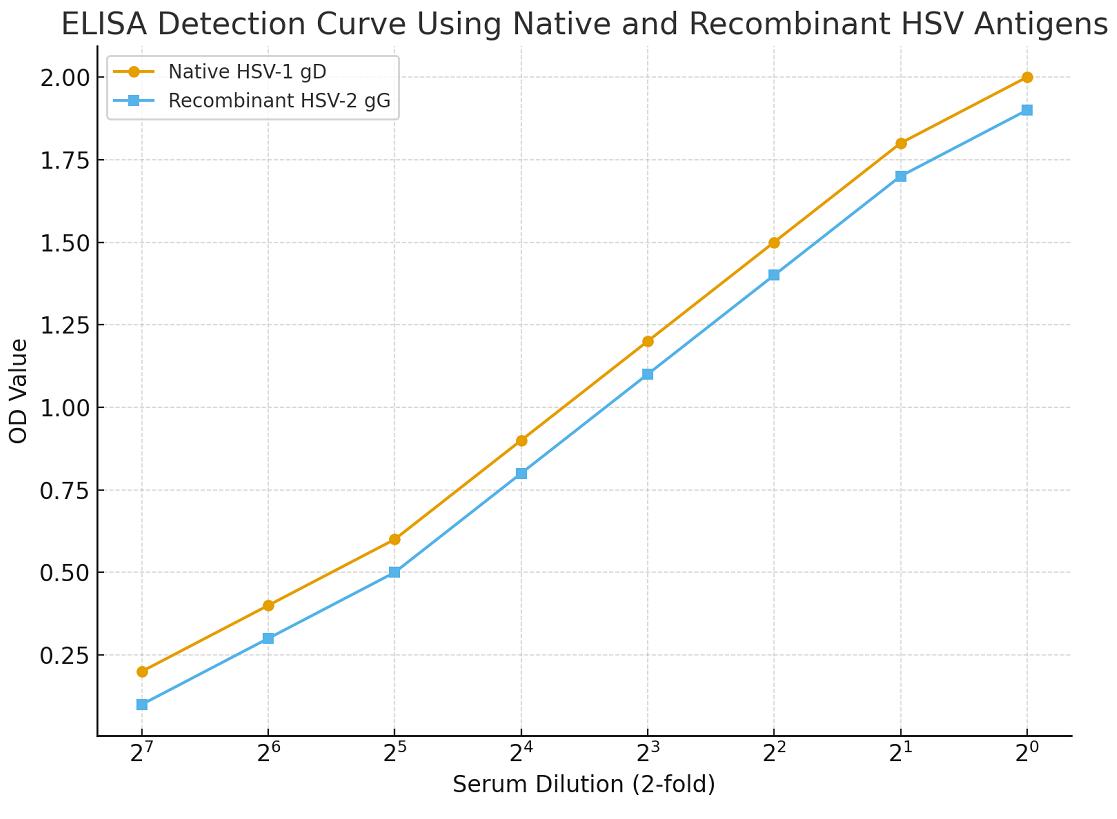
The research team chose Native HSV-1 gD and Recombinant HSV-2 gG as their primary antigens. The natural glycosylation pattern of Native gD creates an immune response that matches real-world conditions while Recombinant gG offers pure and consistent production for standardized manufacturing.
Implementation
The ELISA platform used these two antigens at optimized levels and detection settings while researchers validated multiple production batches.
Results:
Conclusion:
The team achieved a high-performance standardizable HSV serological detection tool through their combination of native and recombinant HSV antigens which enables reliable clinical diagnosis and vaccine development.
The production of recombinant antigens through genetic engineering in cells leads to better stability and higher purity andNative antigens derive from virus extraction methods which preserve their natural structure and glycosylation patterns. The simplified large-scale manufacturing.
Immunofluorescence assay and antibody screening and vaccine development.
The viral surface proteins gD and gG show strong immunogenicThe antigens serve all experiments related to HSV research including ELISA and Western blot and immunoflu properties and produce effective antibody responses. The antigen gG provides excellent discrimination between HSV-1 and HSV-2 infections which makes it suitable for diagnostic applications and research studies.
The antigens maintain essential viral epitopes which makes them suitable for studying immune responses and developing vaccine candidates. The antigens serve as excellent tools for fundamental and practical vaccine research applications.
Loading ......
