Medica 2026
Nov 16-19, 2026 - Düsseldorf, Germany

Ubiquitin/Proteasome Pathway Antibodies

Ubiquitin/Proteasome Pathway Antibodies

Creative Diagnostics now offers antibodies against full length or partial proteins, from the ubiquitin proteasome (UPS) pathway; these include E2 conjugating enzymes, E3 ligases, DUBs, ubiquitin binding proteins substrates and conjugate antibodies and also a number of kinase antibodies. Most of these antibodies can be used in WB and IP and can be supplied as high quality research tools to the life science research community.

Popular Ubiquitin / Proteasome Pathway Antibodies

Ubiquitin is a small protein that is found in almost all cellular tissues in humans and other eukaryotic organisms, which helps to regulate the processes of other proteins in the body and can be found tagged to almost any protein. It is evolutionarily advantageous for all cells of eukaryotic organisms to use the process of ubiquitylation because it removes breaking, worn or sub-functional proteins from cells before the proteins cease functioning entirely. A system that pre-emptively removes proteins from use and tags them for protein recycling keeps cells healthy.

Ubiquitination, also known as ubiquitylation, is an enzymatic process that involves the bonding of an ubiquitin protein to a substrate protein. This has sometimes been referred to as the molecular “kiss of death” for a protein, as the substrate usually becomes inactivated and is tagged for degradation by the proteasome through the attachment of the ubiquitin molecule. Ubiquitination occurs when an ubiquitin molecule bonds to a substrate protein and is a type of post-translational modification.

This process involves three steps with specific groups of enzymes to perform them, which are:

a. Activation with ubiquitin-activating enzymes (E1s)

b. Conjugation with ubiquitin-conjugating enzymes (E2s)

c. Ligation with ubiquitin ligases (E3s)
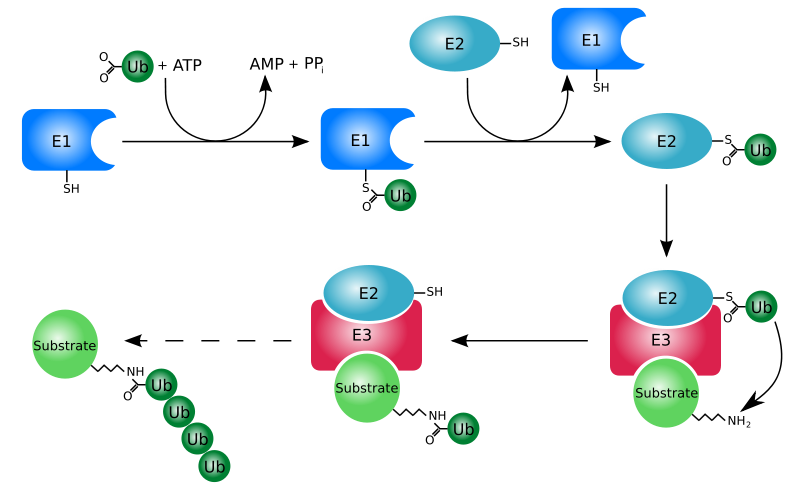
Ubiquitin/Proteasome Pathway Antibodies

The first step involves the activation of ubiquitin by the E1 enzyme, which occurs prior to its attachment to the amino acid cysteine, the active site. Energy in the form of ATP is required in order for the ubiquitin molecule to be transferred to the active site and produce an intermediate substance known as ubiquitin-adenylate. Following this, the ubiquitin-conjugating enzyme (E2) plays its role to bring the two molecules together, by transferring the ubiquitin from E1 to the active cysteine site. The E2 enzyme has a particular structure that allows it to bond to both the ubiquitin and E1 molecules and allow this step to occur. Finally, the ubiquitin protein ligase (E3) is required to recognise and bind the target substrate, subsequently labeling it with the small ubiquitin molecule. This usually occurs by way of an isopeptide bond connecting the last amino acid, glycine 76, of the ubiquitin molecule to a lysine on the substrate protein. This enzymatic process is then repeated to form a small chain with several ubiquitin molecules, marking the protein for degradation in the proteasome.

Ubiquitin is known to form covalent bonds with proteins, marking them in the body for degradation through the ubiquitin/ATP-pathway. This process plays a vital role in the healthy turnover of proteins in the body. When cells marked by ubiquitin bonding are not degenerated properly, the cellular homeostasis is disrupted and eventually this can result in the genesis of certain diseases. Including:

  • Neurofibrillary tangles (Alzheimer's disease)
  • Lewy body (Parkinson's disease)
  • Pick bodies (Pick's disease)
  • Inclusions (Huntington's disease and motor neuron disease)
  • Mallory bodies (alcoholic liver diseases)
  • Rosenthal fibers (astrocytes)
<
Cat_No Description Source Application
CABT-BL6367mono and polyubiquitylated conjugates Mab Mouse WBInquiry    
CABT-BL6368mono and polyubiquitylated conjugates Mab Mouse WBInquiry    
CABT-BL6369mono and polyubiquitylated conjugates Mab Mouse WBInquiry    
CABT-BL6370Polyubiquitylated conjugates Mab Mouse WBInquiry    
DCABY-4229Ubiquitin monoclonal antibody Mouse WB, ELISA(Cap)Inquiry    
DCABY-4303Ubiquitin monoclonal antibody [Biotin] Mouse WB, ELISA(Det)Inquiry    
CABT-B1642Ubiquitin (phospho S65) polyclonal antibody Rabbit WB, ICCInquiry    
DPABH-22055Ubiquitin B polyclonal antibody Rabbit IHC, ICC/IFInquiry    
DPAB2686Ubiquitin+1 polyclonal antibody Rabbit WB, IPInquiry    
CABT-BL6311Human ABIN 1 polyclonal antibody Sheep WB, IPInquiry    
CABT-BL6312Mouse ABIN 1 polyclonal antibody Sheep WB, IPInquiry    
CABT-BL6313Human FAF1 polyclonal antibody Sheep WB, IPInquiry    
CABT-BL6314Human NEMO polyclonal antibody heep IPInquiry    
CABT-BL6315Human Optineurin polyclonal antibody Sheep IPInquiry    
CABT-BL6316Human UBXD7 polyclonal antibody Sheep WB, IPInquiry    
CABT-BL6317Human CAND1 polyclonal antibody Sheep WB, IPInquiry    
CABT-BL6318Human Cullin 3 polyclonal antibody Sheep WBInquiry    
CABT-BL6319Human Cullin 5 (aa 577-689) polyclonal antibody Sheep WB, IPInquiry    
ABT-BL6320Human DCNL3 polyclonal antibody Sheep WB, IPInquiry    
CABT-BL6321Human DCNL4 polyclonal antibody Sheep WB, IPInquiry    
CABT-BL6322Human DCNL5 polyclonal antibody Sheep WB, IPInquiry    
CABT-BL6323Mouse DCNL5 polyclonal antibody Sheep WB, IPInquiry    
CABT-BL6324Human HOIL1 polyclonal antibody Sheep WB, IPInquiry    
CABT-BL6325Human HOIP polyclonal antibody Sheep WB, IPInquiry    
CABT-BL6326Human Parkin polyclonal antibody Sheep WB, IPInquiry    
CABT-BL6327Human RNF7 polyclonal antibody Sheep WB, IPInquiry    
CABT-BL6328Human SHARPIN polyclonal antibody Sheep WB, IPInquiry    
CABT-BL6329Mouse TRAF6 polyclonal antibody Sheep IPInquiry    
CABT-BL6330Human TRIAD1 polyclonal antibody Sheep WB, IPInquiry    
CABT-BL6331Human TRIM65 polyclonal antibody Sheep WB, IPInquiry    
CABT-BL6332Human CYLD polyclonal antibody Sheep WB, IPInquiry    
CABT-BL6333Human OTUB1 polyclonal antibody Sheep WB, IPInquiry    
CABT-BL6334Human OTULIN polyclonal antibody Sheep WB, IPInquiry    
CABT-BL6335Human USP11 polyconal antibody Sheep WB, IPInquiry    
CABT-BL6336Human USP15 polyclonal antibody Sheep WB, IPInquiry    
CABT-BL6337Human AMPK alpha 2 (aa 352–366) polyclonal antibody Sheep WB, IPInquiry    
CABT-BL6338IKK beta polyclonal antibody Sheep IPInquiry    
CABT-BL6339Human IKK epsilon (aa 701-716) polyclonal antibody Sheep WB, IPInquiry    
CABT-BL6340Human IKK epsilon (phospho S172) polyclonal antibody Sheep WB, IPInquiry    
CABT-BL6341Mouse IKK epsilon (aa 702-717) polyclonal antibody Sheep WB, IPInquiry    
CABT-BL6342Human MAPK15 polyclonal antibody Sheep WBInquiry    
CABT-BL6343PINK1 (aa 175-250) polyclonal antibody Sheep WB, IPInquiry    
CABT-BL6344Human PINK1 (phospho T257) polyclonal antibody Sheep WBInquiry    
CABT-BL6345Human PKB alpha polyclonal antibody Sheep IPInquiry    
CABT-BL6346Mouse PKB beta (aa 455-469) polyclonal antibody Sheep WB, IPInquiry    
CABT-BL6347Human PKB gamma (aa 116-127) polyclonal antibody Sheep IPInquiry    
CABT-BL6348Human SGK1 polyclonal antibody Sheep WB, IPInquiry    
CABT-BL6349Human SGK1 (aa 412-431) polyclonal antibody Sheep WB, IPInquiry    
CABT-BL6350Human SGK2 (aa 333-346) polyclonal antibody Sheep WB, IPInquiry    
CABT-BL6351Human SGK3 polyclonal antibody Sheep WB, IPInquiry    
CABT-BL6352Human TBK1 polyclonal antibdy Sheep IPInquiry    
CABT-BL6353Human TBK1 (Phospho S172) polyclonal antibody Sheep WBInquiry    
CABT-BL6354Human UBE2M polyclonal antibody Sheep WBInquiry    
CABT-BL6355Human UBE2T polyclonal antibody Sheep WB, IPInquiry    
CABT-BL6356Human FOXO3A (phospho S294) polyclonal antibody Sheep WBInquiry    
CABT-BL6359Human MYPT1 (aa 728 – 838) polyclonal antibody Sheep WBInquiry    
CABT-BL6360Mouse MYPT1 (phospho S445 ) polyclonal antibody Sheep WBInquiry    
CABT-BL6365Human MYPT2 (aa 350-450) polyclonal antibody Sheep WBInquiry    
CABT-BL6366Human MYPT3 polyclonal antibody Sheep WBInquiry    
Inquiry Basket
loading Loading ......

Inquiry

Inquiry