
Inquiry Basket
 Loading ......
Gentamicin, the most commonly used aminoglycoside antibiotic, is highly effective against moderate-to-severe bacterial infections caused by sensitive agents, particularly gram-negative bacteria. Its mechanism of action involves binding to bacterial ribosomes and disrupting protein synthesis. This inhibition of protein production ultimately leads to the death of the bacteria. Gentamicin has been widely used in the medical field due to its effectiveness against broad-spectrum bacteria.
Gentamicin is active against a variety of bacterial infections, primarily Gram-negative bacteria, including Escherichia coli, Pseudomonas, Klebsiella pneumoniae, Proteus, Serratia, Enterobacter aerogenes, and Gram-positive Staphylococcus. Gentamicin is commonly used to treat many types of bacterial infections, which may include bone infections, endocarditis, pelvic inflammatory disease, meningitis, pneumonia, urinary tract infections, and sepsis.
The efficacy of gentamicin is particularly notable in cases where other antibiotics may be ineffective due to bacterial resistance. It is often used as a first-line treatment for severe infections, especially when caused by multidrug-resistant bacteria. However, it is important to note that gentamicin is not effective against certain types of bacteria, such as anaerobic organisms.
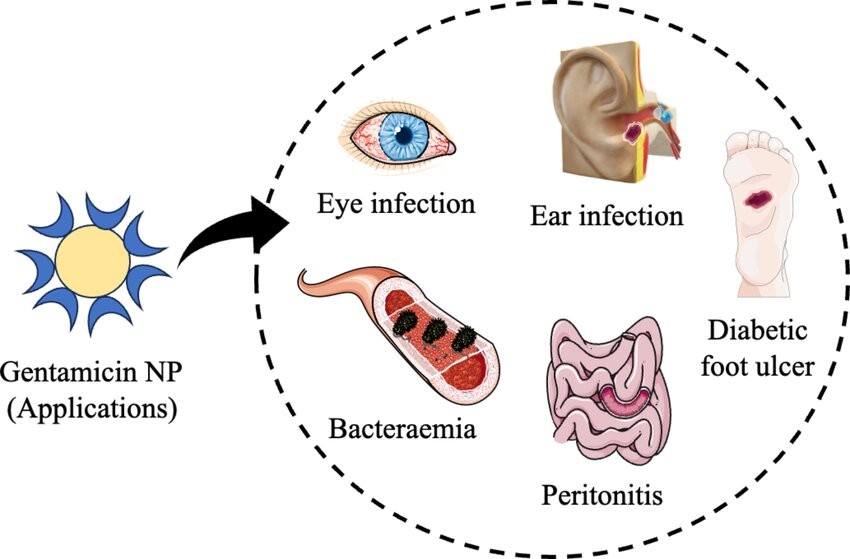 Figure 1. Various applications of Gentamicin conjugated nanoparticles.
(Source: Athauda, I. D. et al., 2023)
Gentamicin is a bactericidal antibiotic that exerts its pharmacological effects by binding to the 30S subunit of the bacterial ribosome, specifically at helix 44 of the 16S rRNA. This binding disrupts the ribosome's ability to properly discriminate between correct and incorrect transfer RNA (tRNA) and messenger RNA (mRNA) interactions during protein synthesis. Normally, if an incorrect tRNA pairs with an mRNA codon, adenosines 1492 and 1493 retract, signaling the ribosome to reject the aminoacylated tRNA complex. However, when gentamicin binds at helix 44, it prevents the retraction of these adenosines, leading to the acceptance of incorrect aminoacyl-tRNAs. As a result, the ribosome synthesizes proteins with incorrect amino acids incorporated throughout the chain, typically occurring at a rate of approximately one error in every 500 amino acids. These non-functional, mistranslated proteins misfold and aggregate, ultimately leading to bacterial cell death.
In addition to its primary binding site, gentamicin has a secondary binding site at helix 69 of the 23S rRNA. This binding site interacts with helix 44 and proteins involved in recognizing stop codons. Gentamicin's presence at this secondary site prevents the ribosome from interacting with ribosome recycling factors, leading to the formation of inactive ribosome complexes even after translation is complete. This results in a pool of non-functional ribosomes within the bacterial cell that cannot re-initiate translation and synthesize new proteins.
Gentamicin is primarily administered parenterally (via intravenous or intramuscular routes) due to its poor oral bioavailability. It has limited absorption from the gastrointestinal tract. Gentamicin exhibits a concentration-dependent pharmacokinetic profile, with higher peak concentrations associated with improved bactericidal activity. It has a relatively large volume of distribution, allowing it to distribute widely into various tissues and body fluids. Gentamicin is eliminated primarily by renal excretion, and its dosage needs to be adjusted based on renal function to avoid toxicity.
Gentamicin use is associated with potential adverse effects, primarily related to its nephrotoxicity and ototoxicity. Nephrotoxicity can manifest as acute kidney injury or impaired renal function, especially with prolonged or high-dose therapy. Ototoxicity, which affects the inner ear, can lead to irreversible hearing loss or balance disturbances. Other potential adverse effects include low blood cell counts, neurotoxicity, allergic reactions, and superinfections.
The main physicochemical analysis and detection methods for the determination of gentamicin residues primarily include gas chromatography (GC), high-performance capillary electrophoresis (HPLE), high-performance liquid chromatography (HPLC), and liquid chromatography-mass spectrometry (LC/MS). However, these analytical methods require highly demanding sample preparation and expensive detection equipment.
Immunological methods based on the specific reaction between antigens and antibodies have been developed as effective approaches for residue detection. These methods offer advantages such as rapidity, high sensitivity, and specificity. Currently, immunological analysis methods applied to antibiotic detection include radioimmunoassay (RIA), enzyme-linked immunosorbent assay (ELISA), substrate-labeled fluorescence immunoassay (SLFIA), solid-phase immunosensor (SIS), and colloidal gold immunochromatography assay (GICA).
Reference
| Target | Cat. No. | Product Name | Size | Species Reactivity | Application | Detection Sample | |
| Gentamicin | DEIA047 | Gentamicin ELISA Kit | 96T | N/A | Quantitative | Vaccine, cell culture | Inquiry |
| DEIA6884 | Gentamicin ELISA Kit | 96T | N/A | Quantitative | serum, plasma, cell lysates, tissue homogenates, and food samples | Inquiry | |
| DEIA-WZ6884 | High Sensitivity Gentamicin ELISA Test Kit | 96T | Quantitative | biological samples | Inquiry | ||
| E. coli | DEIA2348 | E. Coli Verotoxin (Fecal) ELISA Kit | 96T | Qualitative | stool supernatant | Inquiry | |
| DEIA2562 | E.coli Antigen In Food ELISA Kit | 96T | Quantitative | food | Inquiry | ||
| DEIA2437 | E.Coli O157 (Fecal) ELISA Kit | 96T | Qualitative | feces | Inquiry | ||
| NEO | DEIA-XY34 | Neomycin ELISA KIT | 96T | Human | Quantitative, Qualitative | biological samples | Inquiry |
| DEIA043 | Neomycin ELISA Kit | 96T | N/A | Quantitative | cell culture supernatant, vaccine, milk | Inquiry | |
| Streptomycin | DEIA-XY2272 | Streptomycin ELISA Kit | 96T | N/A | Quantitative | Vaccine | Inquiry |
| DEIA020 | Streptomycin ELISA Kit | 96T | N/A | Quantitative | vaccine, cell culture supernatant | Inquiry | |
| DEIA-WZ020 | High Sensitivity Streptomycin ELISA Test Kit | 96T | Quantitative | biological samples | Inquiry |
Loading ......
