
Inquiry Basket
 Loading ......
Human papillomavirus (HPV) is a well-known family of viruses that infect humans, with more than 200 different types identified to date. HPV infections can lead to various diseases, including genital warts and certain types of cancer, such as cervical, anal, and oropharyngeal cancer. Understanding the mechanisms by which HPV enters human cells and involves HPV receptors is crucial for developing effective prevention and treatment strategies.
During the host cell entry of HPV, the virus particle attaches to cell surface receptors to initiate the infection process. Studies have proposed that the initial binding of virions occurs in the basement membrane before transferring to the surface of basal keratinocytes. Significantly, in vitro experiments have shown that HPV entry begins with binding to a cell surface receptor, whereas in the in vivo situation, the primary site of virus binding has recently been identified as the basement membrane.
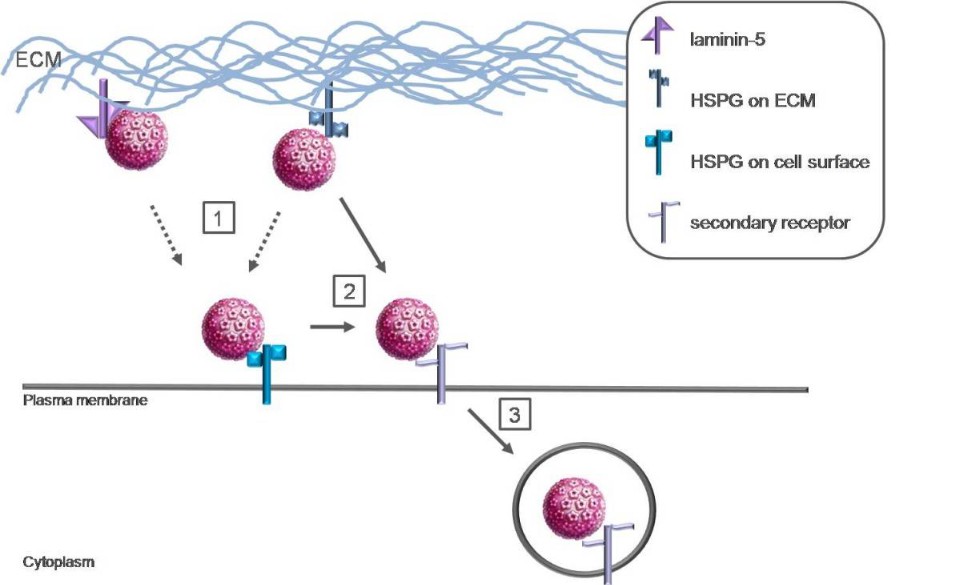 Figure 1. Putative model of interaction of HPV capsids with the ECM and cell surface.
(Source: Horvath, C. A. J. et al., 2010)
Multiple observations suggest that the binding of HPV to cell surfaces involves more than one receptor. One hypothesis proposes that an initial low-specificity binding mediated by the L1 protein is followed by a more specific interaction with a protein component of L2. It is proposed that a specific region in the L2 protein interacts with a cell surface molecule after the virus attaches to a primary receptor. This interpretation implies that a conformational change occurs at the cell surface after attachment, revealing this specific domain in L2. This process is similar to other viruses that trigger downstream events through conformational changes to facilitate interactions with secondary receptors.
Previous research on cell surface receptors for HPV revealed that HPVs bind to a widely expressed and evolutionarily conserved receptor and the interaction primarily depends on L1. The initial attachment of HPV virus-like particles (VLPs) was suggested to occur through binding to glycosaminoglycans (GAGs), particularly heparan sulfate. Heparan sulfate proteoglycans (HSPGs), which are commonly found on the surface of most cells and in the extracellular matrix (ECM), play important roles in various biological functions and are suitable molecules for viral infection. Studies have shown that HSPGs are crucial for the initial attachment of various HPV types, including high-risk oncogenic strains.
Heparan sulfate is often associated with two membrane-bound proteoglycans, namely syndecans and glypicans. Syndecans are the main HSPGs present in epithelial cells, which are the target cells for HPV infection. Among the syndecans, syndecan-1 stands out as a potential primary attachment receptor in vivo due to its high expression level in the relevant target cells and its upregulation during wound healing.
Several in vitro studies have demonstrated the binding ability of HPV to laminin-5, suggesting its potential role in mediating viral attachment to the ECM. While the affinity of HPV for laminin-5 is higher than its affinity for heparan sulfate, it appears that the successful transfer of the virus from the ECM to host cells requires binding to heparan sulfate. This suggests that interaction with heparan sulfate is essential for the efficient entry of HPV into target cells, while the role of laminin-5 in the infection process may be of lesser importance.
Accumulating evidence indicates that in addition to HSPG, a secondary receptor or co-receptor plays a role in the internalization of HPV following its interaction with HSPG. While HSPG promotes conformational changes in the viral capsid, it is not the primary cell surface receptor responsible for virion internalization or subsequent infection events.
The cell adhesion receptor α6-integrin, which mediates cell-to-cell interactions, has been suggested as a secondary receptor for HPV. However, the involvement of α6-integrin in HPV infection remains controversial. Given the close association of proteoglycans and integrins as matrix components, the association between α6-integrin and HPV binding and entry observed in some experiments may be a secondary effect resulting from its interaction with HSPGs.
In conclusion, the study of human HPV receptors is of the utmost importance in understanding the mechanisms of HPV infection. The identification and characterization of specific receptors involved in HPV entry provide valuable insights into the development of diagnostics, therapies, and preventive strategies. Creative Diagnostics, with a diverse portfolio of antibodies, proteins, and assay kits, is at the forefront of HPV research, empowering scientists and clinicians in their quest to combat HPV-related diseases.
References
| Target | Cat. No. | Product Name | Expression System | Tag/Conjugate | Application | |
| HPV | PSVG-HPV16 | Pseudotyped GFP HPV16 | Useful for studying papillomavirus assembly, entry, and neutralization. | Inquiry | ||
| PSVG-HPV18 | Pseudotyped GFP HPV18 | Useful for studying papillomavirus assembly, entry, and neutralization. | Inquiry | |||
| PSVG-HPV31 | Pseudotyped GFP HPV31 | Useful for studying papillomavirus assembly, entry, and neutralization. | Inquiry | |||
| PSVG-HPV33 | Pseudotyped GFP HPV33 | Useful for studying papillomavirus assembly, entry, and neutralization. | Inquiry | |||
| PSVG-HPV39 | Pseudotyped GFP HPV39 | Useful for studying papillomavirus assembly, entry, and neutralization. | Inquiry | |||
| PSVG-HPV45 | Pseudotyped GFP HPV45 | Useful for studying papillomavirus assembly, entry, and neutralization. | Inquiry | |||
| HPV 11 | DAGF-228 | Recombinant Human Papilloma Virus type 11 L1 protein (VLP) | E. coli | Unconjugated | Inquiry | |
| DAG1576 | Recombinant HPV type 11 [GST] | E. coli | GST | N/A | Inquiry | |
| HPV 35 | DAGC142 | Recombinant Human Papilloma Virus type 35 L1 protein (VLP) | E. coli | Unconjugated | SDS-PAGE | Inquiry |
| HPV 39 | DAGC143 | Recombinant Human Papilloma Virus type 39 L1 protein (VLP) | E. coli | Unconjugated | SDS-PAGE | Inquiry |
| HPV16 | DAGF-094 | Recombinant HPV16 E6 protein [His] | E. coli | His | Inquiry | |
| DAGF-095 | Recombinant HPV16 E6 protein (aa 1-158) [His] | Yeast | His | Inquiry | ||
| DAGF-096 | Recombinant HPV16 E7 protein (aa 1-98) [GST] | E. coli | GST | Inquiry | ||
| DAGF-229 | Recombinant Human Papilloma Virus type 16 L1 protein (VLP) | E. coli | Unconjugated | Inquiry | ||
| DAG-P2512 | Recombinant HPV type 16 (aa 1 - 531) | E. coli | Unconjugated | SDS-PAGE | Inquiry |
| Target | Cat. No. | Product Name | Size | Species Reactivity | Application | Detection Sample | |
| HPV | DEIA-F678S | Human Papilloma Virus IgG ELISA kit | 96T | Human | Qualitative | plasma, serum | Inquiry |
| DEIASL404 | Human HPV18 IgM ELISA kit | 96T | Qualitative | Serum, plasma | Inquiry | ||
| DEIASL405 | Human HPV 16 L1-capsids IgG ELISA Kit | 96T | Qualitative | Serum, plasma | Inquiry | ||
| DEIASL406 | Human HPV 16 IgM ELISA Kit | 96T | Qualitative | Serum, plasma | Inquiry | ||
| DEIASL407 | Human Papilloma Virus IgM ELISA Kit | 96T | Qualitative | Serum, plasma | Inquiry | ||
| DEIASL408 | Human HPV 18 L1-capsids IgG ELISA Kit | 96T | Qualitative | Serum, plasma | Inquiry | ||
| DEIASL409 | Rabbit HPV 16 L1-capsids IgG ELISA Kit | 96T | Qualitative | Serum, plasma | Inquiry | ||
| DEIASL410 | Human high risk HPV L1-capsids (HR-HPVL1) IgG ELISA kit | 96T | Qualitative | Serum, plasma | Inquiry | ||
| DEIASL119 | HPV(18) Antigen ELISA Quantitation Kit | 96T | Quantitative | Serum, plasma | Inquiry | ||
| DEIASL120 | HPV(52) Antigen ELISA Quantitation Kit | 96T | Quantitative | Serum, plasma | Inquiry | ||
| DEIASL121 | HPV(58) Antigen ELISA Quantitation Kit | 96T | Quantitative | Serum, plasma | Inquiry | ||
| DEIASL171 | Human HPV 16 E7 Oncoprotein ELISA Kit | 96T | Human | Quantitative | Cell lysates, tissue lysates, cervical smears, plasma, serum | Inquiry | |
| DEIASL172 | Human HPV 18 E7 Oncoprotein ELISA Kit | 96T | Quantitative | Cell lysates, tissue lysates, or cervical smears | Inquiry | ||
| HPV16 | DEIASL118 | HPV (16) Antigen ELISA Quantitation Kit | 96T | Human | Quantitative | Serum and plasma | Inquiry |
Loading ......
