
Inquiry Basket
 Loading ......
Human papillomavirus (HPV) is a prevalent sexually transmitted infection that can lead to various types of cancer, including cervical, anal, and oropharyngeal cancer. Early detection and accurate diagnosis of HPV infection are significant in facilitating early detection, risk assessment, and personalized management of HPV infections and related diseases. By identifying high-risk HPV types, guiding screening strategies, monitoring treatment outcomes, and informing vaccination programs, HPV testing plays a vital role in reducing the burden of HPV-related conditions and improving patient outcomes.
Since HPV is not suitable for in vitro cell culture, simple serum blood tests cannot be used for the diagnosis and typing of HPV. Clinical methods used to detect HPV include cytological methods, immunohistochemistry, in situ hybridization, nucleic acid blotting, and PCR, among which the PCR method has the highest sensitivity and is currently the most used. The type, viral load, and duration of HPV infection determine the development and prognosis of the lesion and are therefore the main components of HPV testing. Currently, it is mainly performed by applying molecular biology methods for the detection of HPV DNA.
Accurate identification of HPV primarily relies on molecular biology techniques. These techniques utilize nucleic probe technology to detect HPV in clinical specimens. The main clinical applications of HPV DNA testing include:
While morphological, serological, and clinical findings can suggest the presence of HPV, accurate diagnosis relies on molecular biology techniques for detection and typing. Nucleic acid-hybridization assays, signal-amplification assays, and nucleic-acid amplification methods are currently available for HPV diagnosis.
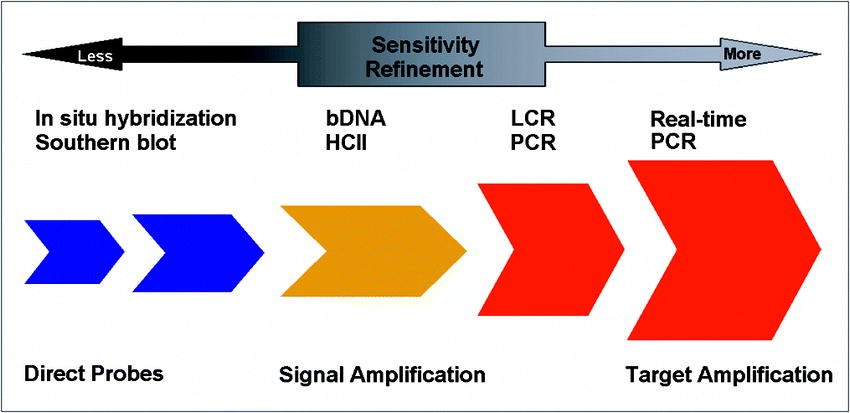 Figure 1. Relative sensitivities of nucleic acid analysis techniques.
(Source: Hubbard, R. A. et al., 2003)
Traditionally, techniques such as in situ hybridization, Southern blotting, and dot-blot hybridization used radio-labeled nucleic acid hybridization assays to detect HPV infection in cervical samples.
| Benefits | Weaknesses |
|
|
These methods improve sensitivity by multimeric layering of reporter molecules on DNA probes. An example of signal amplification is hybrid capture 2 (HC2) detection, in which specific RNA probes are used to target individual DNA sequences containing the HPV genotype to be detected. However, this test cannot determine the specific HPV type present.
| Benefits | Weaknesses |
|
|
Nucleic acid amplification methods include microarray analysis, PCR, PCR-RFLP, Real-time PCR, HPV genome sequencing, microplate colorimetric hybridization assay (MCHA), HPV-mRNA detection, and others. These methods are technologies that hold great promise for addressing all aspects of HPV testing, including HPV detection, viral load quantitation, DNA sequencing, and mutation analysis.
| Benefits | Weaknesses |
|
|
Pap smear is a well-known screening method for cervical cancer. During a Pap smear, cells from the cervix are collected and examined under a microscope for any abnormalities. While not a direct HPV test, abnormal Pap results can indicate the need for further HPV testing.
LBC is an alternative to the traditional Pap smear. Instead of placing the cells directly on a glass slide, they are suspended in a liquid medium, which is then used to prepare a slide for examination. LBC can also be used for HPV testing by extracting DNA from the collected cells and performing molecular tests.
It has been reported that HPV-infected patients with high viral loads (VL) may be at an increased risk of developing cervical cancer. RQ-PCR-based assays represent the best method for quantification of target nucleic acids and allow continuous monitoring of PCR products. Quantification of HPV DNA using real-time PCR has the advantage of being rapid, reproducible, and suitable for the clinical setting. Moreover, other techniques such as HC2 assays can also be used for semi-quantification of HPV VL in clinical samples.
HPV testing methods have significantly evolved, offering improved sensitivity, specificity, and efficiency. Creative Diagnostics has been at the forefront of these advancements, offering innovative solutions for HPV detection, genotyping, and viral load determination. By leveraging technologies such as hybridization capture, PCR, and microarray, Creative Diagnostics plays a crucial role in the fight against HPV-related diseases. Our commitment to excellence and continuous innovation underscores our position as a leader in the field of HPV testing.
References
| Target | Cat. No. | Product Name | Expression System | Tag/Conjugate | Application | |
| HPV | PSVG-HPV16 | Pseudotyped GFP HPV16 | Useful for studying papillomavirus assembly, entry, and neutralization. | Inquiry | ||
| PSVG-HPV18 | Pseudotyped GFP HPV18 | Useful for studying papillomavirus assembly, entry, and neutralization. | Inquiry | |||
| PSVG-HPV31 | Pseudotyped GFP HPV31 | Useful for studying papillomavirus assembly, entry, and neutralization. | Inquiry | |||
| PSVG-HPV33 | Pseudotyped GFP HPV33 | Useful for studying papillomavirus assembly, entry, and neutralization. | Inquiry | |||
| PSVG-HPV39 | Pseudotyped GFP HPV39 | Useful for studying papillomavirus assembly, entry, and neutralization. | Inquiry | |||
| PSVG-HPV45 | Pseudotyped GFP HPV45 | Useful for studying papillomavirus assembly, entry, and neutralization. | Inquiry | |||
| HPV 11 | DAGF-228 | Recombinant Human Papilloma Virus type 11 L1 protein (VLP) | E. coli | Unconjugated | Inquiry | |
| DAG1576 | Recombinant HPV type 11 [GST] | E. coli | GST | N/A | Inquiry | |
| HPV 35 | DAGC142 | Recombinant Human Papilloma Virus type 35 L1 protein (VLP) | E. coli | Unconjugated | SDS-PAGE | Inquiry |
| HPV 39 | DAGC143 | Recombinant Human Papilloma Virus type 39 L1 protein (VLP) | E. coli | Unconjugated | SDS-PAGE | Inquiry |
| HPV16 | DAGF-094 | Recombinant HPV16 E6 protein [His] | E. coli | His | Inquiry | |
| DAGF-095 | Recombinant HPV16 E6 protein (aa 1-158) [His] | Yeast | His | Inquiry | ||
| DAGF-096 | Recombinant HPV16 E7 protein (aa 1-98) [GST] | E. coli | GST | Inquiry | ||
| DAGF-229 | Recombinant Human Papilloma Virus type 16 L1 protein (VLP) | E. coli | Unconjugated | Inquiry | ||
| DAG-P2512 | Recombinant HPV type 16 (aa 1 - 531) | E. coli | Unconjugated | SDS-PAGE | Inquiry |
| Target | Cat. No. | Product Name | Size | Species Reactivity | Application | Detection Sample | |
| HPV | DEIA-F678S | Human Papilloma Virus IgG ELISA kit | 96T | Human | Qualitative | plasma, serum | Inquiry |
| DEIASL404 | Human HPV18 IgM ELISA kit | 96T | Qualitative | Serum, plasma | Inquiry | ||
| DEIASL405 | Human HPV 16 L1-capsids IgG ELISA Kit | 96T | Qualitative | Serum, plasma | Inquiry | ||
| DEIASL406 | Human HPV 16 IgM ELISA Kit | 96T | Qualitative | Serum, plasma | Inquiry | ||
| DEIASL407 | Human Papilloma Virus IgM ELISA Kit | 96T | Qualitative | Serum, plasma | Inquiry | ||
| DEIASL408 | Human HPV 18 L1-capsids IgG ELISA Kit | 96T | Qualitative | Serum, plasma | Inquiry | ||
| DEIASL409 | Rabbit HPV 16 L1-capsids IgG ELISA Kit | 96T | Qualitative | Serum, plasma | Inquiry | ||
| DEIASL410 | Human high risk HPV L1-capsids (HR-HPVL1) IgG ELISA kit | 96T | Qualitative | Serum, plasma | Inquiry | ||
| DEIASL119 | HPV(18) Antigen ELISA Quantitation Kit | 96T | Quantitative | Serum, plasma | Inquiry | ||
| DEIASL120 | HPV(52) Antigen ELISA Quantitation Kit | 96T | Quantitative | Serum, plasma | Inquiry | ||
| DEIASL121 | HPV(58) Antigen ELISA Quantitation Kit | 96T | Quantitative | Serum, plasma | Inquiry | ||
| DEIASL171 | Human HPV 16 E7 Oncoprotein ELISA Kit | 96T | Human | Quantitative | Cell lysates, tissue lysates, cervical smears, plasma, serum | Inquiry | |
| DEIASL172 | Human HPV 18 E7 Oncoprotein ELISA Kit | 96T | Quantitative | Cell lysates, tissue lysates, or cervical smears | Inquiry | ||
| HPV16 | DEIASL118 | HPV (16) Antigen ELISA Quantitation Kit | 96T | Human | Quantitative | Serum and plasma | Inquiry |
Loading ......
