
Inquiry Basket
 Loading ......
In modern poultry health management, serological testing plays a central role in monitoring immune status, evaluating vaccination programs, and detecting field exposure to pathogens. This is especially critical for pathogens that can cause severe economic losses, such as Highly Pathogenic Avian Influenza, Newcastle Disease Virus (NDV) and Fowl Adenoviruses (FAdV). However, hemagglutination inhibition (HI) tests and indirect ELISA typically require 2-3 hours to complete, which can be a significant limitation in routine detection.
Creative Diagnostics based on a VHH-HRP fusion expression platform, provides a new generation of high-quality VHH probes. These reagents can be directly applied in competitive ELISA without the need for enzyme-labeled secondary antibodies. As a result, the workflow is significantly streamlined, while maintaining excellent assay performance.
Serological surveillance of avian viral diseases remains a cornerstone of poultry health management and biosecurity. In FAdVs, the hexon, fiber, and penton base proteins are the primary antigenic determinants, with the hexon protein being the major target for neutralizing antibodies. For NDV, serological assays commonly focus on the hemagglutinin-neuraminidase (HN) and fusion (F) proteins, which are critical for viral attachment and membrane fusion, respectively, and serve as key immunogenic markers. In the case of AIVs, the hemagglutinin (HA) and neuraminidase (NA) surface glycoproteins define viral subtypes and elicit potent humoral responses. Competitive or indirect ELISA platforms targeting these proteins enable sensitive and specific detection of virus-specific antibodies, and supporting large-scale epidemiological studies.
 Fig. 1 Schematic representation of VHH screening, production and cELISA development.
Single-domain antibodies derived from camelids, known as VHHs or nanobodies, have emerged as powerful tools in immunodiagnostics due to their high stability, small size (~15 kDa), and strong antigen-binding affinity. It can be fused with different reporters, which can be used as a probe to avoid the use of enzyme-labeled secondary antibodies and to develop one-step ELISA. Moreover, VHHs can be easily engineered into bivalent or multivalent formats to enhance binding avidity or to recognize different epitopes simultaneously, thereby improving assay sensitivity and specificity.
 Fig. 2 SDS-PAGE analysis of purified FAdV hexon-HVR, fiber-1, fiber-2 and penton proteins.
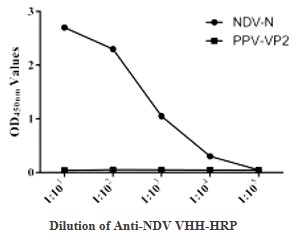 Fig. 3 Analysis of the binding activity of Anti-NDV VHH to the NDV-N protein.
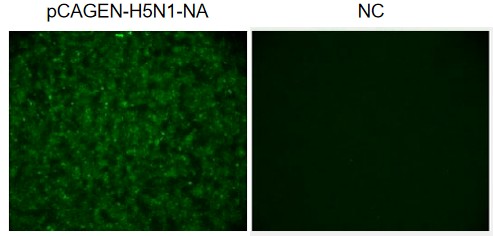 Fig 4. IFA analysis of HEK293T cells transfected with the pCAGEN-H5N1-NA plasmid using anti-H5N1 NA VHH-HRP.
References
| Cat. No. | Product Name | Application | |
| DMABC-JX255 | RapV™ Camel Anti-FAdV-4 Fiber1 VHH Antibody, clone XNV21 [HRP] | ELISA, WB | Inquiry |
| DMABC-JX256 | RapV™ Camel Anti-FAdV-4 Fiber2 VHH Antibody, clone XNV22 [HRP] | ELISA, WB | Inquiry |
| DMABC-JX252 | RapV™ Camel Anti-NDV HN VHH Antibody, clone XNV18 [HRP] | ELISA, WB | Inquiry |
| DMABC-JX253 | RapV™ Camel Anti-NDV (strain LaSota) VHH Antibody, clone XNV19 [HRP] | ELISA, WB | Inquiry |
| DMABC-JX254 | RapV™ Camel Anti-NDV Genotype VII VHH Antibody, clone XNV20 [HRP] | ELISA, WB | Inquiry |
| DMABC-JX241 | RapV™ Camel Anti-IAV H9N2 HA VHH Antibody, clone XNV08 [HRP] | ELISA, WB | Inquiry |
| DMABC-JX242 | RapV™ Camel Anti-IAV H5N1 NA VHH Antibody, clone XNV09 [HRP] | ELISA, WB, IF | Inquiry |
| DMABC-JX244 | RapV™ Camel Anti-IAV H9N2 HA VHH Antibody, clone XNV10 | ELISA, WB | Inquiry |
| Cat. No. | Product Name | Application | |
| DAGC-55263 | Recombinant FAdV-4 Fiber1 Protein [His] | ELISA | Inquiry |
| DAGC-55264 | Recombinant FAdV-4 Fiber2 Protein [His] | ELISA | Inquiry |
| DAGC-55265 | Recombinant FAdV-4 Penton Protein [His] | ELISA | Inquiry |
| DAGC-55266 | Recombinant FAdV-4 Hexon Protein [His] | ELISA | Inquiry |
| DAGC-55254 | Recombinant NDV Fusion Protein [Myc] | ELISA | Inquiry |
| DAGC-55255 | Recombinant NDV HN Protein [Myc] | ELISA | Inquiry |
| DAGC-55256 | Recombinant NDV Nucleocapsid Protein [Myc] | ELISA | Inquiry |
| DAGC-55257 | Recombinant NDV Phosphoprotein [Myc] | ELISA | Inquiry |
Loading ......
