ASM Microbe 2026
June 4-7, 2026 – Washington, DC, USA
ADLM 2026
July 26-30, 2026 – Anaheim, CA, USA

Quantitative Fluorescence Measurements with Multicolor Flow Cytometry Protocol

Introduction of Multicolor Flow Cytometry Protocol

Multicolor flow cytometers are used to monitor the level of expression of multiple cell receptors that are significant in disease diagnostics and immunotherapies. The complexity of the immune response necessitates the monitoring of as many cell receptors as practical. However, to determine the levels of expression of cell receptors requires quantitative measurements, which at present are not very satisfactory. The purpose of this chapter is to detail procedures which can lead to quantitative multicolor flow cytometer measurements. These quantitative measurements rely heavily on the availability of fluorescence standards to calibrate the flow cytometer. In the past, quantitative measurements with single color flow cytometers were performed using microspheres with assigned units of MESF (molecules of equivalent soluble fluorophore) to calibrate the fluorescence signal. Reference standards were developed for assignment of MESF values to microspheres with surface labeled FITC. The use of these microspheres was described in the Clinical and Laboratory Standards Institute (CLSI) guideline for fluorescence calibration and quantitative measurements. However, the quantitation methodology developed for single color cytometers is not easily extended to multicolor flow cytometers. It is impractical to produce different standard reference fluorophore solutions, such as National Institute of Standards and Technology (NIST) fluorescein Standard Reference Material (SRM) 1932, for every fluorophore label used in multicolor flow cytometry. An alternative approach to quantitative measurements with multicolor flow cytometers has been described. This approach involves two major steps and provides a scheme for converting the detected fluorescence signals in various fluorescence channels of a multicolor flow cytometer into numbers of antibodies bound per cell (ABC). The ABC numbers are good indicators of the actual number of different receptors on the cell surface. In the following, we describe the two major steps involved in the quantitation scheme.
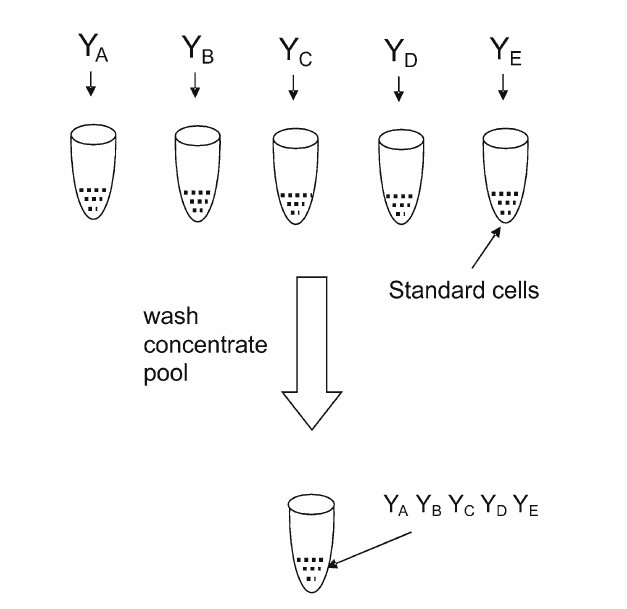
 A schematic of the process used to produce a biological standard.Figure1. A schematic of the process used to produce a biological standard.

Methodology for Quantitative Measurements

  1. In the first step, a unit of fluorescence intensity is assigned to a given population of hard dyed microspheres. The assignment is based on the equality of the fluorescence signals from the microsphere suspension and a solution of reference fluorophores. This fluorescence unit is defined as the equivalent number of reference fluorophores (ERF) that gives the same fluorescence signal as one microsphere. The ERF unit is different from MESF in that the fluorophores embedded in the microspheres and the fluorophores in the reference solution can be very different and may have very different molar absorptivities. Consequently, the ERF unit applies only to a specific excitation-detection scheme associated with a fluorescence channel (FC) in a multicolor flow cytometer. However, the ERF unit assignments can be performed using a fluorimeter that mimics the response of the flow cytometer. The microspheres embedded with multiple fluorophores display a broad emission profile to cover all FCs of multicolor flow cytometers. These microspheres were traditionally used to monitor the daily performance of the flow instruments. However, the microspheres with ERF assignments can also be used to define a linear scale for each FC. The scale is implemented by analyzing 5–6 different microsphere populations, each implanted with different amount of fluorophores and each assigned an ERF value. (We emphasize again that the ERF values are assigned for a specified laser excitation and a specified range of wavelength in the fluorescence detection channel.) For a given FC, the fluorescence signals associated with the different microsphere populations can be plotted versus the ERF values assigned to the different microsphere populations leading to the calibration curves. Such a calibration curve is obtained for each of the FCs yielding an estimate of linearity of response, dynamic range, and detection sensitivity. The detection sensitivity, Q, can be defined as photoelectrons per ERF molecule, and is an important measure of instrument sensitivity for multicolor flow cytometers. The availability of a fluorescence unit, such as ERF, allows the measurement and use of relative Q values for multiple channels of a multicolor flow cytometer.
  2. In the second step, a biological standard such as a lymphocyte with a known number of antibody binding sites (e.g. CD4 binding sites) is used to translate the linear ERF scale to an ABC scale. The antibody specific to the receptor is divided into several lots and each lot is labeled with one of the fluorophores that will be detected in each FC. The mixture of the biological cell standard and the antibodies is incubated. After the incubation, the cells stained with labeled antibodies are washed, concentrated, and pooled. Passing the labeled biological standard through the flow cytometer leads to a response in each of the FC. Subsequent to the calibration, flow cytometer measurements on the analyte cells can be reported in terms of ABC values. The fluorescence spectra of most label fluorophores cover a wide range of wavelengths. Consequently a given label fluorophore may give a large fluorescence signal in the FC assigned to that fluorophore and smaller fluorescence signals in FCs assigned to other label fluorophores. Clearly the fluorescence signal in the FC not assigned to a given label fluorophore is a bias and should be corrected. The correction procedure is called compensation and can be implemented using measurements of the individually labeled biological standard cells. Using the present example, five individual measurements would be carried out on each population of cells stained with an antibody against a highly expressed receptor (e.g. CD45 or CD8) which is labeled with a specific fluorophore. Appropriate mathematical computation, so-called software compensation, on the data collected for each population would provide the necessary correction factors. Note that cells labeled with antibody against CD4 are not optimal for compensation correction. Compared to CD8 or CD45, the expression levels of CD4 are relatively weak so that spillover estimates are hampered by low signal levels.

Materials of Multicolor Flow Cytometry Protocol

Staining Fresh Whole Blood

  1. Freshly drawn human whole blood.
  2. Phosphate buffered saline (1× PBS).
  3. Lysing solution: 1× FACSTM Lysing Solution or ACK lysing solution.
  4. Fluorescently labeled anti-CD4 antibodies covering every FC of a multicolor flow cytometer.
  5. Fluorescently labeled anti-CD8 (or anti-CD45) antibodies covering every FC of a multicolor flow cytometer.

Quality Control of Flow Cytometers

  1. BDTM Cytometer Setup and Tracking (CS&T) microspheres.
  2. Disposable 12 × 75-mm BD Falcon™ capped polystyrene tubes or equivalent.
  3. BD FACSFlow solution with surfactant.
  4. Flow cytometer.

Quantitative Fluorescence Measurements and Data Analysis

  1. Ultra Rainbow microspheres and/or CS&T microspheres.

Methods of Multicolor Flow Cytometry Protocol

In the following we will assign ERF values to Rainbow microspheres and use the microspheres to establish a linear scale for the fluorescence response. Fresh whole blood samples will be utilized to outline the procedure for converting the ERF scale to the ABC scale, which is used in reporting quantitative flow cytometry measurements. The procedures should be applicable for flow cytometers operated with 375, 405, 488, and 632 nm laser lines commonly used in most flow cytometers, and appropriate dichroic mirrors and band pass filters to define the FCs. In addition to the Rainbow microspheres, we will also use CS&T microspheres as another example for assuring instrument performance in terms of linearity, detection efficiency and optical background, and converting the linear scale to a biologically relevant scale. The procedure for the use of CS&T microspheres is different in detail, but very similar in conceptual basis to that outlined for Rainbow microspheres.

Staining Fresh Whole Blood

  1. Wash heparinized normal donor blood samples (6–8 mL) twice with 1× PBS in 50-mL centrifugal tubes. After centrifugation at ~450 × g for 10 min, plasma portion of the blood should be removed by aspiration. Replenish the blood volume with 1× PBS to the original blood volume.
  2. Aliquot 100 mL of washed whole blood into individual tubes. Incubate the whole blood in each tube with differently labeled antibodies designated for each FC of a multicolor flow cytometer for 30 min at room temperature: one set of tubes with anti-CD4 antibody and another set of tubes with anti-CD8 (or anti-CD45) antibody. Protect from light during incubation. Users can either adopt the amount of antibody recommended by a manufacturer (e.g. 20 mL of anti-CD4 antibody from BD Biosciences per 100 mL of whole blood) or perform their own antibody titration curve for the determination of an optimal amount of each antibody used. Start titrations at 3 mg per mL of antibody, and do six 1.5-fold dilutions. Choose the lowest concentration that gives nearly maximal fluorescence.
  3. Lyse the cell suspensions for 10 min with 2 mL of a lysing solution. After centrifugation at ~450 × g for 10 min, remove the supernatant.
  4. Wash once more with 1× PBS. After centrifugation at ~450 × g for 10 min, remove the supernatant.
  5. Add a small volume of 1× PBS (100 mL) in each tube and combine a half volume of differently stained whole blood cells in different tubes into a single tube to make a final sample volume of no more than 1 mL with 1× PBS.
  6. Acquire samples immediately or store tubes at 4°C and acquire within 2 h.

Quality Control of Flow Cytometers

CS&T microspheres are designed for use with BD FACSDivaTM6.0 software to provide automated cytometer characterization and performance tracking of supported BD™ digital flow cytometers. These microspheres are uniquely manufactured to be used with up to 21 different fluorescent parameters for cell analyzers as well as cell sorters. They can also be used with other cytometers if the analysis, described below, is implemented using the software resident on the cytometer. The CS&T microspheres consist of three hard dyed fluorescence microsphere populations. The fluorescence intensity of the bright microspheres is close to the stained cells such as CD4+ stained with various fluorophores. The bright microsphere of CS&T microspheres is used to set the target median fluorescence intensity (MFI) value for cytometer tracking and quality control. The coefficient of variation(CV) of the bright microsphere population is small enough and is used for the assessment of laser alignment to the sample core stream of the flow cell in cytometer. The mid and dim microsphere intensities are designed to measure cytometer performance such as the photon detecting efficiency and the optical background. The dim microspheres mimic the unstained, negative cell intensity. These hard dyed microspheres are stable in time and with temperature. These characteristics make the microspheres ideal for cytometer performance setup and tracking.

Diluted CS&T microspheres are run on the flow cytometer. The MFI and robust CV (rCV) are measured for each microsphere population in all fluorescence detectors. Algorithms within the software differentiate the fluorescence signal from each microsphere type based on the size (scattering) and fluorescence intensity in each detector. The software then uses this data to calculate and report a variety of measurement parameters. The parameters include an estimate of the linear response range, the standard deviation of the electronic noise, and cytometer settings adjusted for maximizing population resolution in each detector. Each lot of bright CS&T microspheres is assigned a fluorescence intensity value in BD internal tracked fluorescence unit referred to as Assigned BD unit (ABD). The ABD value is associated with and is very roughly equivalent to freshly stained CD4+ lymphocytes, which is assumed to yield a cytometer response corresponding to a ABD value of 40,000.

  1. Prepare the CS&T microspheres suspension immediately before use. Add three drops of CS&T microspheres into a 12 × 75-mm tube, with BD FACSFlow solution with surfactant or 1× PBS. Vortex the microsphere suspension thoroughly.
  2. Run CS&T microspheres in suspension on a flow cytometer. Perform cytometer setup to bring the bright microsphere population close to the maximum of MFI axis and within the linear range of each FC. Record 20,000 total events.
  3. Draw a gate on the population showing high scatter intensities on the forward scatter channel (FSC) versus side scatter channel (SSC) dot plot. Draw two subgates on the bright and mid microsphere populations on a histogram of, as an example, the fluorescein isothiocyanate (FITC) channel. This procedure can be performed on any cytometer.
  4. On the same FSC versus SSC dot plot, draw another gate on the population with low scatter intensities shown as the 2 mm gate. This is the dim microsphere population.
  5. The detection efficiency, Qr, is estimated by the slope of rSDph2 vs median of mid and dim microspheres. The rSDph is the robust standard deviation from photon statistics, which is equal to the rSD corrected for the intrinsic microsphere variation. It can be calculated as rSDph = rCVph × (median) /100 for mid and dim microspheres, where rCV = (rCV2-rCVbright2)1/2.
  6. Calculate the slope, k, and intercept, m, of the rSDph2 versus median channel value plot. Note that rSDph2 is used to represent the intensity of the fluorescent photons. This is valid because the SD of the pulse heights from a detector is proportionate to the square root of the photon intensity impinging on the detector. The procedure described above is referred to as the SD2 method.
  7. Compute the Qr and Br using the following equations:
    Qr = 1/k × medianbright/ABD, B =m × Qr × (ABD/medianbright)2
    The parameters, Qr and Br, are calculated in terms of ABD unit. It is assumed that a calibration by the bright microspheres in terms of ABD units has been performed. The method described above provides an estimate of Qr and Br value. It is assumed that the rCV of the bright microsphere provides a correction for the intrinsic CV of fluorescence microsphere. The actual method involves more than the CV of the bright microsphere.

Quantitative Fluorescence Measurements and Data Analysis

In principle, quantitative multicolor flow cytometer measurements can be carried out the ABD units described in Quality Control of Flow Cytometers. However, this approach contains assumptions about qualities of various antibodies and labeling fluorophores (see Note 2) and is optimally applicable to BD Biosciences' instrument platforms. The usefulness of ERF units for the calibration of fluorescence intensity measurements using multicolor flow cytometers is currently being undertaken by the fluorescence calibration task force of International Society for Advancement of Cytometry (ISAC) Standards Committee. Through this exercise, CS&T microspheres would be assigned with ERF values enhancing their utility in different, commercially available flow instrument platforms. Pertinent steps are summarized here.

  1. Add one to three drops of both blank and fluorescent calibration microspheres in 0.5 mL of PBS. Acquire 20,000 events within a most populated microsphere gate on the FSC versus SSC dot plot. Make sure that the brightest fluorescent microsphere population lies within the quantifiable cytometer scale. For analysis, use different gates in each FC histogram to obtain the five median (or geometric mean) channel values for the calibration microspheres.
  2. Construct a calibration curve of the calibration microspheres, median channel value (x-axis) vs ERF value (y-axis). The linear curve fitting results in a linear fitting equation, YERF = a ∙Xmedian channel + b, for every FC of the multicolor flow cytometer, where parameters, a and b, refer to slope and intercept of the linear fit in a given FC, respectively.
  3. FC compensation is carried out by using an unstained control and individual samples of cells stained with different fluorochome-labeled anti-CD8 (or anti-CD45). It is assumed that appropriate software is available to perform the compensation correction.
  4. Run the fluorescently anti-CD4 stained whole blood samples and obtain the respective fluorescence histogram in every FC.Apply a double gating strategy: lymphocyte gate in the FSC vs SSC dot plot, and CD4+ gate on the fluorescence histogram. Obtain the median channel value of CD4+ lymphocyte population for every fluorescence channel. The currently accepted ABC value for freshly stained CD4+ lymphocytes is about 48,000(see Notes 2–4).
  5. Run an unknown blood sample and obtain its median channel value. Determine the ABC value of the receptor of interest in the unknown sample by the following equation, ABCunknown =48,000 + a ∙ (Xunknown − XCD4+), where a is the slope of the linear fit described in step 2, and Xunknown and XCD4+ are the median channel values of the unknown and CD4+, respectively.

Notes of Multicolor Flow Cytometry Protocol

  1. Qr and Br are calculated using actual microsphere intrinsic CV differences and extensions of the original approaches.
  2. It is recommended that a single clone of the antibody amenable to labeling with different types of fluorophores associated with various fluorescence channels is used for the scale conversion. Assuming that similarly labeled, but different antibodies against different antigens have the same average fluorescence per antibody bound, yields a direct measure of ABC. The assumption of equivalent fluorescence of bound antibodies is a significant one that needs to be verified and should include an assessment of uncertainties. A basic factor to consider is whether the effective number of fluorophores per antibody (effective F/P) is the same for the calibration antibody and test antibodies. The ideal situation would use antibody conjugates that consisted of only one fluorophore coupled to each antibody in a location that did not interfere with the ability of the antibody to bind to antigen. Frequently a fluorochrome conjugated antibody will have lower affinity than unconjugated antibody, so both the calibration antibody and any test antibodies should be purified to exclude unconjugated antibody. It is also possible that two different conjugates of the same antibody reagent conjugated with the same average number of fluorophores could give different degrees of cell staining if the distribution of F/P is different.
  3. Poncelet and co-workers reported in 1991 that CD4+ T cells from HIV-infected individuals bound consistently about 46,000 CD4 Mab molecules measured according to the calibration curve generated with cell lines expressing known amounts of CD5 molecules detected via radiolabeled CD5 Mab. A similar CD4 expression level on fresh normal whole blood (~48,000) was measured by researchers. It using three different methods including the most sensitive method that utilized unimolar Leu 3a-PE conjugate and Quantibrite PE microspheres. Nonetheless, measurements of CD4 expression using flow cytometry depend on variables such as fixation conditions, antibody clones, fluorophore and conjugation chemistries, and quantitation methods used and references therein; also see Note 2). An ultimate proteomic approach is currently under investigation for quantifying the number of CD4 receptors per CD4+ T lymphocyte using recombinant soluble CD4 proteins as reference standards.
  4. A lyophilized human blood reference cell standard is presently under development for quantification of CD4+ cell numeration and CD4+ receptor expression. This lyophilized cell standard is produced at the National Institute for Biological Standards and Control, a WHO designated blood institute. The CD4+ count of the reference material will be measured according to the secondary reference measurement procedure of the International Council for Standardization in Hematology (ICSH). The CD4+ expression level will be measured by flow cytometry and ultimately by proteomic approaches carried out at National Institute of Standards and Technology (NIST, USA). The lyophilized reference cell standard will resolve an issue associated with the accessibility of fresh blood samples for most research laboratories.

Reference

  1. Teresa S. Hawley, Robert G. Hawley. Flow Cytometry Protocols. MIMB. 2011, volume 699. ISSN: 978-1-61737-950-5.
Inquiry Basket