ASM Microbe 2026
June 4-7, 2026 – Washington, DC, USA
ADLM 2026
July 26-30, 2026 – Anaheim, CA, USA

Bead-Based Multiplexed Analysis of Analytes by Flow Cytometry Protocol

Introduction of Bead-Based Multiplexed Analysis Protocol

This chapter provides detailed protocols for the multiplexed analysis of user selected analytes by flow cytometry using fluorescence labeled microspheres or beads. There are a number of commercial kits available where the assay for the analyte has been implemented, but there are gaps in the analytes assessed by these kits. For many applications, it is worthwhile to develop a custom kit for the analyte of interest, and protocol examples are provided here. Moreover, this microsphere-based flow cytometry assay can be used to determine other parameters, such as affinity, protease sites, SNPs amongst others; we will provide examples of how levels and affinity can be assessed by using this microsphere platform.
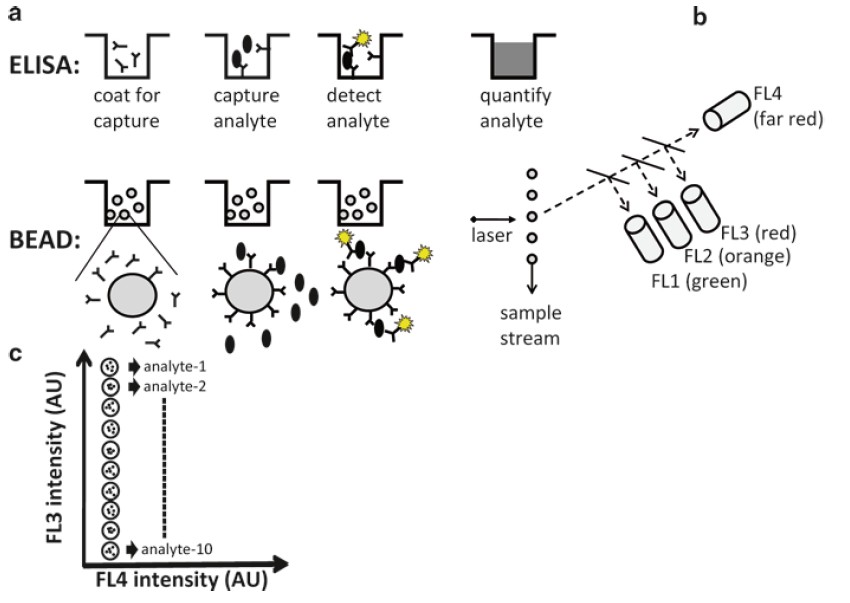
Quantification of analytes.Figure 1. Quantification of analytes.

In essence, any assay that is performed on a solid support with colorimetric, fluorescence, or luminescence detection can be converted to the multiplexed microsphere analysis (MMA). In an ELISA, the capture molecule (usually antibody) is coated onto the plate by overnight incubation; alternate approaches are to use a capture biotinylated molecule, which binds tightly to streptavidin coated plates. In many cases, the capture molecule will be a monoclonal antibody (mAb) but may be any molecule (e.g. proteins or oligonucleotides) that binds the analyte with reasonable affinity. The plate is then washed to remove the unbound antibody. Dilutions of the sample are added to vary the concentration of the analyte, which binds to the capture antibody after several hours of incubation; dilutions of the sample are needed because the linear range of an ELISA is limited. The unbound analyte is washed off. The captured analyte is detected with an antibody specific for a site on the analyte distinct from the binding site of the capture molecule. This antibody can be directly conjugated with peroxidase or alkaline phosphatase or a secondary antibody coupled with an enzyme can be used. The enzyme then converts the colorimetric substrate and the reaction is terminated after a selected period of time. The absorbance is a measure of the amount of analyte captured. Because only a single color is used in this assay, only a single analyte is measured in each well.

In MMA, the beads or microspheres become the solid support in the ELISA and the detection system is fluorescence intensity assessed by flow cytometry rather than colorimetric. The first or coating step is to conjugate the microsphere with the capture molecule. The analyte is then captured on the bead surface. The analyte is then detected by flow cytometric assessment of the fluorescence intensity of each bead. At least 200 individual microspheres for a particular analyte are measured. Conceptually, each microsphere analyzed represents a miniaturized ELISA.

The analysis of multiple analytes by bead-based technologies is possible because flow cytometry measures fluorescence intensity at multiple bands of wavelengths and the beads are impregnated with fluorescent dyes. Each bead population exhibits one of ten different intensities in a selected channel (usually red or FL3); these different intensities can be distinguished in the red channel of the flow cytometer. The capture molecule for each of up to ten analytes is conjugated onto a population of beads with distinct fluorescence, up to a maximum of ten. The intensity of FL3 fluorescence thus provides the "address" of analyte. The orange channel (FL2) is used for detection. If more than ten analytes need to be analyzed simultaneously, beads impregnated with two fluorescent dyes can be used emitting in the red FL3 and far-red FL4 channels. Ten different intensities of fluorescence in each channel have been achieved, providing a 10 × 10 matrix of intensities or 100 different addresses.

The bead assay exhibits similar sensitivity as the original ELISA because similar reagents are used except possibly at the detection step. Fluorescence intensity measurement by flow cytometry using photomultiplier tubes is sensitive, providing the rationale for the sensitivity of bead assay despite the absence of an amplification step. The ELISA uses an enzyme to amplify the signal, which decreases its linear range. The bead assay also exhibits improved reproducibility: the ELISA comprises the assessment of a single well whereas the bead assay represents the median value of about 200 mini-ELISAs performed on the microspheres. In our laboratories, we therefore prefer to use bead assays in the place of conventional ELISA.

Materials of Bead-Based Multiplexed Analysis Protocol

Microspheres, Supplies, and Equipment

  1. Single color microspheres exhibiting up to ten distinct intensities.
  2. Single color microspheres coated with Streptavidin.
  3. Two color microspheres exhibiting up to 100 distinct intensities.
  4. Quantum-PE Molecules of Equivalent Soluble Fluorochrome calibration microspheres.
  5. Multiscreen HTS–BV 1.2 mm non sterile filter plates.
  6. Multiscreen HTS Vacuum manifold.
  7. Siliconized microcentrifuge tubes.
  8. Digital shaker; rotator.
  9. Plate reading flow cytometer. Examples include: Luminex analyzer, Luminex-based analyzer, FACSArray Bioanalyzer, FlowCytomix Pro. Luminex microspheres must be used on Luminex or Luminex based instruments whereas other microspheres are designed for conventional flow cytometers such as BD and Beckman Coulter instruments.

Buffers and Reagents

  1. Phosphate buffered saline (PBS).
  2. PBS containing 0.02% Tween.20.
  3. PBS containing 30 mM glycine.
  4. Activation buffer: 2-(N-morpholino) ethanesulfonic acid buffer.
  5. Capture buffer for proteins: PBS with 0.02% Tween 20 and 10% serum or plasma, or commercial source.
  6. Capture buffer for nucleic acids.
  7. Wash buffer: PBS with 0.02% Tween 20.
  8. Plasma or serum (see Note 1).
  9. 1-Ethyl-3-(3-dimethylaminopropyl) carbodiimide hydrochloride.

Methods of Bead-Based Multiplexed Analysis Protocol

Coating of Beads with Molecule to Capture Analyte

The microspheres are first conjugated with the capture molecule (see Note 2). Depending on the application, the capture may be an antibody, a protein, or oligonucleotide. The following protocols may be used to conjugate these molecules to microspheres.

  • Quick and Easy Conjugation of Beads with Carbodiimide Chemistry
  1. Resuspend 1 × 10⁷ washed and pelleted (14,000 × g) microspheres in a siliconized microcentrifuge tube with 100 mL of concentrated capture molecule (0.1 mg/mL works well) in PBS and incubate overnight at 4°C.
  2. Add 900 mL of PBS to the microspheres (1 mL total volume).
  3. Weigh 10 mg of EDAC in a siliconized microcentrifuge tube and then add the solution containing microspheres. Vortex well for at least 30 s and then incubate with rotation at 4°C for 60 min.
  4. Wash the microspheres three times with 1 mL of PBS containing 0.02% Tween 20.
  5. On the final wash, count the beads by flow cytometry and resuspend at 1 × 10⁷/mL. Store at 4°C.
  • Controlled Conjugation of Protein to Microspheres with Carbodiimide Chemistry
  1. Wash 1 × 10⁷ microspheres in a siliconized microcentrifuge tube three times with MES activation buffer and ensure the microspheres are well resuspended by vortexing vigorously.
  2. Resuspend in 1,000 mL of PBS and add 10 mg of EDAC.
  3. Allow to react for 15 min at room temperature with rotation.
  4. Wash twice with PBS; resuspend in 1,000 mL of PBS and 100 mL of capture molecule solution (usually 1 mg/mL for antibodies). This step may require titration to achieve the optimal conjugation: too little – the signal is low; too much–allosteric hindrance prevents optimal binding of the analyte.
  5. React microspheres with capture molecule for 2–4 h at room temperature.
  6. Wash microspheres with PBS containing 30 mM glycine and then wash with PBS containing 0.02% Tween 20.
  7. Count the microspheres and resuspend at 1 × 10⁷/mL. Store at 4°C until needed.
  • Capture of Double Stranded Oligonucleotides to Microspheres

Proteins or oligonucleotides can be conjugated to carboxyl modified microspheres. A simpler alternative that ensures the correct orientation of the microsphere is to use streptavidin-coated microspheres and either a biotinylated protein or an oligonucleotide synthesized with biotin at 5′ nucleotide. The biotinylated capture molecule is incubated at saturating concentrations with the microspheres. After the capture step, the microspheres are washed twice in PBS with 0.02% Tween 20. Resuspend at 1 × 10⁷/mL. Store at 4°C.

Assessment of Antibody Levels

The assessment of analyte levels can be performed in two types of assays: titer and absolute quantification. The titer allows comparisons of groups without determining the actual concentration. The titer of a sample is defined as the highest dilution of sample that provides a detectable signal by the assay. Some commercial kits use the titer to assess the differences in the phosphorylation of intracellular proteins. In this case, capture antibodies specific for the selected intracellular proteins are conjugated to distinct populations of microspheres. Titer is often used to compare the antibody levels in infected versus uninfected animals, or to compare the efficacy of different vaccine protocols for eliciting antigen-specific antibody. In this example, each of the selected antigens is conjugated to a population of beads. The levels of nuclear translocation can also be assessed by titer to compare activation of transcription within cells by a selected molecule. In the nuclear transcription factor assay, nuclear extracts are made, and the transcription factors selected for analysis are captured by populations of microspheres with oligonucleotides specific for each transcription factor.

Once the selection of the capture molecule has been made and the populations of microspheres generated, the titer assay can be performed and detailed below.

  1. Mix the populations of microspheres for the assay with particular attention paid to blocking the microspheres well in order to minimize nonspecific binding to the bead (see Note 1). Microspheres (1 × 10⁴/mL) are mixed in capture buffer with blocking proteins/nucleotides (see Note 1).
  2. Wet filters by adding 200 mL of wash buffer to the well and then applying vacuum to aspirate the buffer through filter (i.e. washing).
  3. On the first row of a 96-well plate, pipette 20 mL of PBS containing 0.02% Tween 20 (comprises unlabeled beads) into wells 1, 2, and 3; then pipette 20 mL of a positive control into wells 4, 5, and 6.
  4. Pipette 20 mL of capture buffer into the second row of 12 wells on the 96-well plate; the number of rows equals the number of samples to be tested. Dilute the sample 1:2 with capture buffer (20 mL sample into 20 mL buffer) in the first well and then complete the serial dilution by pipetting 20 mL from each well into the next, mixing, then repeating until well 12.
  5. Add 10 mL of the microsphere mixture to each well and mix by pipetting gently.
  6. Cover the plate with plastic sealer to prevent evaporation and place on a digital mixer. The incubation time varies with the molecule to be captured and this step may need to be optimized. Generally, antibodies in serum or plasma require 2 h of incubation at 4°C; intracellular proteins require overnight incubation at 4°C; and oligonucleotide capture of transcription factors requires 4 h incubation at room temperature. This step can be performed in V-bottom plates and then transferred to filter microplates by using a multichannel pipette.
  7. Place the filter microplate on the suction device and apply vacuum; the supernatant should be suctioned off into the collection container below.
  8. Add 200 mL of wash buffer and suction off fluid; repeat for two washes.
  9. Add 30 mL of detection molecule directly conjugated with PE and incubate for 1 h at room temperature with mixing on a rotator. The concentration of the detection molecule should be optimized by titration, but 0.1 mg/mL should be saturating for detection antibodies and provides an initial starting concentration.
  10. The fluid is suctioned off and the microspheres washed twice. The microspheres are then resuspended in 200 mL of wash buffer. The plate is then placed in a plate reading flow cytometer or Luminex instrument depending on the microspheres chosen.
  11. Acquire the negative and positive controls to verify that the assay is working and then acquire the samples and collect at least 200 × # microsphere populations events.
  12. Generate a dot plot for FL3 versus FL4. Each selected microsphere population should be present with about 200 events and exhibit distinct fluorescence from each other. Place a region around each microsphere population and label the population.
  13. Determine the median intensity of PE fluorescence at each dilution of the sample for each of microsphere population. The lowest dilution should exhibit the greatest signal, which decreases as the analyte is diluted. Plot the FL2 intensity versus dilution in log scale for each sample and each microsphere population. The lowest dilution is on the right of the x-axis; the highest dilution is on the left. The dilution value with detectable signal (usually two standard deviations above the signal of the blank microspheres (wells 1–3) then is the titer of the sample for the analyte defined by the microsphere population.

Quantification of Analyte Levels

In order to perform absolute quantification of analytes, each of the selected analytes must be available purified with the concentration of the analyte defined. An initial stock solution is made comprising a defined concentration of each analyte under investigation (=standard). Twofold dilutions of this standard are made in the first 12 wells of the 96-well filter plate. Each sample and twofold serial dilutions of the sample are pipetted into another 12 wells of the plate; replicates of the sample may be performed to measure standard deviation for each sample. The median intensity of fluorescence is assessed for each microsphere population with the standard and sample. The median intensity of fluorescence for each microsphere population binding a specific analyte is then plotted vs. the known concentration of analyte to generate a standard curve. In the linear portion of the curve, a regression line is calculated. The derived line is then used to determine the concentration of the analyte in samples.

Assessment of Analyte Affinity

If the capture microsphere comprises a protein or oligonucleotide, then it is possible to determine the affinity of the analyte for the capture molecule. This measurement is useful to assess the affinity of antigen-specific antibody elicited by infection or vaccination. It is also useful for assessing how the affinity declines for antigenic variants of the same protein. By including a set of oligonucleotides with selected mutations, the changes in affinity of binding of transcription factors can be screened for each mutation. The procedure for affinity assessment of antibody by microsphere analysis is described below:

  1. Assess the median fluorescence intensity of analyte binding to the microspheres after twofold dilutions of known concentrations of the analyte.
  2. Without changing the settings on the flow cytometer, acquire about 2,000 events using Quantum-PE MESF calibration microspheres. There are five peaks each with the number of fluorophores for each peak defined by the manufacturer. Perform linear regression on the line and then use this line to calculate the MESF for each of the median fluorescence intensities measured for each analyte concentration.
  3. Determine the fluorophore/protein ratio for the detection antibody and convert the MESF to the number of molecules bound. First, assess absorbance of the protein in a 1 cm cuvette at 280 nm (A280) and at excitation λmax for fluorophore (Aλmax ; λmax PE: 578 nm; λmax FITC: 564 nm). The protein concentration is then calculated by using the following formula:

    Bead-Based Multiplexed Analysis of Analytes by Flow Cytometry

    where eprotein is the molar extinction coefficient in cm−1 M−1 (203,000 for IgG at 280 nm); dilution is any dilution performed during the absorbance measurement. The correction factor is the fluorophore's contribution to the absorbance at 280 nm and is measured by assessing the fluorescence of an equal concentration of labeled and unlabeled protein (Aλmax = 0); the correction factor for FITC is 0.3. The fluorophore to protein ratio (F:P) is:

    Bead-Based Multiplexed Analysis of Analytes by Flow Cytometry

    where edye is the extinction coefficient of fluorophore at its absorbance maximum (FITC: 68,000 cm−1 M−1). The number of fluorescent molecules bound, which is an estimate of the number of molecules captured on the microsphere, is calculated by dividing the MESF by the F:P ratio. There is a simpler approach to assessing F:P for antibodies by using microspheres coated with precise numbers of anti-Ig antibodies (see Note 3).
  4. Plot the # of molecules bound versus the concentration. This curve is then fit with a hyperbolic single site binding curve.

Notes of Bead-Based Multiplexed Analysis Protocol

  1. Blocking the spaces without capture analyte is an important step to improve the signal to noise ratio of the assay. Blocking molecules bind via adsorption to the microsphere, thereby preventing other molecules (such as the fluorescence-labeled detection molecule) from binding non-specifically to the microsphere. Many companies sell blocking agents under trade names; however, the compositions of these buffers are trade secrets. For our assays analyzing the levels of Ig, we used the same species of plasma as the detecting mAb (rat) to ensure that the detecting mAb did not exhibit cross reactivity. Using 10% plasma or higher in our hands markedly decreased non-specific binding. Herring sperm (10 mg/mL) is added as a blocking agent if oligonucleotides are used.
  2. There are two important parameters that need to be confirmed for the conjugated microspheres: (a) capture molecule is conjugated to the microsphere, and (b) there is low variation in the amount of molecule conjugated to the bead. The simplest approach to verifying that the microsphere is conjugated is by using a fluorescence-conjugated mAb specific for the capture molecule. Starting with a saturating concentration of mAb and then by titrating the fluorescence-labeled mAb over the microspheres, it is possible to determine the number of capture molecules that have been conjugated on the surface of the bead. Alternately, the labeling with a saturating concentration of the fluorescent mAb specific for the capture molecule is assessed by flow cytometry and compared with beads labeled with an isotype control antibody. The labeling should result in at least a two-decade shift in fluorescence intensity and the standard deviation of the labeling should be low.
    Oligonucleotides usually do not have specific antibodies directed against them. To verify that the double stranded oligonucleotides are conjugated to the beads, the binding of the oligonucleotide to the microspheres is detected by incubating them with propidium iodide (100 mL of 5 mg/mL) for 0.5 h and then washing the microspheres once to remove excess propidium iodide. There should be at least a single decade shift if the oligonucleotides have bound to the microspheres and the binding should be saturated. A similar approach may be taken with fluorescent dye that labels proteins CBQCA.
  3. Bangs laboratories sells the Quantum Simply Cellular kits, which can be used to directly quantify the number of molecules without the need for determining the protein concentration and using MESF standard beads. There are five populations of microspheres each conjugated with known amounts of anti-Ig mAbs (0; 8,000; 34,000; 96,000; and 181,000). Saturating quantities (determined by titration) of the fluorescence labeled mAb is incubated for 30 min with microspheres and the intensity of fluorescence assessed by flow cytometry. The median intensity of fluorescence for each population is then plotted versus the known number of binding sites. A linear regression line is calculated. The intensity of fluorescence determined in the experiment is then converted to # of molecules by using the linear regression line.

Reference

  1. Teresa S. Hawley, Robert G. Hawley. Flow Cytometry Protocols. MIMB. 2011, volume 699. ISSN: 978-1-61737-950-5.
Inquiry Basket