
Inquiry Basket
 Loading ......
Various lipids and lipid metabolites bind to and modify proteins in eukaryotic cells, which is termed "protein lipidation." There are four main types of protein lipidation, including myristoylation, glycosylphosphatidylinositol anchoring, palmitoylation, and prenylation. Myristoylation, as an important post-translational modification (PTM), involves attaching myristic acid molecules to the N-terminal glycine residues of specific proteins and affects their physiological properties, such as plasma targeting, subcellular tracking and localization, thereby affecting protein function. N-myristoylation is gaining increasing attention in the field of human diseases due to the identification of novel pathogenic N-myristoylated proteins. This PTM has been implicated in a wide range of conditions, including infectious diseases, parasitic diseases, and cancer.
The mechanism of N-myristoylation involves a series of enzymatic reactions that attach a myristoyl group, derived from myristic acid, to the alpha-amino group of an N-terminal glycine residue of specific proteins. The process of myristoylation can occur either co-translationally or post-translationally, depending on the timing of the addition of the myristoyl group to the protein.
Co-translational myristoylation refers to the addition of the myristoyl group to the protein during the process of protein synthesis. The myristoyl group is attached to the nascent protein chain shortly after the initiator methionine residue is removed. The co-translational myristoylation mechanism involves the following steps:
Post-translational myristoylation occurs after the protein has been fully synthesized, folded, and released from the ribosome. The myristoylation of the protein takes place in the cytoplasm or in specific compartments of the cell. The post-translational myristoylation mechanism involves the following steps:
Co-translational myristoylation and post-translational myristoylation both result in the covalent attachment of the myristoyl group to the protein. The timing of myristoylation can have functional implications, as co-translational myristoylation allows for immediate membrane targeting and localization of the nascent protein, while post-translational myristoylation can regulate protein activity or localization in response to specific cellular signals or conditions.
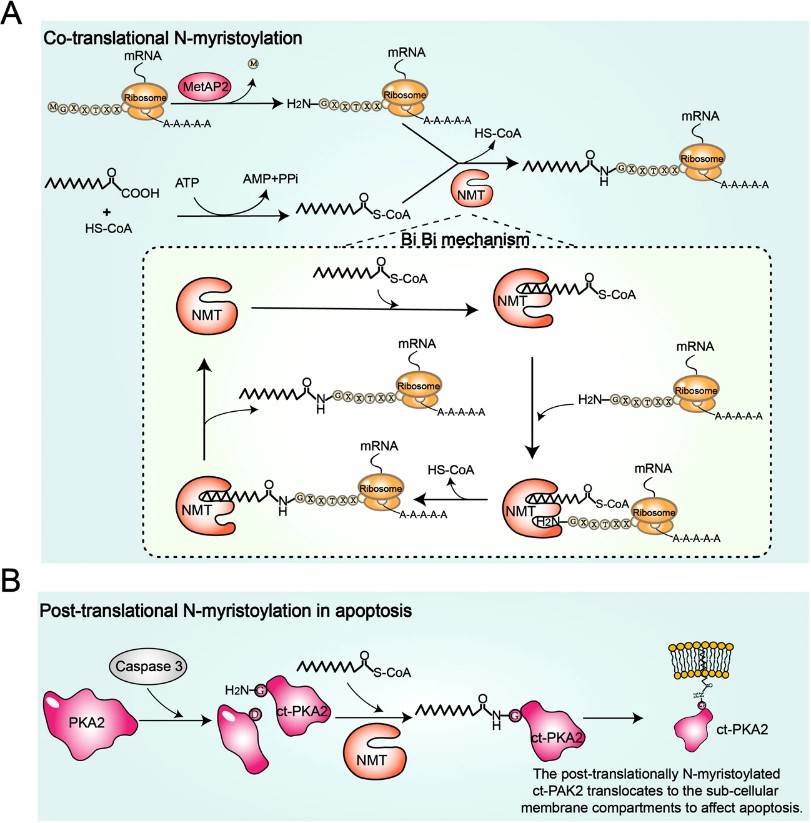 Figure 1. The molecular mechanism of protein N-myristoylation catalyzed by N-myristoyltransferase (NMT).
(Source: Wang, B. et al., 2021)
Protein N-myristoylation has significant biological importance and plays various roles in cellular processes. Some key biological significances of protein N-myristoylation include:
Dual modifications of myristoylated proteins refer to the presence of additional PTMs occurring in conjunction with protein N-myristoylation. These dual modifications can further modulate protein function, localization, stability, and interactions, adding an extra layer of complexity to the regulation of myristoylated proteins. Some common examples of dual modifications in myristoylated proteins include:
References
For research use only, not for use in diagnostic procedures.
| Target | Cat. No. | Product Name | Expression System | Tag/Conjugate | Application | |
| Methionine | DAG3368 | L-Methionine [G-BSA] | N/A | G-BSA | IHC, ICC | Inquiry |
| NO-L-Methionine | DAG3382 | NO-L-Methionine [G-BSA] | N/A | G-BSA | IHC, ICC | Inquiry |
| RSV G Protein | DAG-H10335 | Recombinant RSV Glycoprotein G (Asn 66-Arg 297) [His] | HEK293 | His | N/A | Inquiry |
| DAG-H10336 | Recombinant RSV Glycoprotein G (strain B1) [His] | HEK293 | His | N/A | Inquiry | |
| DAG-H10337 | Recombinant RSV Glycoprotein G [His] | Insect cells | His | N/A | Inquiry | |
| DAG-H10338 | Recombinant RSV Glycoprotein G (Asn66-Arg297) [His] | HEK293 | His | N/A | Inquiry | |
| VZV G protein | DAG3110 | Native VZV Glycoprotein | N/A | Unconjugated | ELISA, WB | Inquiry |
| Target | Cat. No. | Product Name | Size | Species Reactivity | Application | Detection Sample | |
| NMT1 | DEIA-FN1002 | Rat Nmt1 (Glycylpeptide N-tetradecanoyltransferase 1) ELISA Kit | 96T | Quantitative | serum, plasma, cell culture supernatants, tissue homogenate | Inquiry |
Loading ......
