
Inquiry Basket
 Loading ......
A healthy nutritional state is required for all aspects of reproduction and is signaled by the adipokine leptin. Leptin acts in a relatively narrow concentration range: too much or too little will compromise fertility. The leptin signal timing is important to prepubertal development in both sexes. In the brain, leptin acts on ventral premammillary neurons which signal kisspeptin (Kiss1) neurons to stimulate gonadotropin releasing hormone (GnRH) neurons. In the pituitary, leptin stimulates production of GnRH receptors (GnRHRs) and follicle-stimulating hormone at midcycle, by activating pathways that derepress actions of the messenger ribonucleic acid translational regulatory protein Musashi. In females, the normal range of serum leptin levels (10-20 ng/mL) along with gonadotropins and growth factors promote ovarian granulosa and theca cell functions and oocyte maturation. In males, the prepubertal rise in leptin promotes testicular development. In adult males, leptin levels are 10% to 50% of those in females, and high leptin inhibits testicular function.
Food availability is considered the single most important environmental factor that influences mammalian reproduction. The first recognized role for leptin was to send a negative feedback signal to the brain when energy stores were adequate, resulting in decreased food intake and increased energy expenditure. However, studies of animals that are leptin deficient revealed that leptin also plays a dynamic role in reproduction. The findings point to adipocytes as the main, if not the only, source of circulating leptin and are consistent with the tight association between circulating leptin and adiposity.
Pleiotropic leptin receptors. The leptin receptor (LEPR), a product of the Lepr gene and a member of the class I cytokine receptor superfamily. LEPR forms dimers or oligomers and can heterodimerize in the presence and absence of leptin, LEPRs are distributed intracellularly in target cells in the receptor-mediated endocytic pathway.
LEPR signaling pathways. The best characterized signaling pathway activated by the long isoform LEPRb is the Janus kinase (JAK) and signal transducer and activator of transcription proteins (STAT3 and STAT5). Ablation of STAT5 and/or STAT3 in cells expressing LEPR results in normal puberty onset, cyclicity, and fertility over a 4-month period, suggesting that HPG target cells process leptin signals through multiple signaling pathways.
Leptin target cells in the hypothalamus. Stimulation by leptin is mediated by neurons in the ventral premammillary nucleus (PMV), which send connections to kisspeptin neurons in the anteroventral periventricular and caudal arcuate nuclei and stimulate Kiss1 expression by glutamate, PACAP or nitric oxide. Also, leptin normally inhibits the orexigenic AgRP-NPY-GABAergic neurons in the arcuate. When leptin signals are reduced (by food deprivation, for example), these neurons signal kisspeptin neurons in the AVPV and caudal arcuate, inhibiting the expression of Kiss1 by AgRP or GABA. These actions ultimately stimulate or inhibit GnRH neurons and modulate pulsatile activity to effect gonadotropin secretion and the LH surge.
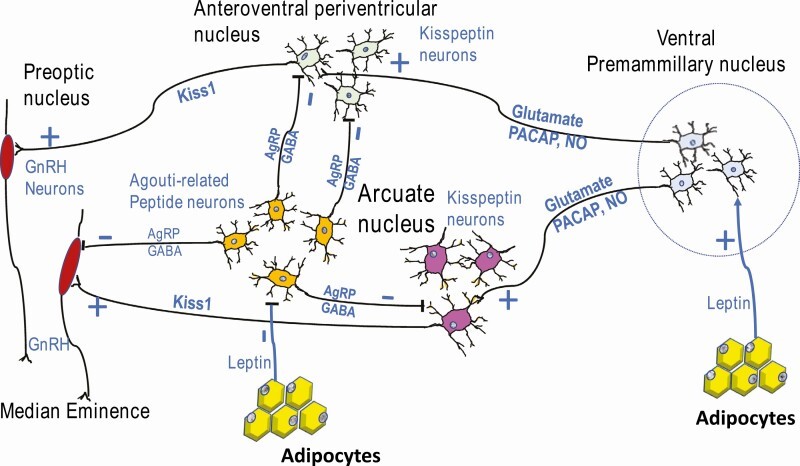 Fig 1. Pathways for leptin's permissive actions in the hypothalamus.
(Source: Endocrinology, 2021)
Pituitary gonadotropes as leptin target cells. Leptin receptors on gonadotropes and somatotropes receive rising serum leptin which peaks at midcycle. Leptin stimulates gonadotropes to produce GnRHR proteins and Fshb and activin mRNAs in partnership with pulsatile GnRH and estradiol positive feedback. Leptin also stimulates the translation of GH and GHRHR proteins to support the cogonadotropic function of somatotropes.
Leptin's actions on gonadotropes: a role for Musashi. Musashi functions to regulate differentiated gonadotropes by mediating their expression of GnRHR. The data support the hypothesis that leptin functions to stimulate hormone expression in the gonadotrope, through its up regulation of GnRHR, activin, and Fshb mRNA levels. We propose that when nutrition is optimal, the midcycle rise in serum leptin would be permissive for the translation of Gnrhr mRNA resulting in an activated gonadotrope population.
Biphasic actions of leptin on target cells in the ovary. All ovarian follicular cells have leptin receptors and physiological levels of leptin stimulate granulosa and theca cells and oocyte maturation. Physiological levels of leptin stimulates, in partnership with growth factors (IGF-1), GH, and FSH, to promote the development of follicles to the antral stage. Leptin also promotes ovulation and oocyte maturation in partnership with LH. Leptin levels rise in association with rising estradiol from the follicles (granulosa cells). Leptin also acts with LH and growth factors to promote oocyte meiosis and formation of the polar body.
Testicular Leptin target cells: a little leptin goes a long way in the male. In the male, leptin is stimulatory before puberty. However, in the earlier section on sex differences in serum leptin levels, it was reported that adult males have relatively low serum leptin, when compared with females. Leptin levels in normal adult males are presumably limited by androgens, which inhibit secretion of adipocyte leptin. Leptin inhibits testicular function if serum levels rise above a certain threshold. However, with obesity levels of leptin, there was a dose-dependent decrease in acetate production, suggesting that rising leptin levels impair Sertoli cell nutritional support for spermatocytes.
References
| Target | Cat. No. | Product Name | Expression System | Tag/Conjugate | Application | |
| LEP | DAG294 | Mouse LEP peptide | N/A | Unconjugated | ELISA | Inquiry |
| DAG332 | Human LEP peptide | N/A | Unconjugated | ELISA | Inquiry | |
| DAG4591 | Chicken Leptin | E. coli | Unconjugated | N/A | Inquiry | |
| DAG4592 | Pufferfish Leptin | E. coli | Unconjugated | N/A | Inquiry | |
| DAG-WT513 | Recombinant Human Leptin | E. coli | Unconjugated | N/A | Inquiry |
| Target | Cat. No. | Product Name | Size | Species Reactivity | Application | Detection Sample | |
| LEP | DEIA8376 | Mouse FABPL (Fatty acid-binding protein) ELISA Kit | 96T | Mouse | Quantitative | Serum, plasma, tissue homogenates and other biological fluids | Inquiry |
| DEIA8379 | Mouse Leptin ELISA Kit | 96T | Mouse | Quantitative | Serum, plasma, tissue homogenates and other biological fluids | Inquiry | |
| DEIA167 | Human LEP (Leptin) ELISA Kit | 96T | Human | Quantitative | Serum, plasma, cell culture supernatants, urine | Inquiry | |
| DEIA3868 | Human LEP(Leptin) ELISA Kit | 96T | Human | Quantitative | Serum, plasma, tissue homogenates and other biological fluids. | Inquiry | |
| DEIA5053 | Leptin (Mouse /rat) ELISA Kit | 96T | Mouse, Rat | Qualitative | serum, EDTA plasma, citrate plasma, heparin plasma, tissues culture supernatants | Inquiry | |
| DEIA1560 | Leptin Human ELISA Kit | 96T | Human | Quantitative | serum, plasma, cell culture supernatant, urine | Inquiry | |
| DEIA5585 | Rat Lep (Leptin) ELISA Kit | 96T | Rat | Quantitative | Serum, plasma, tissue homogenates and other biological fluids | Inquiry | |
| DEIA2215 | Canine Leptin ELISA Kit | 96T | Dog | Quantitative | serum, plasma, other biological media | Inquiry | |
| DEIA130 | Mouse Leptin ELISA Development Kit | 10 plates | Mouse | Quantitative | TBD | Inquiry | |
| CKERS-LEP-144H | Human Leptin, LEP ELISA Kit | 96T | Human | Quantitative | serum, plasma, other biological fluids | Inquiry | |
| CKERS-Lep-049M | Mouse Leptin, Lep ELISA Kit | 10 plates | Mouse | Quantitative | Inquiry |
Loading ......
