ASM Microbe 2026
June 4-7, 2026 – Washington, DC, USA
ADLM 2026
July 26-30, 2026 – Anaheim, CA, USA

Flow Cytometry

Flow cytometry is a widely used laser-based technique for characterizing cells or particles. Find out more in our flow cytometry profile.

What Is Flow Cytometry?

Flow cytometry (FCM) is a biological technique for the high-speed, cell-by-cell quantitative analysis and sorting of single cells or other cellular particles in suspension by detecting a labeled fluorescent signal. The technique can be used for continuous multi-parameter analysis of individual cells flowing through an optical or electronic detector. It provides rapid measurements of Coulter resistance, fluorescence, light scattering, and light absorption. This is done to quantify many critical parameters such as cellular DNA content, cell volume, protein content, enzyme activity, cell membrane receptors, and surface antigens. These parameters are used to separate cells of different types to obtain a pure cell population for biological and medical research.
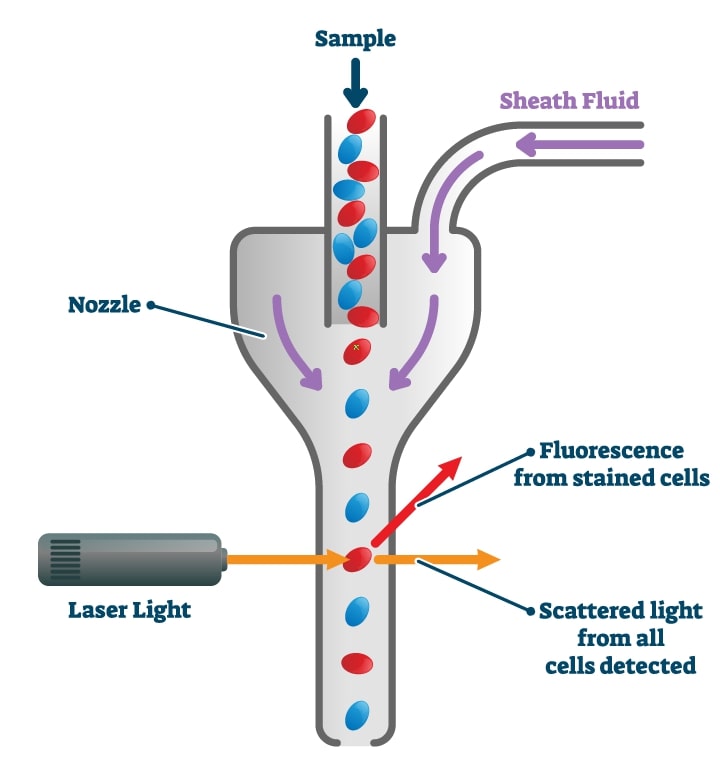
Flow cytometryFig 1. Flow cytometry

Principles of Flow Cytometry

High-frequency oscillations generated by an ultrasonic oscillator cause the flow chamber to vibrate, breaking the stream of cellular fluid ejected from the nozzle into a series of small, uniform droplets, some of which contain cells. The optical system measures the signal (representing the nature of the cell) of these cells before they form a droplet, and if the measured signal matches the nature of the cell selected for sorting, or if the cell to be sorted is found, the instrument injects the entire stream with a brief positive or negative charge just as the chosen cell forms a droplet. When the droplet leaves the stream, the droplet of the selected cell is charged, while the droplet of the unselected cell is not. The positively or negatively charged droplets undergo deflection towards the cathode or towards the anode as they pass through the high-voltage deflector plate. This achieves the purpose of sorting and collecting cells.
Basic Flow Cytometry Procedures

  • Sample preparation: The first step is to prepare the cell sample to be tested. This may involve the isolation of cells from a tissue sample, the collection of blood cells, or the collection of cultured cells. The sample should be properly processed and prepared to ensure accurate analysis of the flow cytometer cells. If cells in the tissue are to be detected, the tissue must first be dissolved as a single-cell suspension.
  • Cell labeling: Flow cytometry uses fluorescent dyes to label molecules on the surface or inside cells. The choice of the appropriate marker depends on the type of cell you are interested in and its purpose. Commonly used markers include fluorescent dyes, antibodies, and fluorescent proteins. Labeled cells can be analyzed according to surface markers or internal molecules.
  • Sample injection: The labeled cell sample is loaded into the flow cytometer. Cell samples are injected into the flow cytometer as a suspension. The flow rate needs to be controlled during sample injection to ensure that individual cells pass sequentially through the laser beam of the flow cytometer.
  • Cell analysis: In a flow cytometer, cells scatter or emit fluorescence after being irradiated by a laser beam. The flow cytometer measures these light signals simultaneously and converts them into digital data.
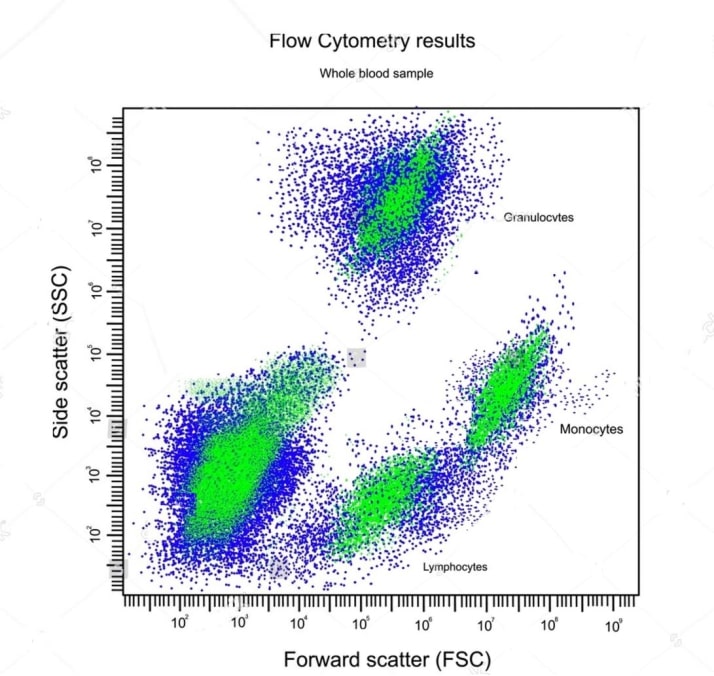
  • Scattering signals: The properties of the light reflected by the cell can provide information about the cell's size and shape. Scattering signals can be classified as forward scattering (FSC) and side scattering (SSC).
  • Fluorescence signal: By laser excitation, a fluorescent marker emits a fluorescence signal of a specific wavelength. The flow cytometer detects fluorescence signals at different wavelengths to determine the presence or absence of the marker in the cell. It also determines its expression level.
  • Data analysis: The flow cytometer generates a lot of raw data. This data can be exported and used for subsequent analyses. Data analysis software allows cells to be counted, sorted, and compared. Histograms, scatter plots, and other graphs can be plotted to present and interpret the data.

Flow cytometryFig 2. Flow cytometry results graphs

Points to Note About Sample Preparation

(1) Single-cell suspension preparation is key to flow cytometry analysis. If cell clumps are encountered they should be filtered through a 300-500 mesh cell sieve before testing on the machine.

(2) Specimens should be fixed and cryopreserved promptly after collection. Bleeding and necrotic tissue should be avoided when taking fresh specimens from surgical excision or biopsy needle aspiration specimens.

(3) Attention should be paid to the removal of dead cells and debris from immunofluorescent specimens, requiring that impurities, debris, and clumps of overlapping cells should be<2% in each sample, especially when sparse cells or cell subpopulations are measured, otherwise the increased non-specific fluorescence of these cells will interfere with the immunofluorescence assay.

(4) Cell samples should be collected to ensure sufficient cell concentration. Generally, 5 x 10⁵/ml to 1 x 10⁶/ml of cells per sample are required. For sample analysis of tumor cell DNA heteroploidy, at least 20% of tumor cells should be present (heteroploidy accounts for more than 1/5 of the main peak before the heteroploidy peak can be confirmed).

Anti-idiotypic Antibodies
Blood Group Antibodies
Cardiac Markers Antibodies
Epigenetics Antibodies
IHC/Pathology Antibodies
Low Endotoxin, Azide Free Antibodies
Matched Antibody Pairs
Monoclonal Antibodies
Neuroscience Antibodies
Phospho-specific Antibodies
Plant Pathogens Antibodies
Polyclonal Antibodies
Small Molecule Antibodies
Tag Antibodies
Zebrafish Antibodies

Application of Flow Cytometry

Flow cytometry has a variety of methods and applications in a wide range of disciplines. Flow cytometry is used exclusively in research for a variety of reasons, for example:

  • Cell counting and characterization: Using surface markers, size, and shape, flow cytometry can count and classify various cell types and populations.
  • Cell surface marker analysis: To study cell behavior and interactions, flow cytometry can be used to locate and measure cell surface markers, such as antigens and receptors.
  • Cell sorting: Using flow cytometry, certain cell populations can be isolated and purified based on cell surface markers or other factors, allowing additional studies or tests to be performed.
  • Multi-parameter analysis: It allows multiple parameters of a single cell to be evaluated simultaneously, resulting in a thorough examination of complex biological materials.
  • Abnormal cell detection: It can be used for the detection and quantification of abnormal or aberrant cells.
  • Immune cell function studies: Using flow cytometry, researchers can examine how immune cells produce cytokines, participate in phagocytosis and move throughout the body.
  • Cell signaling analysis: It can be used to examine how specific signaling pathways are activated in response to different stimuli, providing key insights into cellular processes.
  • Diagnosis and monitoring of blood disorders: It helps diagnose and follow up on various blood disorders such as anemia, leukemia, and lymphoma.
  • Cell biology research: Cellular activity is studied using flow cytometry, which provides profound insights into biological processes such as cell proliferation, differentiation, and apoptosis.

Reference

  1. Pedreira CE, et al. Overview of clinical flow cytometry data analysis: recent advances and future challenges. Trends Biotechnol. 2013; 31 (7): 415-25.
Inquiry Basket