
Inquiry Basket
 Loading ......
Outbreaks of emerging and re-emerging arboviruses are expanding across Latin America and Asia, driving strong demand for reliable research raw materials. Oropouche virus has caused large and expanding outbreaks in South and Central America; chikungunya continues to spread through tropical and subtropical regions; yellow fever remains a persistent threat with recurring sylvatic spillover; VEEV poses both public-health and biodefense research concerns; and the tick-borne bunyaviruses SFTSV and CCHFV are priority hemorrhagic fever research pathogens across Asia, Europe, and Africa.
The Emerging and Arbovirus Antigen Panel consolidates recombinant antigens, virus-like particles (VLPs), inactivated virus quality controls, and site-specifically biotinylated antigens for these six pathogens into a single, coherent portfolio. Research teams developing ELISA, chemiluminescent, lateral flow, and multiplex immunoassays can source nucleoproteins, envelope glycoproteins, and non-structural proteins for multiple pathogens from one supplier, under comparable production and quality standards, simplifying multiplex panel research for acute febrile illness pathogens.
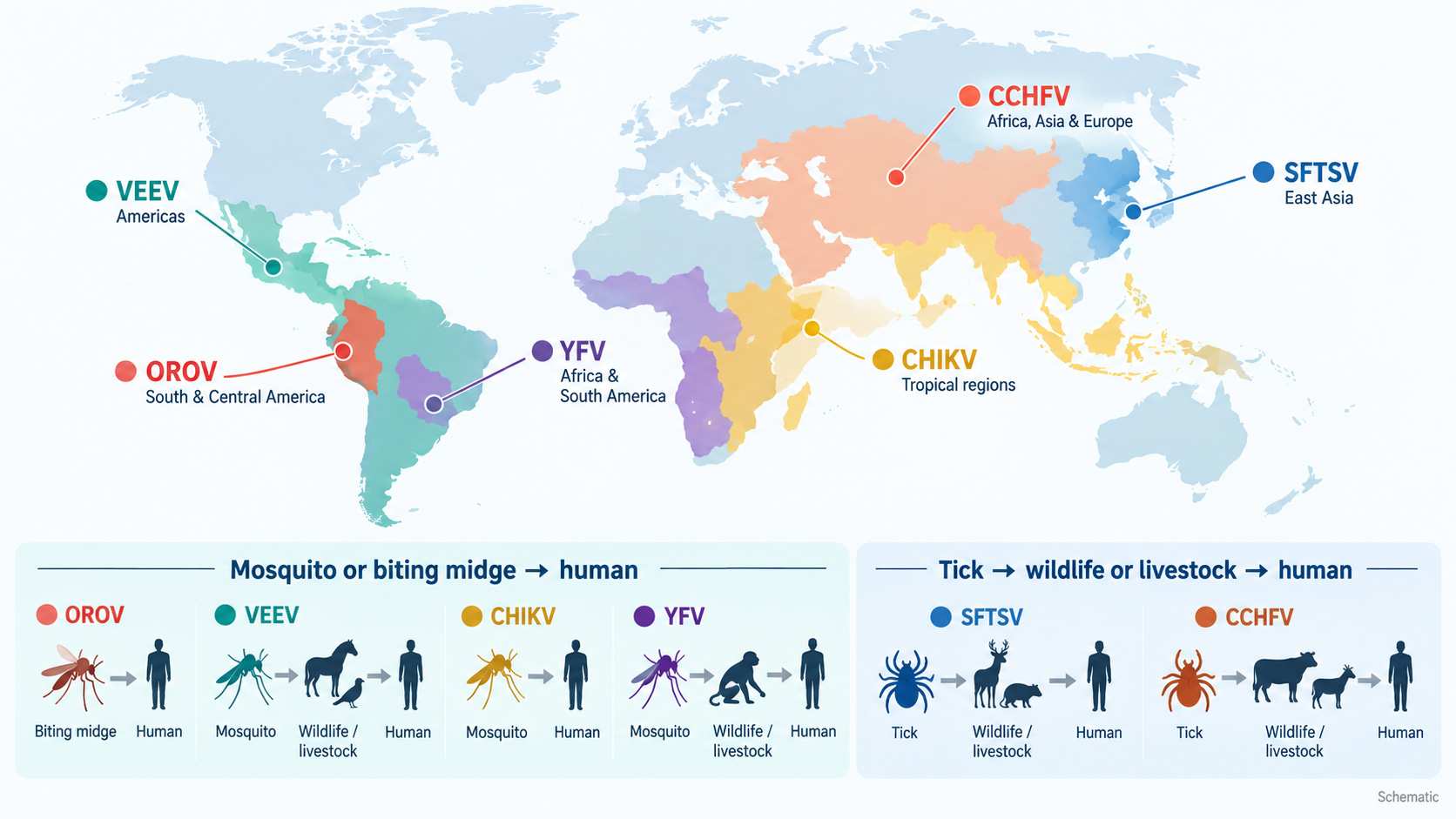 Fig. 1. Geographic distribution and transmission cycles of the six covered pathogens
OROV (Peribunyaviridae) is the cause of Oropouche fever, an acute febrile illness with clinical presentation overlapping dengue, chikungunya, and Zika. The panel offers the nucleoprotein (NP) and nucleocapsid antigens for IgM/IgG research serology, the non-structural protein NSs, and the surface glycoproteins Gn and Gc in His- and Fc-tagged formats, supporting both capture and indirect assay architectures.
VEEV (Alphavirus) causes epizootic and epidemic encephalitis in the Americas. The immunodominant E2 glycoprotein (aa 348-701) is offered in two recombinant formats for serological research and neutralizing antibody studies.
CHIKV antibody research relies heavily on E1/E2 envelope antigens and capsid protein. The CHIKV coverage is the most extensive in the panel: wild-type and A226V-mutant E1, E2 antigens from strains S27 and 37997 in His and Fc formats, an E1-E2 composite antigen, full and partial E2 constructs, capsid and non-structural proteins (NSP1, NSP2, NSP3), two VLP products, site-specifically biotinylated E2 and nsP1 for streptavidin-based systems, and an inactivated natural virus quality control.
YFV antigens span the envelope protein (full-length, fragments, Domain III, and an Envelope VLP), prM, NS1 in multiple tag formats (His, GST, tag-free), polyprotein and non-structural fragments (NS4A, NS5, NS2A), a 17D cell lysate, and an inactivated 17D quality control. NS1-based formats support research strategies that differentiate infection-associated from vaccination-associated antibody responses.
SFTSV (Phenuiviridae) is an emerging tick-borne pathogen in East Asia with high case fatality. The recombinant nucleoprotein supports antibody research assay development, and an inactivated natural virus quality control supports molecular and immunoassay research QC.
CCHFV (Nairoviridae) is a WHO priority pathogen. The panel covers the nucleoprotein in two constructs, the Gn and Gc glycoproteins for neutralization-oriented research serology, and the GP38 mucin-like domain protein, enabling both broad screening and glycoprotein-specific assay research.
Oropouche fever, chikungunya, and yellow fever share overlapping clinical presentations. This panel enables side-by-side development of multiplex serological research assays covering these pathogens within a single testing workflow.
Recombinant antigens in multiple tag formats support indirect, capture, and competitive assay architectures on plates, chemiluminescent platforms, and rapid-test research formats.
Inactivated natural virus quality controls for CHIKV, YFV, and SFTSV provide process controls for nucleic acid and antigen research workflows.
VLPs, envelope glycoproteins, and biotinylated antigens support monoclonal antibody screening, epitope mapping, neutralization assay research (in combination with NeutraAb antibodies and pseudotyped virus systems), and vaccine antigen research.
| Cat. No. | Product Name | |
| DAG-WT8027 | Recombinant Oropouche virus Nucleoprotein (NP) [His] | Inquiry |
| DAGA-2014 | Oropouche virus Nucleocapsid (aa 1-231) [His] | Inquiry |
| DAGA-3105 | Recombinant Oropouche virus NSs [His, GST] | Inquiry |
| DAGA-3108 | Recombinant Oropouche virus Gn [His] | Inquiry |
| DAG-WT6458 | Recombinant Oropouche virus (OROV) Gc [hFc] | Inquiry |
| DAG-WT6459 | Recombinant Oropouche virus (OROV) Gc [mFc] | Inquiry |
| DAG-WT6460 | Recombinant Oropouche virus (OROV) Gc (a.a. 482 C894) [His] | Inquiry |
| Cat. No. | Product Name | |
| DAGA-268 | VEEV E2 glycoprotein (aa 348-701) [His] | Inquiry |
| DAG-WT1030 | Recombinant VEEV E2 glycoprotein (aa 348-701) | Inquiry |
| Cat. No. | Product Name | |
| DAG-WT7126 | Inactivated Natural Severe Fever with Thrombocytopenia Syndrome Virus (SFTSV) Quality Control | Inquiry |
| DAG-WT640 | Recombinant SFTS Virus Nucleoprotein | Inquiry |
| Cat. No. | Product Name | |
| DAGA-3109 | Recombinant CCHFV Nucleoprotein [His] | Inquiry |
| DAGF-200 | Crimean-Congo haemorrhagic fever virus (CCHFV) Gn protein [His] | Inquiry |
| DAGA-3110 | Recombinant CCHFV Gc [His] | Inquiry |
| DAG-WT795 | Recombinant CCHFV GP38 [His] | Inquiry |
| DAG-WT1209 | Recombinant Crimean-Congo haemorrhagic fever virus (CCHFV) NP [His] | Inquiry |
Loading ......
