
Inquiry Basket
 Loading ......
In the field of medicine, the discovery and development of effective antibiotics have revolutionized the treatment of bacterial infections. Streptomycin, an aminoglycoside antibiotic, has emerged as a critical weapon in the treatment of multi-drug resistant mycobacterium tuberculosis and various non-tuberculosis infections. However, streptomycin is neurotoxic, and long-term use at high doses can cause hearing impairment and loss of balance maintenance in humans. In addition, due to the development of drug resistance, streptomycin is currently mainly used as an adjuvant treatment for multidrug-resistant tuberculosis.
Browse all Streptomycin products
Streptomycin is a broad-spectrum alkaline antibiotic derived from the culture medium of Streptomyces griseus, with a central aldose sugar-streptose connected to an amino sugar N-methyl-l-glucosamine and aglycone-streptidine containing two guanidine groups via O-glycosidic linkages. This complex arrangement and connectivity contribute to the unique properties and antimicrobial activity of streptomycin.
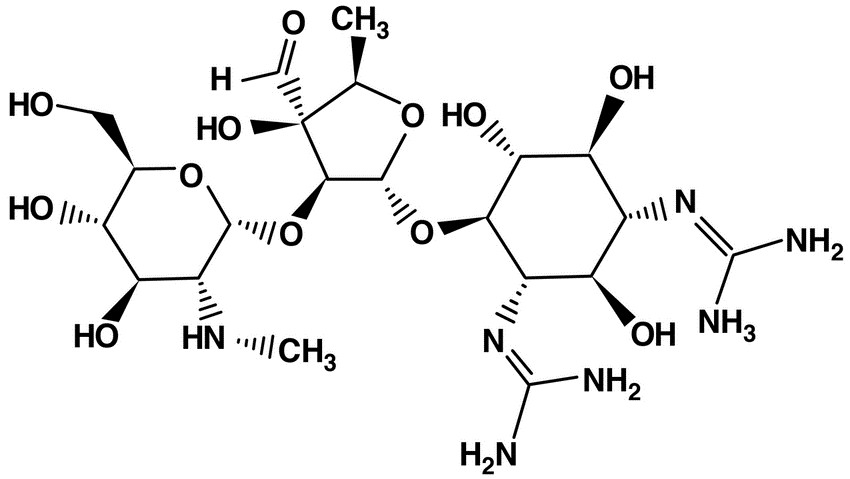 Figure 1. Streptomycin structure.
(Source: Kwiatkowska, B. et al., 2013)
The mechanism of action of aminoglycosides, including streptomycin, involves multiple phases that contribute to their bactericidal effects.
The inhibition of protein synthesis is a crucial aspect of aminoglycoside efficacy. Aminoglycosides bind to specific regions of the 16S rRNA in the bacterial ribosome, particularly in helix 44 (h44) near the A site of the 30S ribosomal subunit. This binding alters the interactions between h44 and h45 and displaces important residues, mimicking the conformational changes associated with successful codon-anticodon pairing. These disruptions in the ribosomal structure inhibit translation, initiation, elongation, and ribosome recycling. Additionally, recent evidence suggests the presence of a second binding site in the 23S rRNA of the 50S ribosomal subunit, contributing to the overall mechanism of action.
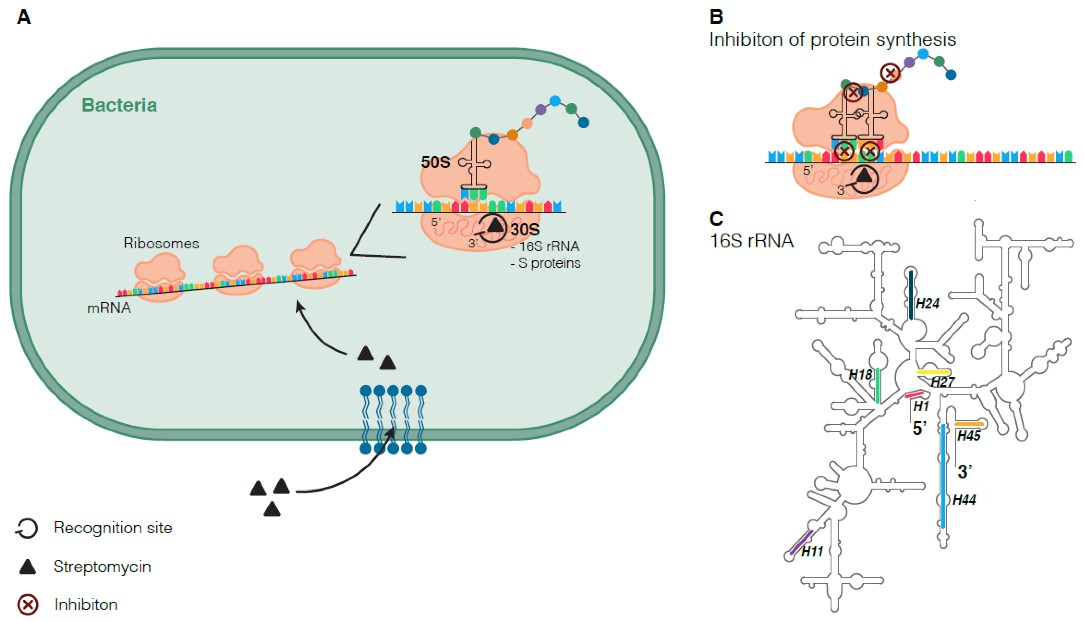 Figure 2. Inhibition of protein synthesis through the interaction of streptomycin and 30S ribosome subunit.
(Source: Rocha, D. M. et al., 2021)
Streptomycin, an antibiotic commonly used to treat bacterial infections, can cause various toxicities and side effects. Monitoring for streptomycin toxicity is particularly important in young patients and those with renal impairment, as streptomycin is eliminated primarily through glomerular filtration. Renal impairment can significantly prolong the drug's half-life, leading to increased accumulation in the body.
The hallmark toxicities of streptomycin include ototoxicity and vestibular impairment. These can result in irreversible hearing loss and balance disturbances. Caution should be exercised when combining streptomycin with other potentially ototoxic drugs. Vestibular impairment typically occurs during treatment and is often permanent.
Streptomycin is also associated with nephrotoxicity, which may manifest as mild proteinuria, excess cellular excretion, and mild elevations in blood urea. Unlike ototoxic effects, nephrotoxicity is usually transient.
Neurotoxic effects of streptomycin can manifest as optic nerve dysfunction, peripheral neuritis, and encephalopathy. There have been reports of neuromuscular blockade when streptomycin is used in conjunction with neuromuscular blocking agents or in cases of overdose in children. Intrathecal use has been associated with arachnoiditis, although this route of administration is rarely employed.
In the event of streptomycin toxicity, dialysis can be used to lower the serum concentration of the drug. Monitoring for adverse reactions and promptly reporting any concerning symptoms to healthcare providers are crucial for the safe use of streptomycin.
References
| Target | Cat. No. | Product Name | Host | Isotype | Application | |
| Streptomycin | DPAB-DC4776 | Anti-Streptomycin polyclonal antibody | Sheep | EIA | Inquiry | |
| DPABY-968 | Anti-Streptomycin polyclonal antibody | Sheep | ELISA, Pr* | Inquiry | ||
| DPATB-H82163 | Anti-Streptomycin polyclonal antibody | Sheep | IgG | cELISA | Inquiry | |
| HMABPY045 | RHA™ anti-Streptomycin monoclonal antibody, clone STR | Mouse | IgG | ELISA, LFIA | Inquiry | |
| Rifampicin | CABT-L4237 | Mouse Anti-Rifampicin monoclonal antibody, clone RFP | Mouse | IgG | ELISA, LFIA | Inquiry |
| PCN | DMABT-Z60054 | Anti-Penicillin monoclonal antibody, clone Rgn-20 | Mouse | IgG1 | ELISA | Inquiry |
| DMABT-Z60353 | Anti-Penicillin monoclonal antibody, clone R4D20 | Mouse | IgG1 | IP, ELISA, RIA | Inquiry | |
| CABT-L2440 | Anti-Penicillin chimeric monoclonal antibody, clone FH3 | Mouse | IgE | ELISA | Inquiry | |
| CABT-L2441 | Anti-Penicillin chimeric monoclonal antibody, clone DH3 | Mouse | IgE | ELISA | Inquiry | |
| DPATB-H82987 | Anti-Penicillin polyclonal antibody | Sheep | IgG | cELISA | Inquiry | |
| DMAB8847 | Anti-Penicilline G monoclonal antibody, clone G84U84 | Mouse | cI-ELISA | Inquiry |
| Target | Cat. No. | Product Name | Size | Species Reactivity | Application | Detection Sample | |
| Streptomycin | DEIA-XY2272 | Streptomycin ELISA Kit | 96T | N/A | Quantitative | Vaccine | Inquiry |
| DEIA020 | Streptomycin ELISA Kit | 96T | N/A | Quantitative | vaccine, cell culture supernatant | Inquiry | |
| DEIA-WZ020 | High Sensitivity Streptomycin ELISA Test Kit | 96T | Quantitative | biological samples | Inquiry | ||
| PCN | DEIABL-QB24 | Penicillin ELISA Kit | 96T | N/A | Quantitative | Animal tissue (muscle, liver, shrimp and fish), milk etc | Inquiry |
| DEIABL-QB25 | Benzyl penicillin ELISA Kit | 96T | Benzyl penicillin | Quantitative and Qualitative | N/A | Inquiry |
Loading ......
