
Inquiry Basket
 Loading ......
The zoonotic disease toxoplasmosis originates from the protozoan Toxoplasma gondii and occurs globally. IgG antibody production during Toxoplasma infection monitors host immune status and provides critical research markers.
Toxoplasma gondii induces a multifaceted immune response by penetrating host cells where it quickly multiplies and escapes immune detection.
Pathogen-associated molecular patterns such as glycoproteins and cyst antigens on Toxoplasma surfaces activate the host innate immune system upon detection. Dendritic cells and macrophages release IL-12 and TNF-α cytokines which then stimulate NK cells and CD8⁺ T cells to produce interferon-gamma (IFN-γ). Interferon-gamma (IFN-γ) functions as the main cytokine to regulate Toxoplasma dissemination across the body.
Toxoplasma IgG ELISA Kit (DEIA-JY2121)
The adaptive immune system gets activated when an infection progresses. Through Toxoplasma antigen recognition B cells mature into antibody-producing plasma cells with assistance from T helper cells especially Th1 cells. The immune response starts with IgM antibodies that are later succeeded by durable IgG antibodies. IgG antibodies act as the principal component for eliminating parasites while maintaining immune regulation and building immune memory.
 Figure 1. Autophagy initiates host immunity and Toxoplasma immune evasion (Source: Zhu W, et al. 2019)
The body produces Toxoplasma IgG antibodies at a specific pace after infection which ultimately persists for years or becomes lifelong.
The initial production of Toxoplasma IgG antibodies starts within 1–2 weeks following infection before reaching maximum levels at 4–8 weeks and then continuing to exist for years or even throughout an individual's life. The antibodies perform dual functions by neutralizing the parasite and enhancing phagocytosis while providing reliable evidence of prior infection.
The balance of IgG subclasses including IgG1, IgG2, IgG3, and IgG4 changes during infection stages because it represents how the immune system responds. At the start of infection IgG1 takes a leading role with significant neutralizing power but IgG3 engages more actively during inflammatory reactions.
Browse All T. gondii Antibodies
Additionally, research indicates that persistent Toxoplasma infections lead to an increased binding strength of IgG antibodies to specific antigens like SAG1, GRA7, and BAG1 which demonstrates both immune memory development and antigen affinity maturation. IgG serves as a crucial marker to differentiate acute infections from chronic ones.
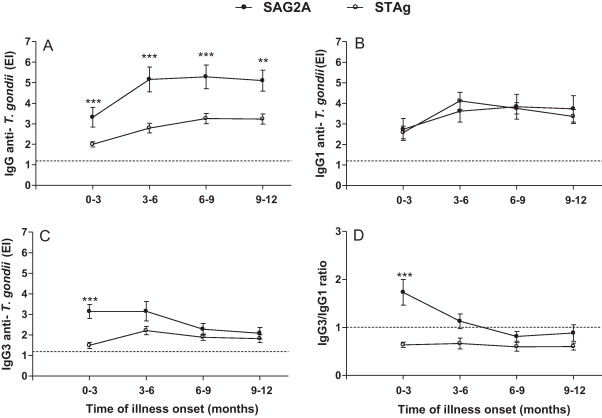 Figure 2. Kinetics of IgG (A), IgG1 (B) and IgG3 (C) antibody isotypes to Toxoplasma gondii determined by indirect ELISA (Source: Silas SS, et al. 2012)
Toxoplasma IgG demonstrates extensive utility in disease research and immunological screening because of its high stability and durability combined with precise antigen targeting.
1. Infectious Disease Pathology
Toxoplasma IgG functions as a fundamental biomarker for research into T. gondii life cycle studies alongside its immune evasion tactics and host-pathogen interactions. The study of IgG response profiles enables researchers to track infection stages along with pinpointing primary antigens.
2. Pregnancy and Congenital Infection Studies
T. gondii infection in pregnant women leads to serious consequences such as fetal deformities and pregnancy loss. IgG testing identifies if pregnant women already have immune protection which supports research on maternal immunity impact on fetal infection risk and developmental progress.
The patterns of IgG antibody breakdown and half-life duration delivered through the placenta provide important understandings about the immunity between mother and fetus.
3. Neuroimmune Mechanism Research
Research shows that chronic Toxoplasma infections are linked to multiple neuropsychiatric disorders such as epilepsy and Alzheimer's disease with Parkinson's disease and schizophrenia. Research into Toxoplasma IgG concentrations within brain tissue and serum demonstrates how the parasite impacts neuroinflammation while disrupting apoptosis and synaptic function.
4. Autoimmunity and Immune Modulation
Through persistent inflammation Toxoplasma infection disrupts immune tolerance and triggers autoimmune reactions to sustain its presence. Research indicates Toxoplasma infections contribute to the development of autoimmune conditions including rheumatoid arthritis and systemic lupus erythematosus. Medical research on immune tolerance disruptions now identifies Toxoplasma IgG detection as a critical marker.
5. Tumor Immunity Research
Toxoplasma can alter the tumor microenvironment through immune system modulation which includes regulatory T cell suppression and CD8⁺ T cell activation to boost anti-tumor defense mechanisms. Toxoplasma IgG detection enables research into potential protective functions of the parasite during tumor development.
We provide an all-inclusive and dependable toolkit for Toxoplasma immune research with support for both basic mechanistic studies and preclinical research applications.
View our Toxoplasma Antigens, Antibodies, and ELISA Kits section to discover more about our Toxoplasma-related products.
Our research tool collection provides high-quality resources for scientists engaged in Toxoplasma IgG research including:
References
| Target | Cat. No. | Product Name | Size | Species | Application | Detection Sample | |
| T. gondii | DEIA10772 | Human Toxoplasma Gondii IgG ELISA Kit | 96T | Human | Quantitative | Human Serum or Plasma (citrate, heparin) | Inquiry |
| DEIA8988 | Toxoplasma IgM Capture ELISA Kit | 96T | Human | Qualitative | serum | Inquiry | |
| DEIA009 | Human Anti-Toxoplasma Gondii IgG Antibody, Anti-TOXO IgG ELISA Kit | 96T | Human | Qualitative | serum | Inquiry | |
| DEIA010 | Human Anti-Toxoplasma Gondii IgM Antibody, Anti-TOXO IgM ELISA Kit | 96T | Human | Qualitative | serum | Inquiry | |
| DEIA379 | Toxoplasma gondii IgG ELISA Kit | 96T | Human | Quantitative | serum, plasma | Inquiry | |
| DEIA380 | Toxoplasma gondii IgM ELISA Kit | 96T | Human | Quantitative | serum, plasma | Inquiry | |
| DEIA1797 | Toxoplasma gondii IgG ELISA Kit | 96T | Human | Quantitative | serum | Inquiry | |
| DEIA1798 | Toxoplasma gondii IgM ELISA Kit | 96T | Human | Quantitative | serum, plasma | Inquiry | |
| DEIA1839 | Toxoplasma gondii IgA Antibody ELISA Kit | 96T | Human | Quantitative | Serum | Inquiry | |
| DEIA2276 | Toxoplasma IgG ELISA Kit | 96T | Human | Quantitative | serum, plasma, urine, aqueous humor, culture supernatants, other sample matrices | Inquiry | |
| DEIA2277 | Toxoplasma IgM ELISA Kit | 96T | Human | Quantitative | aqueous humor, tear samples, plasma, serum, whole blood, CSF | Inquiry | |
| DEIA1028 | Toxoplasma Gondii IgM ELISA Kit | 96T | Human | Qualitative | serum, plasma | Inquiry | |
| DEIA1039 | Toxoplasma Gondii IgG ELISA Kit | 96T | Human | Qualitative | serum, plasma | Inquiry | |
| DEIA1078 | Toxoplasma gondii IgG ELISA Kit | 96T | Human | Qualitative | serum | Inquiry | |
| DEIA-JY2449 | Monkey Toxoplasma (TOXO) Antibody ELISA Kit | 96T | Monkey | Qualitative | Serum | Inquiry | |
| DEIA-JY2465 | Mouse Toxoplasma (TOXO) Antibody ELISA Kit | 96T | Mouse | Qualitative | Serum | Inquiry | |
| DEIA-JY2477 | Rat Toxoplasma (TOXO) Antibody ELISA Kit | 96T | Rat | Qualitative | Serum | Inquiry | |
| DEIA-JY2479 | Hamster Toxoplasma (TOXO) Antibody ELISA Kit | 96T | Hamster | Qualitative | Serum | Inquiry | |
| DEIA-JY2485 | Guinea Pig Toxoplasma (TOXO) Antibody ELISA Kit | 96T | Guinea Pig | Qualitative | Serum | Inquiry | |
| DEIA-JY2486 | Rabbit Toxoplasma (TOXO) Antibody ELISA Kit | 96T | Rabbit | Qualitative | Serum | Inquiry | |
| DEIA-JY2489 | Canine Toxoplasma (TOXO) Antibody ELISA Kit | 96T | Canine | Qualitative | Serum | Inquiry | |
| DEIA-JY2491 | Feline Toxoplasma (TOXO) Antibody ELISA Kit | 96T | Feline | Qualitative | Serum | Inquiry | |
| DEIA-VT250301 | Toxoplasma gondii IgG Multi-species ELISA Kit | 96T | Multi-species | Quantitative | serum, plasma | Inquiry | |
| DEIANS034 | Toxoplasma gondii IgM ELISA Kit | 96T | Human | Quantitative | serum | Inquiry | |
| DCABH-201829 | Anti-Tox-IgG Humanization Antibody | 100 μl | Positive control in Tox ELISA Kit | Inquiry | |||
| DCABH-201830 | Anti-Tox-IgM Humanization Antibody | 100 μg | Positive control in Tox ELISA Kit | Inquiry | |||
| Toxoplasma | DEIA-JY2121 | Toxoplasma IgG ELISA Kit | 96T | Human | Quantitative and Qualitative | Serum and Plasma | Inquiry |
| DEIA1798-2 | Toxoplasma gondii IgM ELISA Kit | 96T | Human | Quantitative | Serum, plasma, cell Lysis and other biological samples. | Inquiry |
Loading ......
