
Inquiry Basket
 Loading ......
Fungi have a long and intimate connection with humankind, particularly at the chemical level. The bioactive molecules in fungi termed secondary metabolites (also known as natural products), are produced by specific fungal taxa, predominately by filamentous fungi that belong to the Pezizomycotina Ascomycete class, and several Basidiomycete classes (for example, Agaricomycetes and Exobasidiomycetes). Secondary metabolites are derived from central metabolic pathways and primary metabolite pools, it is a key participant in the development of fungi, and positively affects the interaction with other organisms. Besides, it also showed antibacterial, antifungal or antitumor activities. Through the study of BGC classification and genetics, cluster transcription and epigenetic regulation of fungal secondary metabolites, it is found that secondary metabolites have great potential in drug discovery and play an important ecological role in national defense, war and development.
The synthesis of secondary metabolites primarily involves the polymerization of primary metabolites by dedicated enzymes. The backbone enzyme defines the chemical class of the generated secondary metabolite. The metabolites generated by the backbone enzymes are further 'decorated' by additional enzymes that can vastly alter the bioactivities of the metabolites. The genes involved in the biosynthesis of fungal secondary metabolites are typically arranged in BGCs, a chromosomal architecture that has facilitated the development of algorithms to predict BGCs that encode conserved synthases and/or synthetases in fungal genomes. BGC can range from two genes to more than 20 genes. lgorithms are merely predictive and may underpredict or overpredict inclusion of genes within a BGC. True association with a cluster can be confirmed only through gene deletion.
The transcriptional and epigenetic activation of BGCs is a consequence of environmental stimuli and is dependent on the developmental stage of the producing fungus. Nutritional input has long been realized to be important as reflected in the one strain-many compounds (OSMAC) approach to metabolite mining. Temperature and light have been observed to induce or repress the synthesis. The effect of BGC is regulated by cluster-specific regulators and global transcription complexes. Approximately, up to 50% of fungal BGCs contain a cluster-specific transcription factor, occasionally a BGC contains more than one transcription factor. Some cluster transcription factors can simultaneously regulate several BGC and genes in metabolic pathway. Several studies have coupled secondary metabolite regulatory networks with the epigenome. Efforts to remodel the fungal chromosome landscape by altering transcriptional accessibility to BGCs have been particularly fruitful in identifying metabolites from cryptic clusters. The idea that heterochromatin and euchromatin could be important features in BGC accessibility arose from the gene cluster architecture, which suggested a co-regulation mechanism of expression associated with chromosome structure.
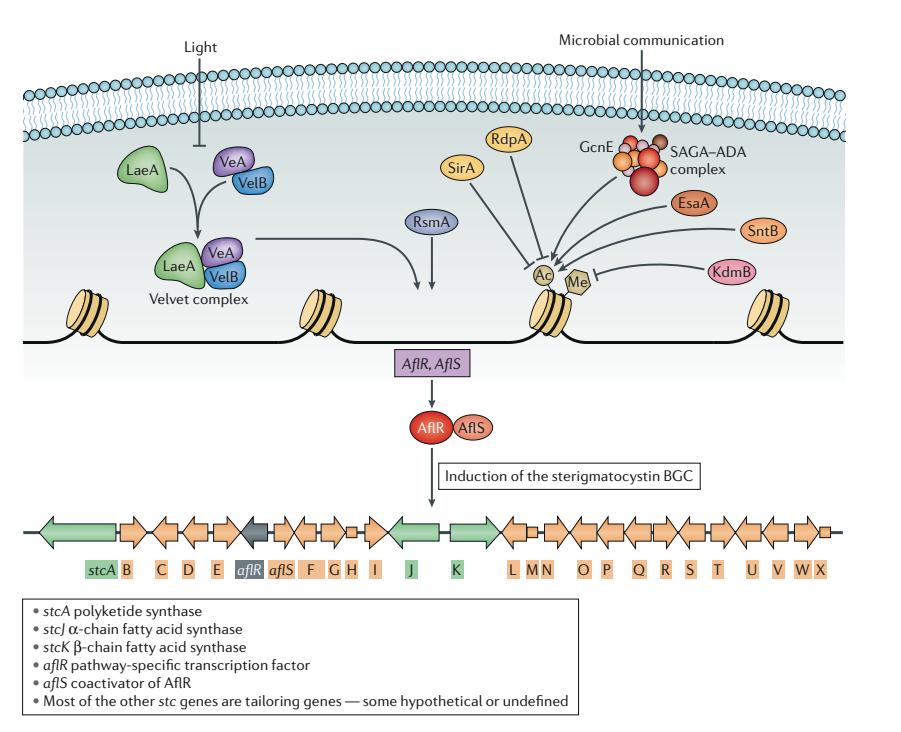 Fig1. Regulation of the sterigmatocystin biosynthetic gene cluster. (Nature Rev Microbiol. 2019)
Studies showed that many genes that encode secondary metabolites are regulated in a manner congruent with fungal development or in response to stressors (both abiotic and biotic) and that loss or overproduction of specific secondary metabolites can alter fungal development, survival or interkingdom and intrakingdom encounters.
Protection from UV damage. Melanin is a natural pigment typically found in spores or hyphae, many studies have demonstrated the role of melanins and other aromatic natural products in photoprotection and/or protection from antioxidant chemicals.
Defence and weapons. The secondary metabolites of fungi can protect them. On the one hand, the natural products produced by fungi can play a mutually beneficial role in symbiotic microorganisms, and the toxic metabolites are also a part of their arsenal. It help fungi obtain land rights in highly competitive ecological niches.
Protection from toxic natural products. So many of the BGC products are antifungal, in order to protect ourselves from the attack of their own weapons. Fungi have evolved three main intra-cluster self-protection strategies, including efflux transporters or cellular BGC intermediate transporters, detoxification enzymes changing the chemical structure of secondary metabolites to reduce key target binding characteristics and repeated copies of target proteins.
The secondary metabolites of fungi have been widely used in drug research and application. Several potent fungal secondary metabolites (for example, penicillin, statins, cyclosporin and mycophenolic acid) were knowingly used in large-scale efforts to extend human life starting in the 20th century. With the development of genetic tools, we can have a further understanding of fungal metabolomics and fungal genome sequences. The ability to capture, produce and characterize fungal secondary metabolites requires use of algorithms to identify BGCs, further bioinformatic tools to assist in structure prediction, genetic expression and induction techniques, host fungi for expression and instrumentation to detect and elucidate structure. The latest algorithm can capture all BGC and cover its replication problem on the premise of identifying the conserved synthetase and/or synthetase coding genes in BGC. Once a BGC of interest is identified, the expression of that gene can be activate in producing fungi (endogenous activation) or heterologous host. Expression cassettes can be used for gene overexpression, gene deletion, yeast recombineering and fungal artificial chromosome (FAC) construction. Inducers that can activate cryptic BGCs include abiotic stress, epigenetic chemicals, nutrients and co-cultures. Outputs include new drugs that may overlap with endogenous function of the fungus, including warfare and developmental signals.
| Target | Cat. No. | Product Name | Size | Species Reactivity | Application | Detection Sample | Inquiry |
| A. fumigatus | DEIA312 | Human Aspergillus Fumigatus IgG ELISA Kit | 96T | Human | Quantitative | serum, plasma | Inquiry |
| A. fumigatus | DEIA313 | Human Aspergillus Fumigatus IgA ELISA Kit | 96T | Human | Quantitative | serum, plasma | Inquiry |
| A. fumigatus | DEIA314 | Human Aspergillus Fumigatus IgM ELISA Kit | 96T | Human | Quantitative | serum, plasma | Inquiry |
| ASCA | DEIABL320 | ASCA Screen ELISA Kit | 96T | Human | Quantitative, Qualitative | serum | Inquiry |
| ASCA | DEIA6113 | ASCA IgG/IgA ELISA Kit | 96T | Human | Quantitative | serum, plasma | Inquiry |
| ASCA | DEIA1935 | ASCA combi ELISA Kit | 96T | Human | Qualitative | serum | Inquiry |
| ASCA | DEIA1936 | ASCA IgA ELISA Kit | 96T | Human | Qualitative | serum | Inquiry |
| ASCA | DEIA1937 | ASCA IgG ELISA Kit | 96T | Human | Qualitative | serum | Inquiry |
| Fusarium spp. | DEIABL66 | Fusarium antigen ELISA Kit | 96T | N/A | Quantitative | Soil, growing or harvested plants, grain, food, washes from industrial equipment and other types of material | Inquiry |
| Target | Cat. No. | Product Name | Expression System | Tag/Conjugate | Application | Inquiry |
| A. aculeatus Pectolyase Y-23 | DAG097 | Native A. aculeatus Pectolyase Y-23 | N/A | Unconjugated | N/A | Inquiry |
| A. Giganteus Alpha-Sarcin | DAG4644 | Native Aspergillus Giganteus Alpha-Sarcin | N/A | Unconjugated | N/A | Inquiry |
| A. Restrictus Restrictocin | DAG4642 | Native Aspergillus Restrictus Restrictocin | N/A | Unconjugated | N/A | Inquiry |
| A. Restrictus Restrictocin | DAG4643 | Native Aspergillus Restrictus Restrictocin Dimer | N/A | Unconjugated | N/A | Inquiry |
| Aspergillus | DAGA-459 | Aspergillus fumigatus | A. fumigatus | Unconjugated | EIA | Inquiry |
| Aspergillus | DAGA-460 | Glucose oxidase | A. niger | Unconjugated | Controls, Calibrators | Inquiry |
Loading ......
