
Inquiry Basket
 Loading ......
Hepatitis A is characterized by inflammation of the liver due to infection with the hepatitis A virus (HAV). While some individuals may experience only mild symptoms lasting a few weeks, others may face more severe complications that persist for months. In rare cases, though, hepatitis A can be severe and cause liver damage or liver failure.
HAV is a small, nonenveloped virus belonging to the Hepatovirus genus within the Picornaviridae family. It has a diameter of 27-32 nm and possesses a single-stranded positive-sense RNA genome consisting of approximately 7500 nucleotides. The HAV genome encodes a single large polyprotein that is responsible for the synthesis of both structural and nonstructural proteins. The translation of the polyprotein is regulated by an internal ribosome entry site (IRES). The structural proteins (VP1, VP2, VP3, VP4) are derived from the P1 region of the genome, while the nonstructural proteins involved in viral replication are encoded by the P2 and P3 regions. The capsid of HAV, composed of the four capsid proteins, exhibits a highly conserved antigenic structure, resulting in a single serotype of human HAV.
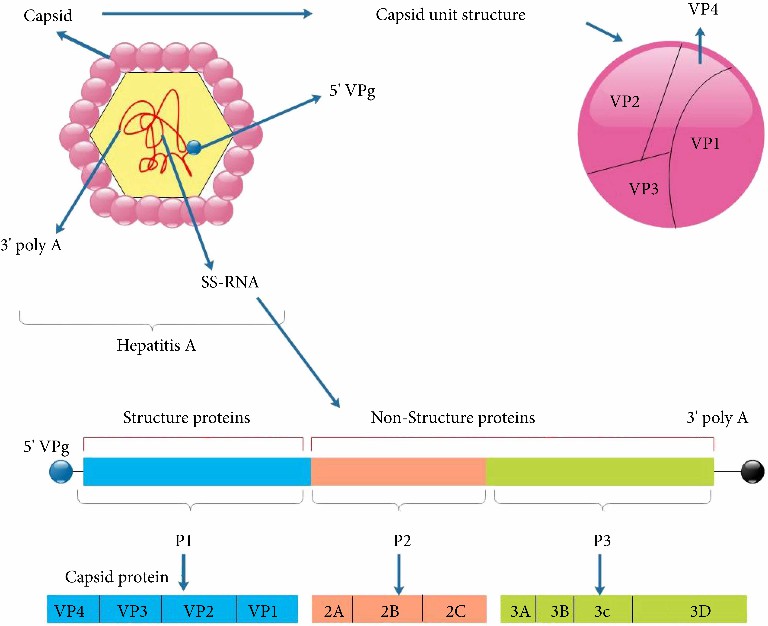 Figure 1. HAV Structure.
(Source: Gholizadeh, O. et al., 2023)
Adsorption and penetration: HAV binds to receptors on the host cell surface through its surface antigen VP1, and then adsorption occurs. Subsequently, the virus enters the host cell through endocytosis.
Uncoating: In host cells, HAV particles are induced by the acidic environment of lysosomes in endocytoses, leading to the uncoating of the virus particles. After uncoating, the virus releases its RNA genome.
Replication: The RNA genome of HAV serves as a template to synthesize new viral RNA molecules through the participation of ribosomes and enzymes in the host cell. These newly synthesized RNA molecules can further serve as templates to synthesize more viral RNA.
Assembly: The newly synthesized viral RNA molecules will combine with the structural proteins VP1, VP2, VP3, and VP4 in the viral particles to form new viral particles. These viral particles aggregate within host cells to form viral colonies.
Release: Finally, the newly synthesized virus particles are released outside the host body through cell lysis or secretory pathways. These virus particles can further spread to other tissues and organs through the blood circulation.
Immune Response: As HAV replicates in the liver, the immune system recognizes the presence of the virus and mounts an immune response. The immune response involves the activation of various immune cells, including T cells and B cells. T cells, specifically CD8+ T cells, play a crucial role in clearing the virus by directly killing infected hepatocytes. B cells produce antibodies that can neutralize the virus and help in its elimination. The immune response leads to the production of specific antibodies against HAV, which can provide long-term immunity.
Hepatitis A is primarily transmitted through two main routes:
Hepatitis A testing is a crucial diagnostic tool used to identify and confirm the presence of HAV infection in individuals. It involves various tests that detect specific antibodies or the genetic material of the virus. Some key details about hepatitis A testing include:
References
| Target | Cat. No. | Product Name | Expression System | Tag/Conjugate | Application | |
| HAV | DAG178 | Native Inactivated HAV Antigen(>70%) | N/A | Unconjugated | ELISA | Inquiry |
| DAG-P2692 | HAV (aa 1392 - 1521) | E. coli | Unconjugated | WB, ELISA, SDS-PAGE | Inquiry | |
| DAG-P2693 | HAV (aa 1643 - 1743) | E. coli | Unconjugated | WB, ELISA, SDS-PAGE | Inquiry | |
| DAG-P2808 | HAV (aa 1121 - 1234) | E. coli | Unconjugated | WB, ELISA | Inquiry | |
| DAG-P2632 | HAV (aa 5 - 164) | E. coli | Unconjugated | ELISA, SDS-PAGE | Inquiry | |
| DAG4428 | Native Hepatitis A Virus Antigen | N/A | Unconjugated | N/A | Inquiry | |
| DAGCF-0177 | Recombinant HAV genotype 1 VP1 Protein [His] | E. coli | His | ELISA, Immunogen | Inquiry | |
| DAGCF-0175 | Recombinant HAV VP1 (FJ01) | E. coli | His | ELISA, Immunogen | Inquiry | |
| DAGCF-0176 | Recombinant HAV VP1 (genotype 3) | E. coli | His | ELISA, Immunogen | Inquiry |
| Target | Cat. No. | Product Name | Size | Species Reactivity | Application | Detection Sample | |
| HAV | DEIA007 | Human Anti-Hepatitis A Virus IgG (HAV-IgG) ELISA kit | 96T | Human | Qualitative | serum, plasma | Inquiry |
| DEIA008 | Human Anti-Hepatitis A Virus IgM Antibody, Anti-HAV IgM ELISA Kit | 96T | Human | Qualitative | serum, plasma | Inquiry | |
| DEIASL276 | Human Anti-Hepatitis A Virus IgG ELISA Kit (Quantitative) | 96T | Quantitative | serum, plasma | Inquiry | ||
| DTS597 | Hepatitis A Antigens Rapid Test | 20T | Human | Qualitative | Stool | Inquiry | |
| CD8 | DEIA-BJ472 | Human Scd8 ELISA kit | 96T | Quantitative | Serum, plasma, cell culture supernatants, body fluid and tissue homogenate | Inquiry |
Loading ......
