
Inquiry Basket
 Loading ......
CD19 is a type I transmembrane glycoprotein, belonging to the immunoglobulin superfamily that is exclusively expressed in the B-lymphocyte lineage. It is a coreceptor required for B cell development, activation, proliferation and differentiation, and it exquisitely tunes the threshold of BCR-mediated signaling to orchestrate B cell–mediated immune responses. Due to its restricted and stable expression on the surface of B cells, CD19 has emerged as a gold-standard target for diagnosis and treatment of B-cell malignancies, such as leukemia and lymphoma. In recent years, CD19-directed immunotherapies, in particular chimeric antigen receptor T-cell therapy, have achieved revolutionary advances and have dramatically transformed the treatment paradigm for relapsed/refractory B-cell malignancies.。
Browse all CD19 related products
CD19 is a type I, single-pass transmembrane glycoprotein. The approximate molecular mass of CD19 is 95 kDa and its structure is highly conserved. The protein is composed of three distinct parts: the extracellular domain, the transmembrane region and the intracellular domain. The extracellular domain of CD19 contains two C2-type immunoglobulin-like domains which are separated by a short non-Ig-like helical region. The extracellular domain serves as a major protein-protein interaction site for CD19's interaction with other molecules and a target for binding by targeting antibodies. This region also contains several (five predicted) potential N-linked glycosylation sites for the proteins post-translational modification for proper folding.
The intracellular domain has been shown to be the primary functional domain for signal transduction activity of CD19. The cytoplasmic tail is a cytoplasmic tail of approximately 240–242 residues that is rich in acidic residues, and highly conserved. More importantly, it contains multiple (usually nine) conserved tyrosine residues that upon activation of BCR signals become phosphorylated and act as binding sites for various downstream signaling molecules, mediating or regulating intracellular signaling cascades. These critical tyrosine residues (e.g. Y391, Y482, and Y513) have been shown to be responsible for recruitment and activation of signaling molecules such as PI3K upon phosphorylation.
CD19 is not an antigen-binding molecule itself. It is, however, a critical co-stimulatory constituent of the B-cell receptor (BCR) complex, that reduces the threshold of antigen needed to activate the B cell. CD19 is a constituent of a multi-molecular cell membrane-signalling complex with CD21 (complement receptor 2), CD81 and CD225 (Leu-13). This complex functions to synergize with the BCR in antigen recognition. Specifically, when an antigen is opsonized by complement fragments such as C3d, CD21 recognizes C3d. This interaction recruits the entire CD19 complex into proximity with the BCR, thereby dramatically amplifying the strength and sensitivity of the activation signal.
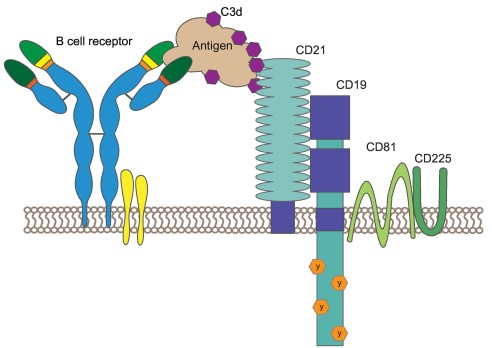 Figure 1. The CD19 complex consists of CD19, CD81, CD21 and CD225 and signals in conjunction with the B cell receptor, to reduce the threshold for antigenic stimulation
(Source: Wentink MWJ, et al. 2018)
The core function of CD19 is to amplify BCR-mediated signals. Upon antigen binding to the BCR, Src family kinases (such as Lyn) are activated. Activated Lyn, on one hand, phosphorylates the ITAM motifs of BCR complex, on the other hand, efficiently phosphorylates tyrosine residues on the intracellular domain of CD19. The phosphorylated CD19 functions as a signal amplifier and recruits and activates a cascade of critical downstream signaling molecules, such as PI3K, Vav family guanine nucleotide exchange factors, and other signaling molecules.
The p85 regulatory subunit of PI3K can directly bind to phosphorylated CD19 and be activated. The subsequent conversion of PIP2 to PIP3 activates the Akt pathway, which promotes cell survival, proliferation, and metabolism. Vav recruitment may also lead to the activation of the downstream Ras/MAPK pathway, which is also involved in the regulation of cell proliferation and differentiation. In addition, many other SH2 domain-containing signaling molecules such as the adaptor protein Grb2, phospholipase Cγ2 (PLCγ2), and c-Abl can bind to phosphorylated CD19 and be involved in the regulation of calcium flux, reorganization of the cytoskeleton, and other biological processes. This mechanism also provides B cells with the ability to respond to low concentrations of antigen and launch an effective humoral immune response.
CD19 and CD20 are both expressed during B cell development. Expression of CD20 is initiated at the late pro-B cell stage, and it is stably expressed on all mature B cells; it is lost upon terminal differentiation into plasmablasts and plasma cells. It is also expressed on certain T-cell subsets and on early plasmablasts in some cases.
CD19, in contrast, is expressed over a broader range, throughout the large majority of B cell developmental stages. Expression is initiated at the early pro-B cell stage and continues on through the mature B cell stage, only being significantly downregulated or lost when B cells terminally differentiate into plasma cells. CD19 is critical in stabilizing the peripheral B cell repertoire, in forming germinal centers, and in generating humoral immune responses.
 Figure 2. Cell surface CD19 and CD20 expression during B-cell development
(Source: Komura K. 2024)
CD19 is not expressed on hematopoietic stem cells, myeloid cells, erythroid cells, or T lymphocytes and in healthy individuals expression is highly restricted to B-lymphocyte lineage, which is the basis for an ideal therapeutic target.
In addition to B cells, expression of CD19 has also been reported on follicular dendritic cells (FDCs), and may have a role in B cell activation and selection.
CD19 remains expressed on B-cell-derived malignancies in over 95% of cases in malignant tumors such as acute lymphoblastic leukemia (B-ALL), chronic lymphocytic leukemia (CLL), diffuse large B-cell lymphoma (DLBCL), follicular lymphoma (FL) and mantle cell lymphoma (MCL). CD19 has become the "gold standard" B-cell marker in clinical practice and used to identify and enumerate (both normal and malignant) B cells in flow cytometric immunophenotyping. In some B-cell tumor subtypes, aberrant expression levels of CD19 can be useful in differential diagnosis.
It is noteworthy that in certain tumors derived from terminally differentiated B cells, such as multiple myeloma (a plasma cell neoplasm), CD19 expression is typically negative or very weak, reflecting its downregulation during normal plasma cell differentiation.
The most advanced and successful approach to date is CAR-T therapy. CD19-directed CAR-T therapies have been approved in adult patients with relapsed or refractory mantle cell lymphoma, relapsed or refractory B-ALL, and relapsed or refractory LBCL after two or more lines of systemic therapy. CAR-T therapies have led to remarkably high response rates in these highly refractory patient populations, including a meaningful fraction with deep and durable complete remissions. The treatments are also characterized by unique adverse effects, including cytokine release syndrome, immune effector cell-associated neurotoxicity syndrome, and B-cell aplasia. In addition to the approved CAR-T therapies, other forms of CD19-targeted therapeutics are being investigated in an effort to enhance efficacy, safety, or accessibility. Bispecific T-cell engagers bind to CD19 on tumor cells with one arm and to CD3 on T cells with the other, leading to T-cell recruitment to the tumor site and subsequent targeted tumor cell killing. Antibody-drug conjugates (ADCs) are composed of a CD19-targeting monoclonal antibody linked to a potent cytotoxic drug. The antibody transports the cytotoxic "warhead" directly into CD19-positive tumor cells for targeted cell killing with reduced effects on healthy tissues.
More importantly, CAR-T therapy also provided great hopes for refractory severe autoimmune diseases that could not be controlled by conventional methods, such as systemic sclerosis (SSc). After a single infusion of CD19 CAR-T cells, patients with refractory SSc achieved a significant reduction in skin score, improvement in disease activity index, and reduction in the level of specific autoantibodies. At the same time, its potential paradoxical adverse effects, unknown long-term safety, high cost, and complex technical requirements are also serious obstacles to the extensive application of this therapy, which requires careful clinical application.
 Figure 3. Phases and challenges of treatment with autologous CAR T cells in autoimmune diseases
(Source: Schett G, et al. 2023)
References
| Target | Cat. No. | Product Name | Size | Species | Application | Detection Sample | |
| CD19 | DEIA-NS2307-100 | Human CD19(Cluster of Differentiation 19) ELISA Kit | 96T | Human | Quantitative | Serum, plasma, cell culture supernatant and other biological samples. | Inquiry |
| DEIA-XYA358 | CD19 ELISA Kit | 96T | Qualitative | Cultured cells | Inquiry | ||
| DEIA-XYA359 | CD19 (Phospho-Tyr531) ELISA Kit | 2 x 96T | Qualitative | Cultured cells | Inquiry |
| Target | Cat. No. | Product Name | Expression System | Tag/Conjugate | Application | |
| CD19 | DAGC353 | Recombinant Human CD19 Protein [His] | HEK293 Cells | His | ELISA | Inquiry |
| DAGC354 | Recombinant Human CD19 Protein [mFc] | HEK293 Cells | mFc | ELISA | Inquiry |
Loading ......
