
Inquiry Basket
 Loading ......
The original term CD, an abbreviation for cluster of differentiation, referred to a number of antibodies (a minimum of two) which were grouped together by statistical analysis of the reactivity data. The statistical procedure used was cluster analysis and the reactivity of the antibodies was assessed on cells of characteristic states of differentiation, hence cluster of differentiation. Although the cluster was a group of antibodies, the emphasis was on the antigen. It is common practice to refer to either the antigen or the antibody with the CD designation.
There are molecules with descriptive names which achieved widespread use before the availability of mAbs but where the descriptive name turned out to be misleading. The CD name is no more difficult to remember than a three-letter gene name. Therefore, it is likely that the CD-numbered molecules will continue to grow in number, that the names will be used more for some molecules and less for others, which have good alternative names and that antibodies which have been through the CD Workshops will continue to be used in preference to antibodies that have not. The activity of an antibody preparation and particularly its non-specific reactivity, will depend on the detailed history of that particular preparation. Different antibodies against the same CD molecule may behave quite differently because of differences in target epitope or affinity. The fact that an antibody has a CD number does not guarantee predictable behavior but it is far preferable to using an antibody without a CD classification.
Profiles nearly 400 known leukocyte cell surface molecules are summarized in CD system (CD1-CD350). Most CD molecules are integral membrane proteins that have one or more pass through the plasma cell membranes. Knowing which regions of a protein are intracellular or extracellular is important in the selection of peptides for immunization, for the expression of domains of the protein, and to understand the interaction of the protein with other proteins. CD markers are great targets for diagnostic and research of different types of diseases as a potential treatment for a variety of tumors.
The cell membrane is the obvious place to attack a cell if you want to kill it, and antibodies, under the right conditions, provide the right ligands. The binding of ligands to cell surface molecules can have more subtle but equally useful effects - cells may be activated, induced to differentiate, or inhibited from responding to activation-inducing signals or differentiation inducing signals. Under the right conditions, antibodies can take the place of the natural ligands in these processes.
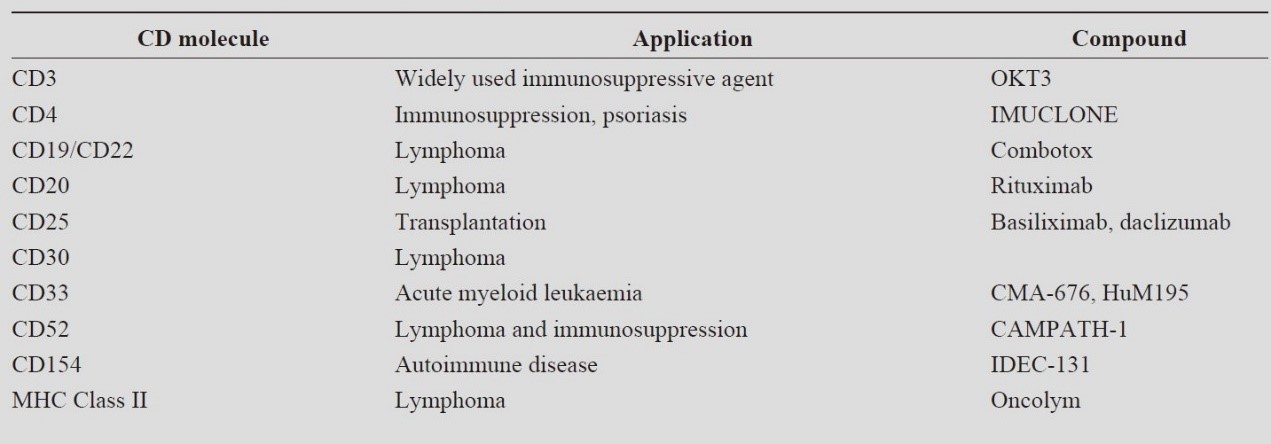
Table 1. CD molecules targeted in therapeutic applications.
(Expert Opinion on Biological Therapy, 2001)
CD antigens as drug target
Immunosuppression. OKT3, which is an antibody against CD3, a component of the T-cell receptor, is used to reverse T-cell-mediated rejection of organ transplants. It does this principally without killing the target T-cells; the T-cells continue to circulate but have downregulated their CD3 and are therefore ineffective in attacking the transplanted tissue. OKT3 also activates T-cells, in the sense that it stimulates them to release cytokines. This cytokine release response is an unwanted side effect in the context of transplantation, although it might be a desirable response in other situations. OKT3, as a foreign protein, is immunogenic in humans. The immune response to OKT3 is probably muted because the patients are immunosuppressed, but nevertheless limits treatment. OKT3 thus illustrates some of the effects that can be achieved in vivo with antibody against cell-surface determinants and also illustrates some of the constraining factors. Antibodies against other lymphocyte surface molecules have been used to dampen down the immune response in transplantation and in auto-immune disease. Several of these specificities illustrate different aspects of the multiple opportunities offered by antibodies against surface antigens. Bone marrow transplantation represents a special case, where the major problem is usually not rejection of the transplant but rather an immunological attack by the transplanted immune cells on the tissues of the recipient (the graft versus host reaction).
Cancer therapy. The control and eradication of tumors by antibodies has a history much longer than that of mAbs and the CD system. The principles are straightforward and there is a body of literature demonstrating success in animal models but clinical success has been slow in coming and sporadic.
References
| CD2 | CD3d | CD3e | CD3G | CD18 | CD19 | CD20 | CD22 |
| CD25 | CD30 | CD32b | CD33 | CD40 | CD52 | CD58 | CD66e |
| CD80 | CD86 | CD106 | CD120b | CD126 | CD134 | CD137 | CD152 |
| CD154 | CD221 | CD227 | CD254 | CD257 | CD261 | CD262 | CD279 |
| CD309 | CD326 | CD340 |
| CD2 | CD24 | CD31 | CD38 | CD44 | CD48 | CD54 | CD66a |
| CD66b | CD66c | CD66e | CD74 | CD87 | CD96 | CD97 | CD98 |
| CD106 | CD111 | CD112 | CD117 | CD126 | CD130 | CD138 | CD140b |
| CD143 | CD144 | CD146 | CD147 | CD166 | CD171 | CD202b | CD208 |
| CD221 | CD227 | CD239 | CD309 | CD321 | CD324 | CD326 | CD333 |
| CD340 |
Loading ......
