

Inquiry Basket
 Loading ......
Bionic nanozymes represent nanomaterials with enzymatic capabilities which mimic natural enzymes' catalytic functions. Nanomaterials have both their inherent high stability, low cost and ease of large-scale production while displaying enzyme-like catalytic activity and substrate specificity. Its basic characteristics are as follows: The material functions as an efficient catalyst for substrate conversion under physiological conditions with reaction kinetics that parallel natural enzymes while exhibiting multifunctionality through its magnetic, optical and electrical properties which provide extensive application possibilities across various fields. The properties of this substance render it a perfect alternative to natural enzymes.
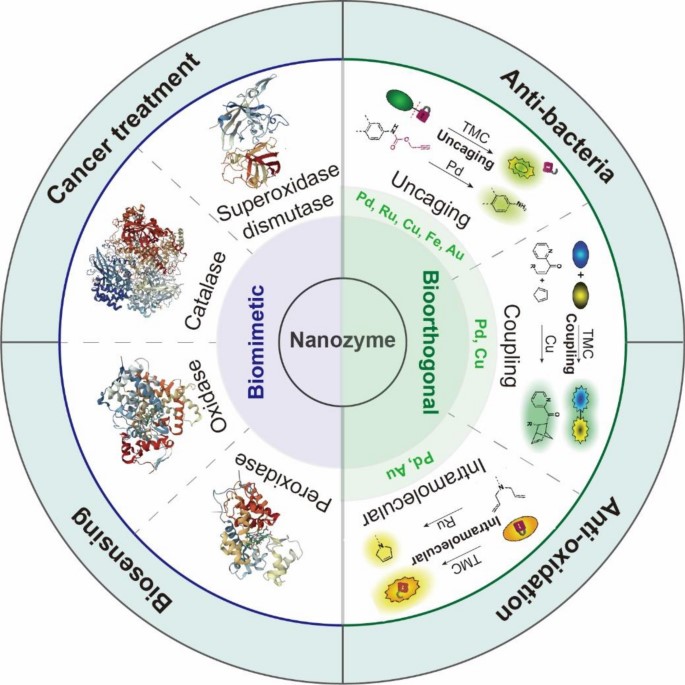 Figure 1. Schematic diagram of nanozymes and their biomedical applications. (Sources: Keum C, et al. 2023)
Multiple traditional approaches exist for synthesizing small molecule drugs. Target drugs are manufactured through multi-step synthesis by gradually transforming basic raw materials via sequential reactions. To achieve efficient and pure results in each step of the synthesis process the right reaction conditions and intermediates must be chosen. Drug development employs classic Suzuki coupling reactions alongside various other technologies which organic synthetic chemistry depends on. The field of chemical synthesis encompasses solid-phase synthesis which prepares peptide drugs and liquid-phase synthesis which produces small molecule compounds. Natural product synthesis plays a crucial role during the initial stages of drug development while artificial synthesis methods create compounds that demonstrate targeted drug activity. The synthesis of chiral drugs often first synthesizes left and right chiral mixed primary products and then separates them. Although effective, it is highly wasteful. Traditional plant chemical methods are used in traditional Chinese medicine research to separate and screen small molecule compounds as new drug targets. Micro-synthesis technology improves synthesis efficiency and environmental protection by reducing the number of reactants and optimizing reaction conditions. However, with the development of technology, the integration of chemical synthesis and biosynthesis methods is an important direction to improve synthesis efficiency.
Bionic nanozymes have many applications in catalytic reactions. In the field of biosensors, Fe3O4 magnetic nanoparticles are used for H2O2 and glucose detection, and Ni3V2O8 nanoflowers are used for ascorbic acid detection. In cancer treatment, MnO2-Au nanozymes can enhance oxygen production in tumors, improve radiotherapy effects, and alleviate hypoxic environments; MOF-818 (Cu)-based dual nanozymes are used for multi-wavelength colorimetric sensing of adrenaline. In environmental monitoring, CeO2 microspheres modified with Co3O4 nanoparticles are used for glucose colorimetric determination, and MOF-818 (Cu)-derived nanozymes perform well in environmentally friendly catalysis. It has also been developed as a long-lasting and safe antibacterial agent, and nanozyme hydrogels can accelerate diabetic wound healing and achieve environmental remediation. In biocatalysis, Fe-N/C single-atom nanozymes have excellent performance in a variety of simulated activities, and MOF-818 (Cu)-derived nanozymes have high sensitivity and selectivity in glucose detection. In addition, the biomimetic cascade enzyme-triggered toxic free radical generation device is used to enhance biological immunotherapy.
Here is a comparison table of Bionic Nanozymes vs. Natural Enzymes vs. Traditional Chemical Catalysts based on their performance characteristics:
| Property | Bionic Nanozymes | Natural Enzymes | Traditional Chemical Catalysts |
| Catalytic Activity | Mimic active sites of natural enzymes; some exhibit 12x higher efficiency. | High activity but highly dependent on environmental conditions (pH, temperature). | Require extreme conditions (high temperature/pressure) for activation. |
| Stability | Broad pH/temperature tolerance; retain activity in harsh environments. | Easily denatured by heat, pH extremes, or solvents. | Stable under specific conditions but degrade in variable environments. |
| Cost | Low-cost synthesis; scalable production via chemical methods. | Expensive purification; limited natural sources. | High manufacturing and recycling costs. |
| Substrate Specificity | Moderate selectivity; tunable via surface modification. | Highly substrate-specific (e.g., one enzyme for one reaction). | Low specificity; often catalyze side reactions. |
| Reusability | Recyclable with minimal loss of activity. | Low reusability; degrade after reaction cycles. | Often single-use or require complex regeneration. |
Bionic nanozymes have obvious advantages in drug synthesis. They have efficient catalytic performance, can mimic the activities of a variety of natural enzymes, and are suitable for complex reaction environments; they have high stability and are not easily affected by pH and temperature; they are multifunctional and can achieve antibacterial, antioxidant, drug delivery and other functions; they are cost-effective, simple to prepare, low-cost, and suitable for industrialization; they have good biocompatibility, such as gold nanoparticles and carbon-based materials, which are suitable for biomedicine. However, there are also limitations. Multiple microenvironmental factors make nanozyme catalytic activity hard to control and some materials are cytotoxic which requires examination of their long-term safety and metabolic pathways; producing specific functional nanozymes involves complex processes that raise production costs; the bodily distribution and metabolic pathways of nanozymes remain undiscovered and there is a risk of organ accumulation; nanozymes lack sufficient specificity to fully substitute natural enzymes in complex biological systems. Future work must focus on refining design and preparation techniques to enhance catalytic efficiency and safety to enable broader application.
Bionic nanozymes are nanoscale materials engineered to mimic enzymatic catalytic functions while retaining intrinsic nanomaterial properties. Their core features include:
Traditional methods face three key limitations addressed by nanozymes:
Scale-up challenges: Batch processes dominate traditional synthesis, whereas magnetic nanozymes enable continuous flow systems with 3x higher throughput.
Recent breakthroughs demonstrate:
| Metric | Bionic Nanozymes | Natural Enzymes | Chemical Catalysts |
| Activity | 1-12x higher turnover | Substrate-limited | Require extreme conditions |
| Stability | >1 month (pH 3-11, 80°C) | <24h at 50°C | Catalyst leaching issues |
| Cost | $50-200/g (scalable) | 10,000−10,000−50,000/g (purified) | 500−500−2,000/g (Pt/Pd-based) |
| Tunability | Atomic-level site design | Limited genetic engineering | Fixed active sites |
While promising, key challenges include:
References
| Target | Cat. No. | Product Name | Type | Host | Conjugate | Application | |
| Metformin | DAG5652 | Metformin [KLH] | Synthetic | N/A | KLH | ELISA | Inquiry |
| Metformin | DAG5653 | Metformin [BSA] | Synthetic | N/A | BSA | ELISA | Inquiry |
| Diclofenac | DAG5654 | Diclofenac [OVA] | Synthetic | N/A | OVA | ELISA | Inquiry |
| Chlorpheniramine | DAG5655 | Chlorpheniramine [OVA] | Synthetic | N/A | OVA | ELISA | Inquiry |
| Chlorpheniramine | DAG5656 | Chlorpheniramine [KLH] | Synthetic | N/A | KLH | ELISA | Inquiry |
| Chlorpheniramine | DAG5657 | Chlorpheniramine [BSA] | Synthetic | N/A | BSA | ELISA | Inquiry |
| Fluorescein | DAG5658 | Fluorescein [OVA] | Synthetic | N/A | OVA | ELISA | Inquiry |
| Fluorescein | DAG5659 | Fluorescein [KLH] | Synthetic | N/A | KLH | ELISA | Inquiry |
| Fluorescein | DAG5660 | Fluorescein [BSA] | Synthetic | N/A | BSA | ELISA | Inquiry |
| Digoxin | DAG5661 | Digoxin [KLH] | Synthetic | N/A | KLH | ELISA | Inquiry |
| Nitrofurazone | DAG7032 | 4-Nitrofurazone [BSA] | Synthetic | N/A | BSA | ELISA | Inquiry |
| Nitrofurazone | DAG7033 | 2-Nitrofurazone [BSA] | Synthetic | N/A | BSA | ELISA | Inquiry |
| Nitrofurantoin | DAG7034 | 4-Nitrofurantoin [BSA] | Synthetic | N/A | BSA | ELISA | Inquiry |
| Nitrofurantoin | DAG7035 | 2-Nitrofurantoin [BSA] | Synthetic | N/A | BSA | ELISA | Inquiry |
| Furazolidone | DAG7036 | 4-Furazolidone [BSA] | Synthetic | N/A | BSA | ELISA | Inquiry |
| Furazolidone | DAG7037 | 2-Furazolidone [BSA] | Synthetic | N/A | BSA | ELISA | Inquiry |
| Furaltadone | DAG7038 | 4-Furaltadone [BSA] | Synthetic | N/A | BSA | ELISA | Inquiry |
| Furaltadone | DAG7039 | 2-Furaltadone [BSA] | Synthetic | N/A | BSA | ELISA | Inquiry |
| Methcathinone | DAGA-302A | Methcathinone[BSA] | Synthetic | N/A | BSA | LFIA | Inquiry |
| Acetylcysteine | DAGPY-H83045B | Synthetic Acetylcysteine [BSA] | Synthetic | N/A | BSA | ELISA | Inquiry |
| Aflatoxin | DAGP-8910B | Aflatoxin B1 [BSA] | Synthetic | N/A | BSA | ELISA | Inquiry |
| Aflatoxin | DAGS003 | Aflatoxin G1 standard | Aspergillus flavus | N/A | ELISA | Inquiry | |
| Aflatoxin | DAGS004 | Aflatoxin G2 standard | Aspergillus flavus | N/A | ELISA | Inquiry | |
| Aflatoxin | DAGS005 | Aflatoxin M1 standard | Aspergillus flavus | N/A | ELISA | Inquiry | |
| Alternariol | DAGS007 | Alternariol standard | N/A | N/A | ELISA | Inquiry | |
| DON | DAGS008 | Deoxynivalenol standard | N/A | N/A | ELISA | Inquiry |
Loading ......
