
Inquiry Basket
 Loading ......
Vitamins are small amounts of organic compounds that are necessary for the maintenance of normal physiological function and the promotion of overall health. These micronutrients play important roles in various biochemical processes that support growing, developing, metabolizing, and overall health. Vitamin B is a water-soluble vitamin, and the body cannot store large quantities of water-soluble vitamins for long periods of time, so people must stabilize supplementation levels through diet or medication. Children and pregnant women have a higher than normal need for B vitamins. Because vitamin B12 is essential for DNA synthesis, cellular replicative processes, normal red blood cell production, normal growth, and other physiological processes, deficiencies may cause many health issues.
The core of the VB12 structure is a modified tetrapyrrole bound to a central cobalt ion, and this tetrapyrrole-derived ring has a special characteristic - it undergoes a ring-contraction process that removes one of the bridging carbon atoms that traditionally connect the four pyrrole rings. This transformation produces a contracted, asymmetric macrocycle that differs from the tetrapyrrole framework found in heme and chlorophyll. This ring structure is known as corrin. In addition, VB12 contains a nucleotide ring containing a dimethylbenzimidazole (DMB). The nucleotide ring is fused to the propionic acid side chain of corrin via an aminopropanol linker that extends below the plane of corrin, making DMB a subordinate ligand for the cobalt ion. The upper ligand that binds to the cobalt ion can take different biochemical forms, including cyano, adenosine, methyl, and hydroxyl, so that cyanocobalamin, adenosylcobalamin, methylcobalamin, and hydroxocobalamin represent the major cobalamin compounds of VB12.
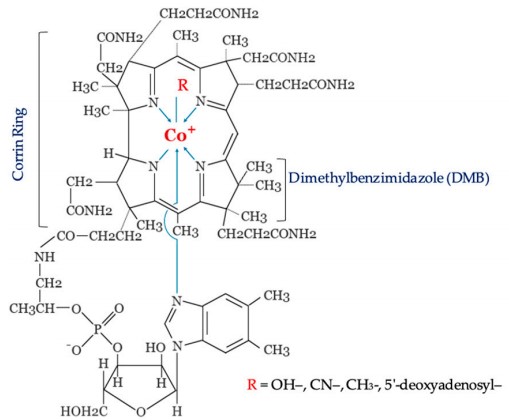 Figure 1. Chemical structure of VB12
(Source: Gharibzahedi SMT, et al. 2023)
VB12 is rich in animal tissues, rendering it exclusive to animal-derived sources. The main dietary sources of VB12 include meat, milk and its products (liver, 26-58 μg/100g; beef and lamb, 1-3 μg/100g; eggs, 1-2.5 μg/100g; and dairy products, 0.3-2.4 μg/100g; and chicken, trace-1 μg/100g), various species of fish (salmon, sardines, trout, tuna, etc., 3.0-8.9 μg/100g) and shellfish (10 μg/100g), and fortified ready-to-eat cereals. Liver is a rich source of VB12 followed by kidney and heart. The content of VB12 in milk is not high, but drinking milk frequently is related to the high concentration of VB12 in serum of healthy elderly. Some trace amounts of plant-derived VB12 analogs have been reported to exist in addition to animal-derived foods, such as certain microalgae species, mushrooms, soy-based fermented foods, and soil-contaminated vegetables, but these plant-derived compounds do not provide a reliable source of VB12 activity for humans.
For most people, the dietary intake of VB12 exceeds the metabolic requirement, resulting in the accumulation of 1-5 mg of VB12 in the liver. The typical Western diet provides 4–6 μg/d of VB12, from which 1–5 μg is absorbed. For healthy adults with normal absorption, the bioavailability of VB12 in food is assumed to be 50%, while the absorption rate of crystal VB12 in supplements and fortified foods is 55% to 74%. Absorption rates vary considerably between different types of food, for example, 24%-36% for egg products, 42% for fish and 65% for lean meat. The dietary intake of VB12 also varies with sex and age. In order to maintain normal blood values and normal serum concentrations of VB12, the recommended intake of VB12 is set, assuming that 50% of vitamin B12 can be absorbed from the diet. The recommended intake for adults is 4 μg/d in the European Union and 2.4 μg/d in the United States, with higher intakes during pregnancy and lactation (2.6 and 2.8 μg/d, respectively). The recommended intake for children in the United States ranges from 0.4 μg/d to 1.8 μg/d.
As a micronutrient, VB12 is essential for red blood cell production and maintenance and for neuronal myelination. It is also involved in the production of neurotransmitters as well as DNA and RNA. Many people find that supplementing with VB12 helps to improve their nutritional levels. VB12 deficiency can occur in infancy, childhood, adolescence, and adulthood and is associated with a variety of pathophysiological mechanisms.
The presentation of VB12 deficiency is similar to that of a number of diseases, and in clinical diagnosis the disease may present a different perspective from that of a physician in a different specialty, thus requiring clinical acumen on the part of the physician. Typical presentations include features associated with anemia (weakness, fatigue, dyspnea during fatigue), gastrointestinal symptoms (loss of appetite, epigastric discomfort, nausea, heartburn), nervous system symptoms (limb numbness, needling sensation, impaired fine movements of fingers, gait ataxia, orthostatic dizziness, loss of taste or smell), as well as symptoms associated with psychological and psychiatric disorders (irritability, personality changes, memory and intellectual impairment, disorientation, depression, mental retardation, delirium, dementia). VB12 deficiency mainly affects hematological and neurological parameters, but neuropsychiatric symptoms are often the first clinical manifestation.
The causes of cellular VB12 deficiency include inadequate intake, malabsorption, chemical inactivation or disruption of VB12 transport in the blood or intracellular metabolism.
Individuals consuming large amounts of animal products or supplements can easily meet VB12 requirements, but vegetarians consume only 0-0.25 μg/day. A low intake of foods of animal origin may be involuntary due to a limited food supply, or it may be voluntary due to cultural, religious, or personal constraints. The requirements for VB12 intake vary according to age and physiological condition. Factors affecting bioavailability should be considered in addition to recommended intakes. Different people, different gastrointestinal conditions, different sources of food, and different total intakes of VB12 will all affect its bioavailability. To some degree, bioavailability is related to the release of VB12 from food. The bioavailability of VB12 in milk is higher than in other foods of animal origin. The anesthetic gas nitrous oxide chemically inactivates VB12 by irreversible oxidation of its coenzyme form, methylcobalamin, at the active site of the VB12-dependent methionine synthase reaction. Depending on the VB12 status of the individual exposed to the gas, the frequency of use, and the duration of use, the degree of VB12 deficiency will vary. Levels may drop precipitously or gradually.
Pernicious anemia causes VB12 malabsorption in patients, resulting in gradual depletion of the body's VB12 reserves, which can lead to VB12 deficiency. Mutations in the GIF gene, which encodes the intrinsic factor, also cause hereditary VB12 malabsorption, similar to pernicious anemia, but without the involvement of autoantibodies. Haptocorrin is a VB12-binding protein found in many body fluids that protects VB12 as it passes through the acidic environment of the stomach. Reduced gastric acid secretion associated with chronic gastritis or long-term use of proton pump inhibitors affects the release of dietary VB12 from food proteins.
Some intestinal diseases affect VB12 absorption through villous atrophy and mucosal damage. Pharmacologic interventions may also lead to VB12 malabsorption. Cholestyramine, which is used to treat hypercholesterolemia, can chelate intrinsic factor. Colchicine and several antibiotics (including the antituberculosis drug p-aminosalicylic acid) can act as inhibitors of intrinsic factor-VB12 endocytosis, but these drugs are usually not sufficient to cause clinical VB12 deficiency.
Approximately 20% of total plasma VB12 levels are bound to transcobalamin (holotranscobalamin) and thus can enter cells via receptor-mediated uptake, with the remaining major component bound to a circulating form of haptocorrin. Holotranscobalamin is internalized by receptor CD320 antigen (in the brain and other tissues) or LRP2 (in the luminal portion of renal tubules) and subsequently degraded in lysosomes. In the cell, VB12 is reduced and converted to its coenzyme active form for two intracellular processes: the conversion of homocysteine to methionine and the metabolism of methylmalonyl-CoA to succinyl-CoA by the mitochondria. Several hereditary diseases affect the continuous steps of VB12 assimilation, transport, and intracellular processing. Mutations in TCN2 encoding transcobalamin 2 have been found to cause stunted growth and severe disease in infants. These mutations are associated with severe megaloblastic anemia and neurological problems, which can be fatal if not detected in time and treated with high doses of VB12.
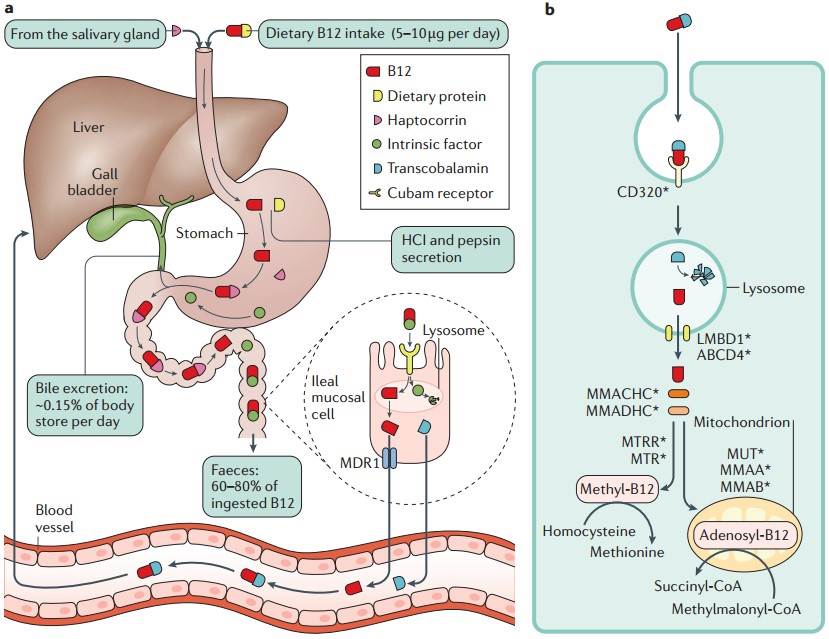 Figure 2. Absorption, enterohepatic circulation and intracellular metabolism of vitamin B12
(Source: Green R, et al. 2017)
References
| Target | Cat. No. | Product Name | Size | Species Reactivity | Application | Detection Sample | |
| VB12 | DEIA280NS | Vitamin B12 (Cobalamin) Plate Kit | 96T | N/A | Quantitative | Food | Inquiry |
| DEIA-H002 | Vitamin B-12 ELISA Kit | 96T | Human | Quantitative | Blood, serum | Inquiry | |
| DEIA2451 | Vitamin B12 ELISA Kit | 96T | N/A | Quantitative | Food | Inquiry | |
| DEIA-JY2109 | Vitamin B12 (Cobalamin) ELISA Kit | 96T | N/A | Quantitative | Food and dietary supplements. | Inquiry | |
| DEIA280 | Vitamin B12 ELISA Kit | 96T | N/A | Quantitative | Food | Inquiry | |
| DEIA2541 | Food Vitamin B12 ELISA Kit | 96T | Quantitative | Multivitamin tablets, capsules, multivitamin juices, multivitamin jam, grain products, multivitamin sweets | Inquiry | ||
| DEIASL091 | Vitamin B12 ELISA Kit | 96T | Quantitative | Cereals, milk, milk powder | Inquiry | ||
| DEIACL6 | CDSimple™ Vitamin B12 Chemiluminescent ELISA Kit | 96T, 192T | Quantitative | Serum | Inquiry |
| Target | Cat. No. | Product Name | Expression System | Tag/Conjugate | Application | |
| Vitamin B12 | DISNJ01 | Vitamin B12 Standard Solution | N/A | N/A | ELISA | Inquiry |
| DAGA-068B | Vitamine B12 [BSA] | N/A | BSA | LFIA | Inquiry | |
| DAGA-073K | Vitamine B12 [KLH] | N/A | KLH | Immunogen | Inquiry | |
| DAGT5413-HRP | Vitamine B12 [HRP] | N/A | HRP | ELISA | Inquiry | |
| DAG271S | Vitamin B12 [HSA] | N/A | HSA | ELISA | Inquiry | |
| DAG545S | Vitamin B12 [HSA-Biotin] | N/A | HSA-Biotin | ELISA | Inquiry | |
| DAG3037 | Vitamin B12 [BSA] | N/A | BSA | N/A | Inquiry | |
| DAG3038 | Vitamin B12 [HRP] | N/A | HRP | N/A | Inquiry | |
| DAG3039 | Vitamin B12 [KLH] | N/A | KLH | N/A | Inquiry | |
| VB12 | DAGA-068O | Vitamin B12 [OVA] | N/A | OVA | ELISA, LFIA | Inquiry |
| Target | Cat. No. | Product Name | Host | Isotype | Application | |
| Vitamin B12 | HMABPY073 | RHA™ anti-Vitamine B12 monoclonal antibody, clone VB12 | Mouse | IgG | ELISA, LFIA | Inquiry |
| DPATB-H83238 | Anti-Vitamin B12 polyclonal antibody | Rabbit | IgG | ELISA | Inquiry |
Loading ......
